

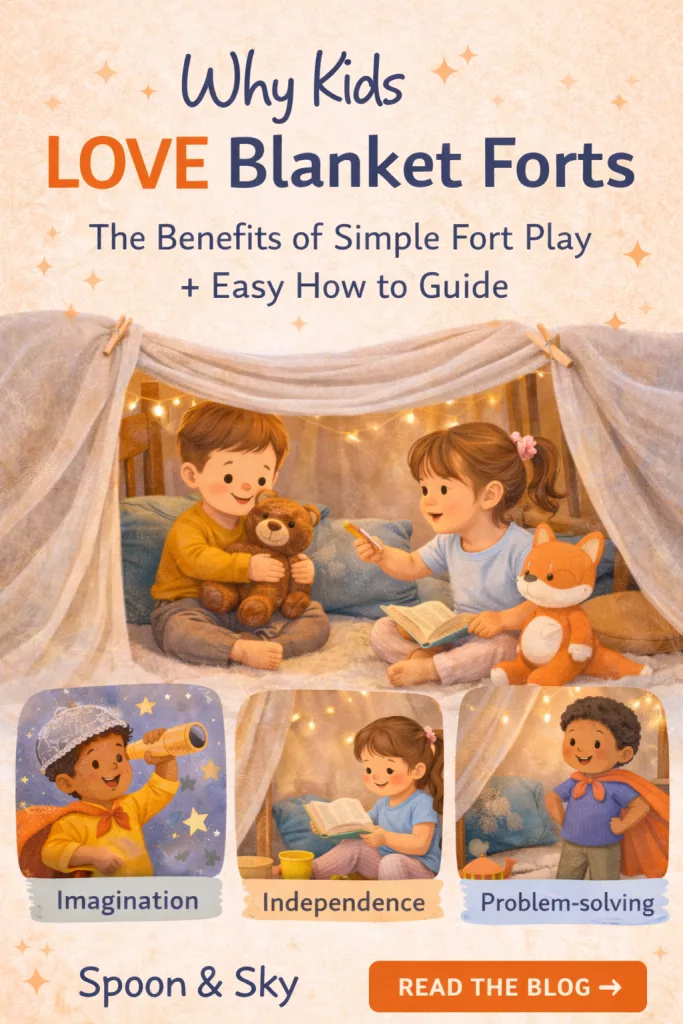
Blanket fort play ideas have been captivating children for generations — and it’s no coincidence. When kids build forts, they’re doing far more than playing pretend; they’re creating spaces of control, comfort, and creativity where imagination leads the way. Using nothing more than blankets, cushions, and a little curiosity, fort play supports emotional regulation, language development, problem-solving, and independent play — all without screens or expensive toys. In this guide, you’ll learn how to turn a simple fort into an imagination station that nurtures calm, confidence, and deep, meaningful play at home.
Every child, at some point, builds a fort.
Under tables.
Between chairs.
Behind sofas.
With cushions, blankets, and whatever else happens to be nearby.
And it never really gets old — not for them, and if we’re honest, not for us either.
There’s something timeless about forts. Something instinctive. Something deeply human.
Forts offer children control, creativity, and comfort all at once. Inside their small, enclosed worlds, kids make rules, tell stories, negotiate roles, and rehearse emotions safely. A fort is not just a play structure — it’s a micro-world, designed entirely on their terms.
In a world where children are often told where to sit, what to do, and how to behave, forts offer something rare: ownership.
This post will show you how to transform a blanket and a few chairs into a powerful imagination station — no batteries, no screens, and no budget required. Just simple tools, gentle prompts, and a little trust in your child’s inner world.
Why Fort Play Is So Powerful (And Always Will Be)
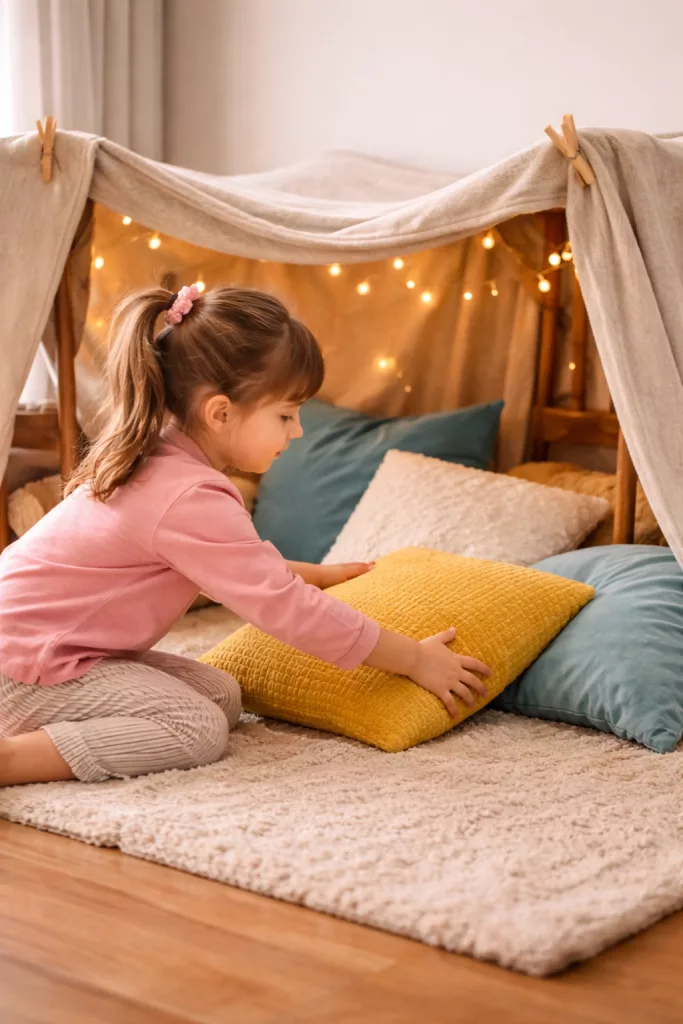
Before we get practical, it helps to understand why fort play holds such lasting appeal.
Forts meet several core developmental needs at once:
🏡 A Sense of Control
Inside a fort, children decide:
- Who is allowed in
- What the rules are
- What the space represents
This autonomy is deeply regulating, especially for children who feel overstimulated or emotionally stretched.
🎭 A Safe Space for Emotional Processing
Role play allows children to explore feelings indirectly.
They can be the doctor, the hero, the customer, the baby, the storm survivor — without personal risk.
This is how children practice:
- Empathy
- Problem-solving
- Emotional expression
- Language and negotiation
🌱 Comfort Through Enclosure
Small, enclosed spaces calm the nervous system.
That’s why kids crawl under tables when overwhelmed, or hide behind sofas when tired.
A fort is cozy by design — it tells the body, “You’re safe here.”
When all of these elements come together, something magical happens: deep, sustained independent play.
The Imagination Station Philosophy
At Spoon & Sky, we talk a lot about simple tools for joyful structure. A fort is one of the simplest tools there is — but with the right approach, it becomes something much bigger.
The goal isn’t to build the “best” fort.
The goal is to set the stage, then step back.
You provide:
- The materials
- A little connection
- A gentle prompt
Your child provides:
- The story
- The rules
- The meaning
Let’s break this down step by step.
Step 1: Set the Stage (The Cozy Corner Method)
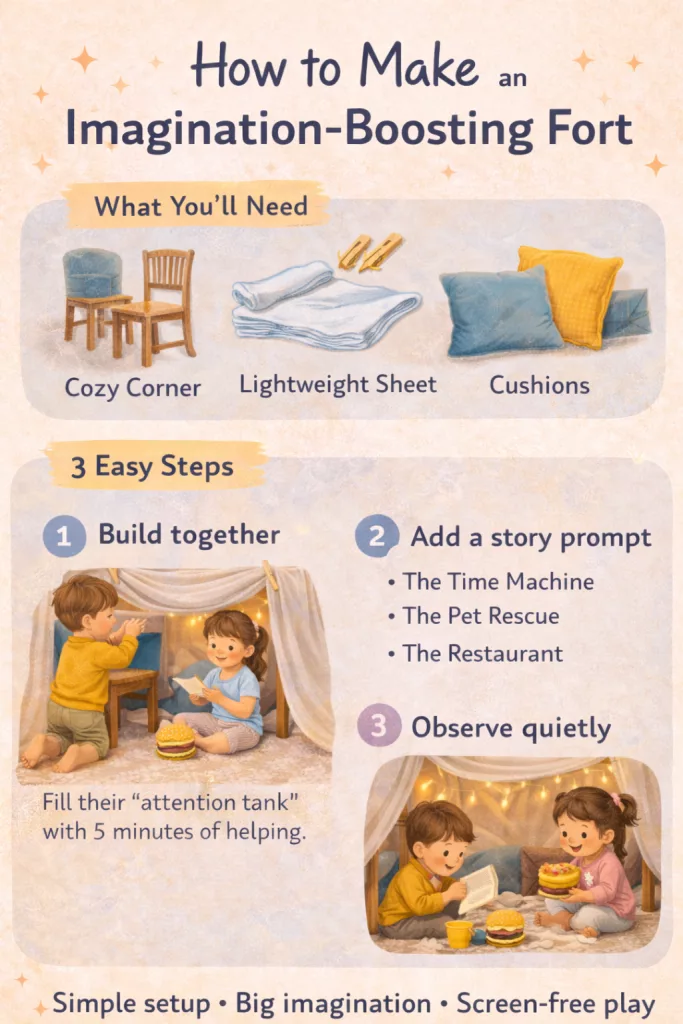
Choose a quiet corner of your home — it doesn’t need to be large. Corners work beautifully because they already feel enclosed and safe.
What to Offer (Keep It Simple):
- One lightweight sheet or blanket
- A few clothespins, clips, or hair ties
- Some cushions or pillows
That’s it.
Resist the urge to add too much. Fewer materials invite more imagination.
The Most Important Part: Build Together (Briefly)
Spend five minutes helping your child build the base of the fort.
Not fifteen.
Not an hour.
Just enough.
This short burst of connection fills what we often call a child’s “attention tank.” When children feel seen and supported at the beginning, they’re far more likely to play independently afterward.
You might:
- Hold a chair steady
- Clip a blanket
- Ask where the door should go
Then gently say something like:
“I love how you’ve built this. I’m going to make a cup of tea — I can’t wait to see what happens inside.”
And then… step back.
This moment — where you trust them to take over — is where imagination blooms.
Step 2: Add a Story Prompt (Open the Door, Don’t Lead Them Through It)
Story prompts are invitations, not instructions.
They give play a spark — without scripting the outcome.
Here are three Spoon & Sky–approved prompts that work again and again:
🚀 The Time Machine
“What time are you traveling to today?”
Suddenly the fort could be:
- The future
- The dinosaur age
- Ancient Egypt
- A time when dragons lived
This prompt encourages:
- Narrative thinking
- Curiosity
- Cause-and-effect reasoning
🐾 The Pet Rescue
“Oh no — your stuffie is sick! What’s the doctor’s plan?”
This often becomes:
- A vet clinic
- A hospital
- A rescue centre
Children explore:
- Caregiving
- Empathy
- Problem-solving
- Medical role play
You might overhear gentle reassurance, diagnoses, and treatment plans — all emotional processing in disguise.
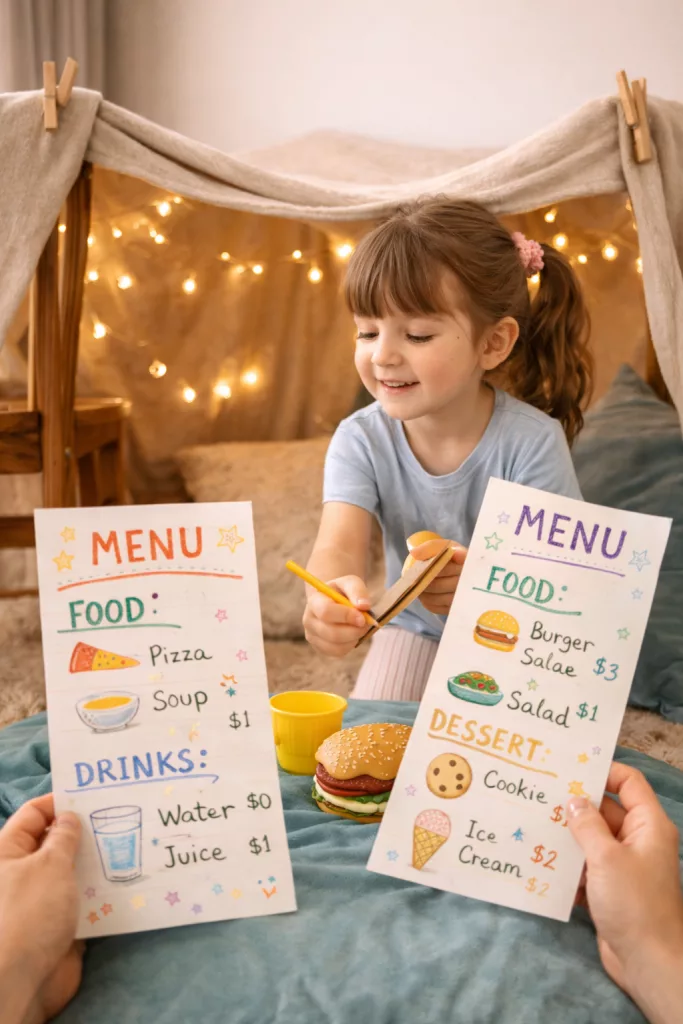
🍽️ The Restaurant
“This is a five-star restaurant. What’s on the menu? How much does it cost?”
This one is pure gold.
Children practice:
- Language
- Early maths
- Turn-taking
- Social scripts
You may be “served” invisible soup, charged imaginary money, or given a very serious explanation of today’s specials.
All of it counts.
Step 3: Observe Quietly (The Art of Not Interrupting)
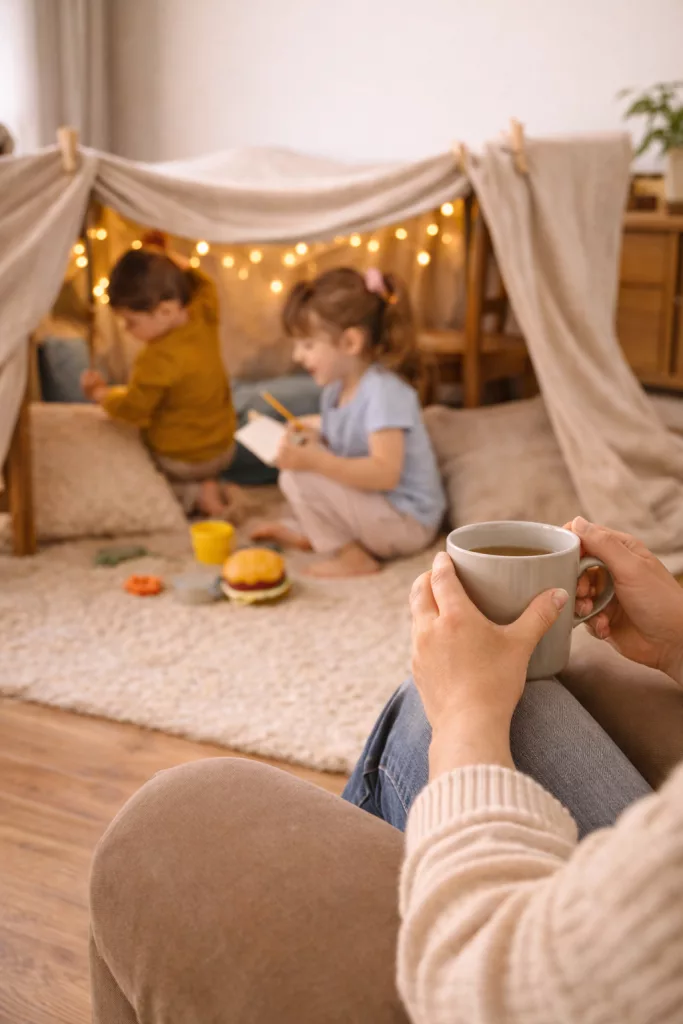
Once play is underway, your role shifts again.
You become the observer.
This can be surprisingly hard — especially when you hear something adorable and want to jump in. But this quiet observation is where the real magic happens.
You might overhear your child:
- Whispering lines
- Creating multiple voices
- Explaining rules to imaginary characters
- Negotiating prices
- Solving problems
This is narrative development in action.
Role play is how children:
- Make sense of their experiences
- Try out social roles
- Process fears and joys
- Build confidence in communication
When we interrupt too often, we unintentionally pull them out of this deep state.
So listen. Smile. Take mental notes.
And let the story unfold.
Bonus Tip: Add Light and Texture (Expand the World Gently)
Once the fort is established, small sensory additions can transform it even further.
You don’t need all of these — choose one or two.
✨ Light
- Fairy lights
- A small torch
- A lamp nearby
Light changes mood instantly and signals “this space is special.”
🧸 Texture
- Soft blankets
- A rug
- A fluffy cushion
Texture increases comfort and encourages longer play.
🌬️ Movement
- A small fan for “stormy weather”
- Curtains that flutter
- A scarf for wind
Movement brings the story to life.
These elements don’t take over the play — they simply deepen it.
Why This Kind of Play Matters (More Than We Realise)
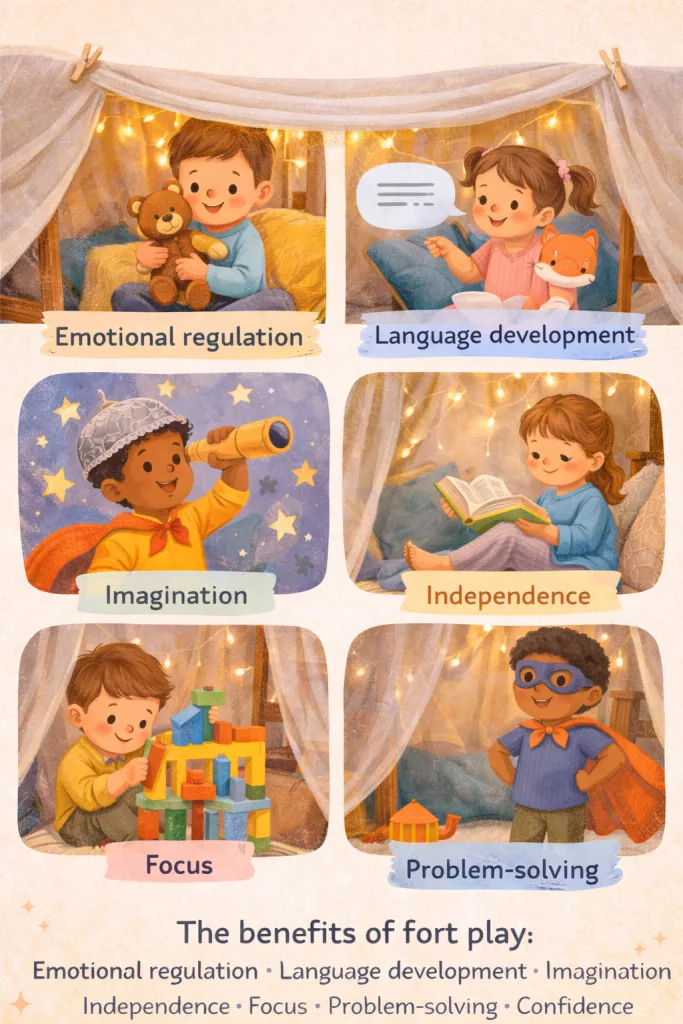
Fort play supports so many foundational skills, often all at once:
- Emotional regulation
- Language development
- Imagination
- Independence
- Focus
- Problem-solving
- Confidence
And it does so gently — without worksheets, apps, or adult direction.
In a fort, children aren’t performing.
They’re being.
This kind of play:
- Lowers stress
- Builds resilience
- Creates calm from the inside out
It’s not about filling time.
It’s about giving children a space where they feel powerful, safe, and free.
When to Suggest Fort Play
Fort play works beautifully:
- On rainy afternoons
- During school holidays
- After busy social days
- When emotions are running high
- When siblings need separate worlds
- When you need a quiet reset
You don’t need to announce it as an “activity.”
Sometimes all it takes is placing a blanket over a chair and walking away.
Children notice.
Children build.
Children imagine.
If you loved this type of play have a look at another favourite in our house: role play.
The Bigger Picture: Simple Tools, Lasting Magic
Forts remind us of something important:
Children don’t need constant novelty.
They need permission.
Permission to:
- Slow down
- Invent
- Explore
- Control their environment
- Make sense of their feelings
A blanket fort is a quiet rebellion against overstimulation.
A return to play in its purest form.
And when we trust children with these small worlds, they show us just how rich their inner worlds already are.
I believe the simplest moments often hold the greatest power. A blanket, a chair, and a little imagination can become a sanctuary — a place where children feel in control, comforted, and creatively alive.
Here’s to forts that wobble, stories that wander, and children who feel safe enough to dream out loud.
Simple tools for joyful structure — always.
Written with softness, curiosity, and a deep belief in childhood magic,
Lily Luz — Spoon & Sky Studios


✨ Get Your Free Printable ✨
Looking for a simple way to bring a little more calm, structure, or creativity into your day?
Enter your email below and get instant access to your free printable from Spoon & Sky — made to spark joy, imagination, and gentle rhythms at home. 🌿
We’ll send your printable and a few kind, helpful ideas to your inbox. No spam — just calm, creative family tools.
Leave a Reply