
Creating a Simple Plan this Half Term for Calm, Creative Days (That Still Leave You Time to Breathe)
Half term arrives like a double-edged sword, doesn’t it?
On one hand — no school runs, no lunchboxes, no clock-watching for pickup time. Bliss!
On the other hand — no school runs, no lunchboxes, no clock-watching for pickup time.
Suddenly, you’re the activity planner, snack provider, referee, and (if you’re working from home) the one praying for just twenty minutes of quiet to get something done.
Here’s the good news: with a little planning — and a lot of grace — you can turn half-term from a chaos marathon into a gentle, enjoyable rhythm for everyone.
At Spoon & Sky, we believe in simple tools for joyful structure, and this week off is the perfect time to put that into practice. Let’s build an activity plan that works for your family — calm, flexible, and fun.
🌿 Why a Half Term Schedule Helps (Even If You’re Not a Planner)
When kids have structure, they feel safe.
When parents have structure, they feel sane.
It’s not about filling every minute — it’s about creating a predictable rhythm that everyone can lean on.
A half-term routine helps:
- Reduce meltdowns (kids know what’s coming next)
- Balance energy (mixing calm play and movement)
- Support independence (kids can self-initiate play)
- Give parents guilt-free breathing space
Think of it as a flexible framework — not a strict schedule, but a guide that gives shape to your days.
🧩 Step 1: Know Your Circumstances
Before you print out a schedule or plan a full week of outings, start here:
What kind of half-term do you need?
💻 If You’re Working From Home:
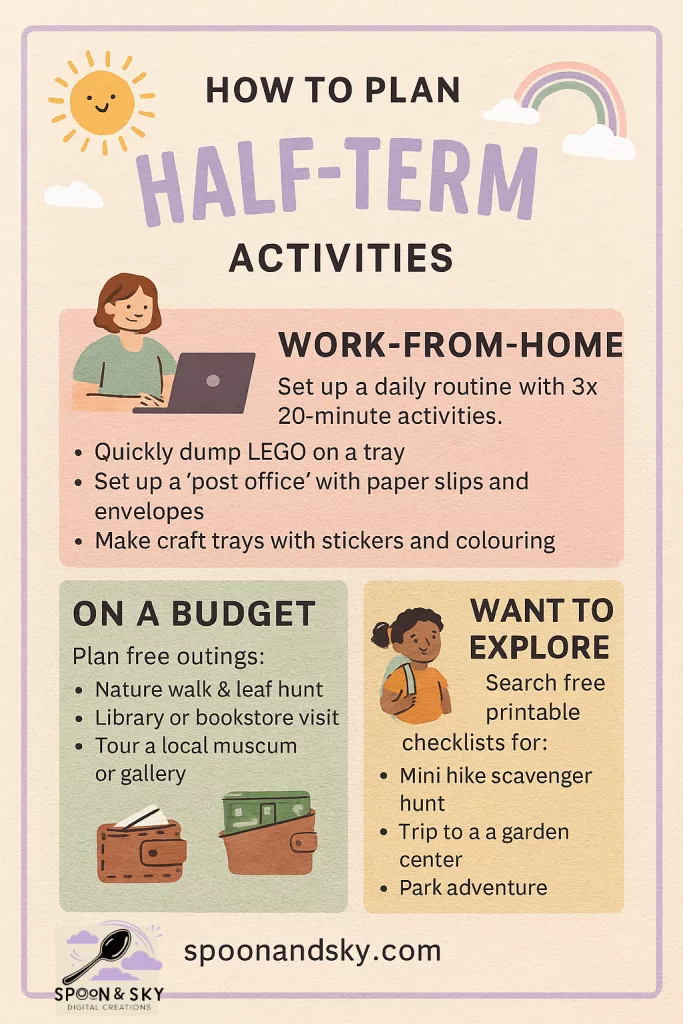
- Plan 3 short independent play blocks (15–30 minutes each).
- Use quiet, self-led setups like sticker books, construction toys, or play trays.
- Schedule calls or focus tasks during these windows.
- Save a movement break for after each work sprint — even a dance party counts.
🏡 If You’re Home With the Kids:
- Build a rhythm with 3 main parts: creative, active, cozy.
- Mornings: crafts, baking, or small projects.
- Afternoons: park time, scavenger hunts, or playdates.
- Evenings: quiet play, reading, and family downtime.
🚗 If You’re Out and About:
- Plan one “anchor activity” per day — a simple outing (library, museum, woods).
- Keep the rest of the day light and flexible.
- Use a “Go Bag” with snacks, wipes, a spare change of clothes, and mini toys.
🕰️ Step 2: The 3×20 Rule (Your New Half-Term Lifesaver)

You don’t need hours of structured play — just three short bursts a day can make a huge difference.
✨ The 3×20 Rule:
Three activities. Twenty minutes each. That’s it.
Here’s a sample flow:
- Morning: Creative — painting, building, or small-world play.
- Afternoon: Movement — outdoor scavenger hunt, bike ride, dance party.
- Evening: Calm — reading corner, sensory tray, or drawing.
Each 20-minute block buys you chunks of time and keeps kids happily engaged.
🖍️ Step 3: Themed Days for Simplicity
When the days start to blend together, themed days add variety without more planning.
Here are a few easy examples:
| Day | Theme | Activity Ideas |
|---|---|---|
| Monday | Make & Create | Crafts, cardboard projects, art hour |
| Tuesday | Tiny Adventures | Nature walk, scavenger hunt, mini trip |
| Wednesday | Water & Sensory | Wash toy cars, bubble play, kitchen water trays |
| Thursday | Together Time | Baking, cooking, family games |
| Friday | Fort Friday! | Blanket fort, storytelling, movie & snack night |
You don’t need to plan every detail — just one theme anchor per day is enough.
🧺 Step 4: Plan Around Energy Levels
If you’ve ever watched your kids bounce off the walls by 3pm, you know the secret: timing is everything.
Here’s how to match activities to their natural rhythms:
- Morning: Best for focus (puzzles, crafts, learning play)
- Midday: High energy (outdoor play, obstacle courses, movement)
- Afternoon: Wind-down time (drawing, small-world play, cozy storytime)
💡 Tip: Set out morning activities the night before — it makes for a calmer start and buys you a cup of tea before chaos begins.
🌦️ Step 5: Have a Backup Plan (Because It Will Rain)

Half-term and rain go hand-in-hand — but you don’t need to panic.
Keep a list of rainy day rescue ideas ready to go, check out this blog post:
- Build an indoor obstacle course.
- Create a “shop” or “restaurant” with toys.
- Try a sensory tray (rice, pasta, or pom-poms).
- Have a storytime picnic indoors.
- Put on a themed movie afternoon (pajamas optional).
Store these in a “Half-Term Box” — include coloring pages, stickers, a craft kit, and maybe a special snack for emergencies.
🎨 Step 6: Add Creative Anchors
Creativity doesn’t have to be messy or complicated.
Here are a few low-prep creative prompts that work for most ages (3–8):
- Draw your dream playground.
- Make a mini puppet show with paper and tape.
- Create a “weather station” on the window with markers and stickers.
- Recycle box creations (robots, houses, or rocket ships).
- Leaf printing or nature collage.
Each one keeps hands busy and imaginations engaged — perfect while you answer emails or fold laundry nearby.
🧃 Step 7: Outings That Don’t Break the Bank
You don’t need expensive activities to make half-term memorable. Here are some budget-friendly ideas that make the week special:
🌳 Outdoors
- Forest trail treasure hunt (collect pinecones, leaves, pebbles).
- Park picnic — even if it’s just sandwiches on a blanket.
- “Neighborhood explorers” — map out your street and draw landmarks.
- Local nature reserves or beaches for fresh air and freedom.
🏛️ Indoors
- Library reading challenge (many run half-term activities).
- Free local museum or gallery — focus on just one exhibit to avoid overwhelm.
- Community centers often host family craft mornings or sensory play days.
☕ Home Outings
- “Play Café” — kids make and serve snacks.
- “Mini Cinema” — tickets, popcorn, and a favorite film.
- “DIY Spa” — warm cloths, lotion, and calm music for a sensory wind-down day.
🪄 Step 8: The Power of Visual Schedules
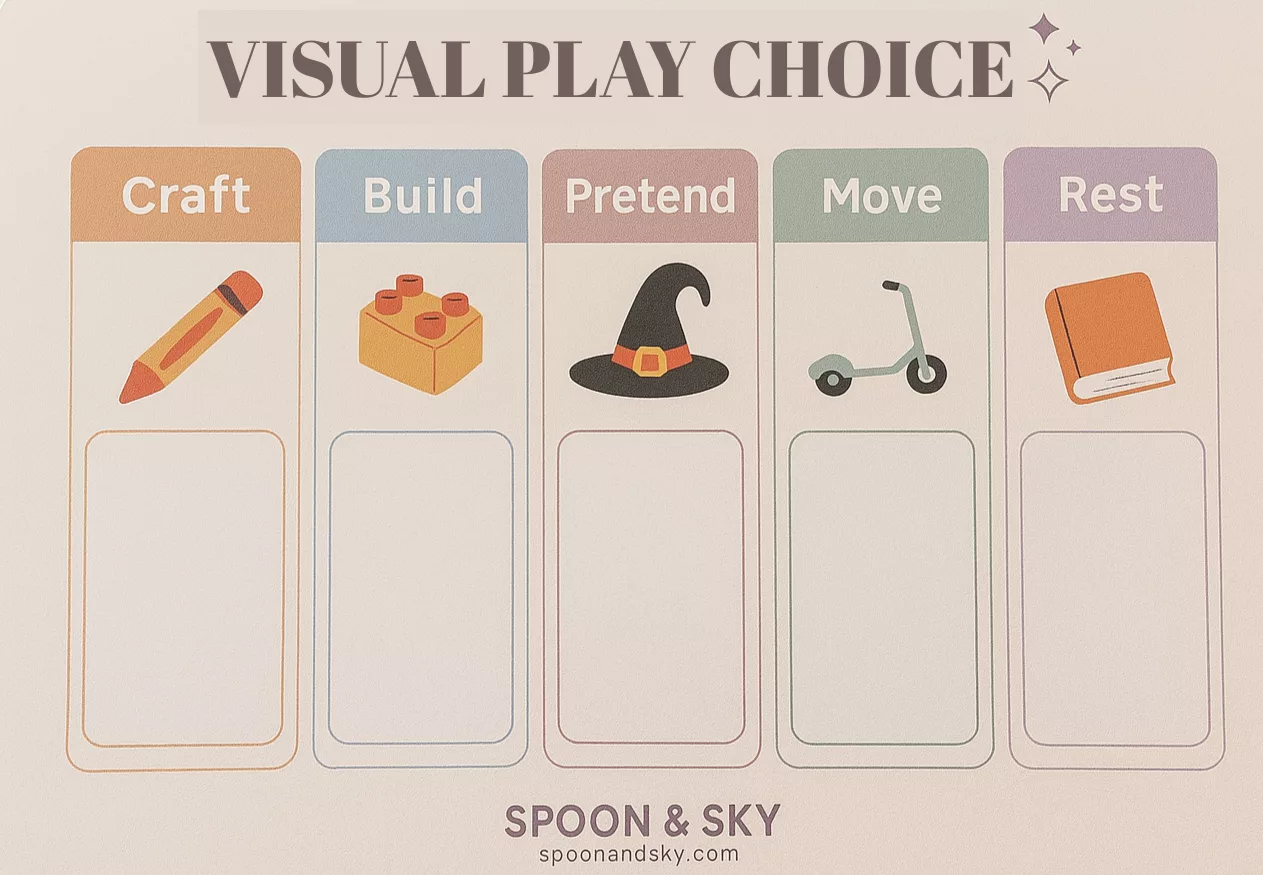
You know how kids ask “What are we doing next?” every 3 minutes?
A visual schedule solves that — and gives them back a sense of control.
Print or draw a simple chart:
- Morning 🌞
- Midday 🌤️
- Afternoon 🌙
Let your child add stickers or draw pictures for each part of the day.
They’ll understand what’s coming, and you’ll get fewer interruptions.
💤 Step 9: Keep the Evenings Gentle
After full days of excitement, evenings should feel like a slow exhale.
Stick to predictable cues: dim lights, calm voices, cozy routines.
Try a simple flow:
- Bath or shower
- Quiet play (puzzles or coloring)
- Storytime
- Soft music or white noise
✨ Tip: Visual routine cards (like the Spoon & Sky Routine Bundle) help kids transition calmly and independently.
🌼 Step 10: Remember — It’s Not About Filling Every Minute

Half-term isn’t a competition.
You don’t need to host Pinterest-perfect activities or plan endless outings.
The best days are often the simplest — a morning walk, a shared craft, a quiet hour snuggled with a book.
This week, aim for connection, not perfection.
Keep your rhythm gentle.
And give yourself permission to rest, too.
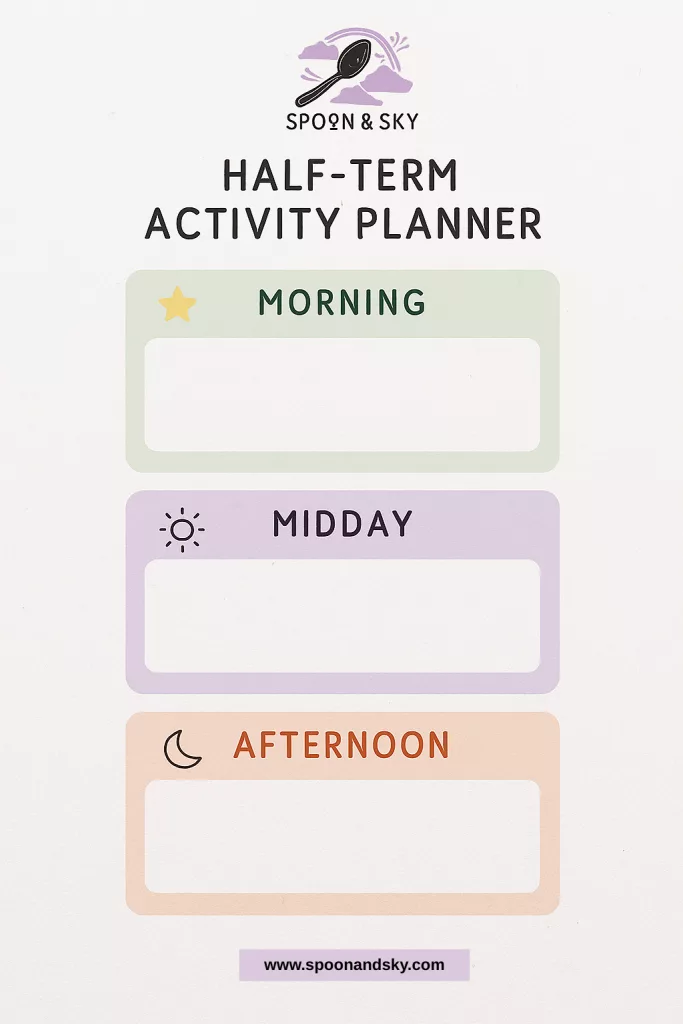
🪴 Free Printable: Half-Term Activity Planner
Download your Half-Term Activity Planner — a customizable sheet with blocks for:
- Morning, Midday, Afternoon
- Activity Ideas
- Notes for Outings or Work Blocks
Designed in calm Spoon & Sky pastel tones, it’s perfect for your fridge or command center.
With pencils scattered, snacks packed, and a little space carved out for yourself,
Lily Luz — Spoon & Sky


✨ Get Your Free Printable ✨
Looking for a simple way to bring a little more calm, structure, or creativity into your day?
Enter your email below and get instant access to your free printable from Spoon & Sky — made to spark joy, imagination, and gentle rhythms at home. 🌿
We’ll send your printable and a few kind, helpful ideas to your inbox. No spam — just calm, creative family tools.
Leave a Reply