"I Don't Want to Go to School": 9 Gentle Ways to Help With Back-to-School Anxiety
“I Don’t Want to Go to School”: 9 Gentle Ways to Help With Back-to-School Anxiety
The school bag is packed.
The shoes are by the door.
Breakfast has been eaten — mostly.
And then come the words:
“I don’t want to go to school.”
Sometimes they arrive quietly.
Sometimes they come with tears, a tummy ache, a refusal to get dressed or a child suddenly clinging to your leg when you thought the morning was going surprisingly well.
And when you're already watching the clock, trying to find a missing water bottle and wondering how it can possibly take this long to put on two shoes, it can be difficult to know what to say.
You want to reassure them.
You want them to know they're safe.
But you also know that, somehow, you still need to get everyone through the school gates.
Back-to-school anxiety can appear in many different ways, particularly during the first few weeks of a new school year.
A child doesn't necessarily need to say, “I'm anxious about school,” for school to be feeling difficult.
Instead, you might hear:
“My tummy hurts.”
“I don't like school.”
“I want to stay with you.”
“Nobody plays with me.”
“Do I have to go tomorrow?”
Or simply:
“No.”
If this is happening in your house, the goal isn't necessarily to make every uncomfortable feeling disappear.
It's to help your child feel heard, supported and capable of moving through it.
Here are nine gentle ways to begin.
1. Start by listening rather than fixing
When our children tell us they're worried, our instinct is often to reassure them immediately.
“You'll be fine.”
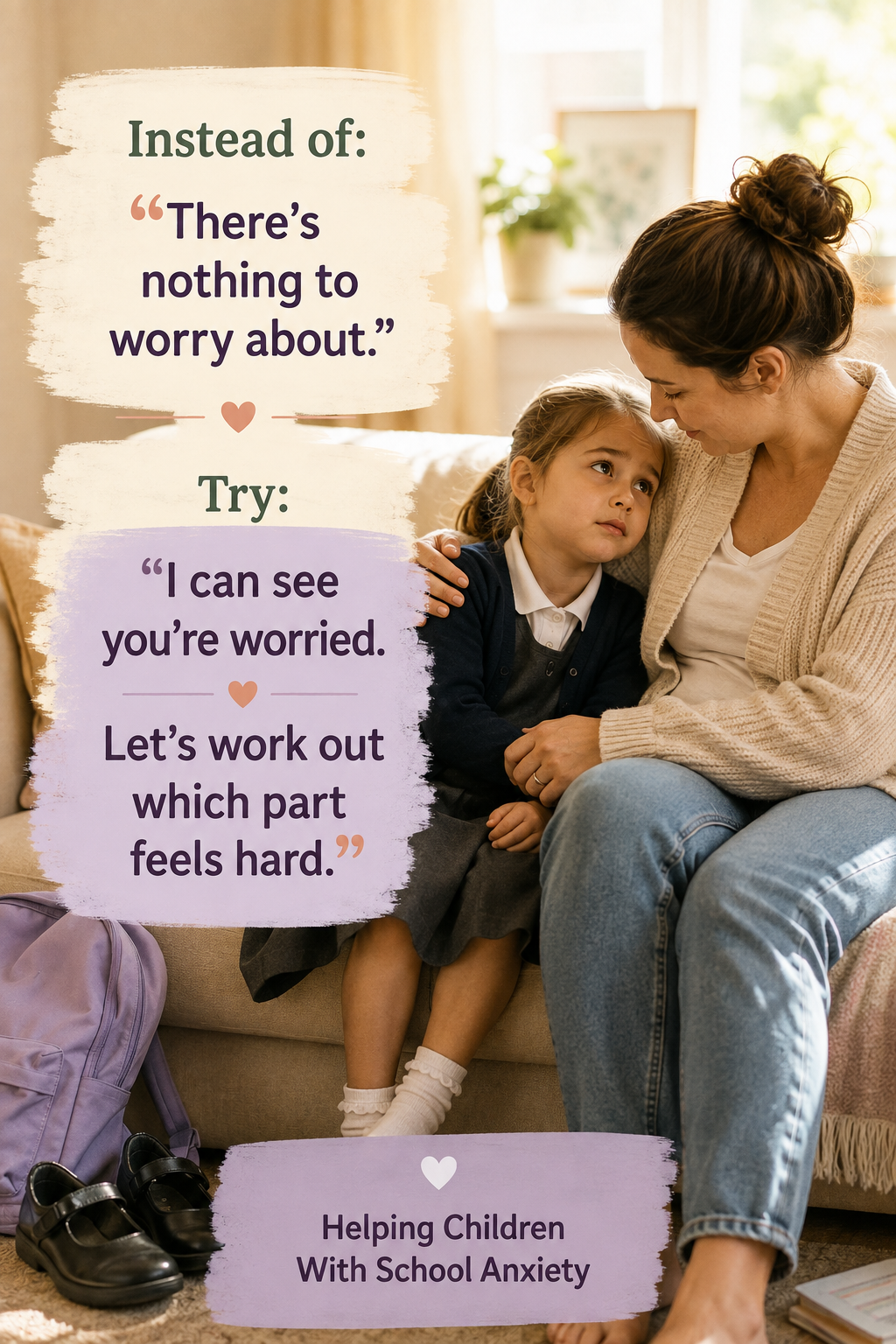
“There's nothing to worry about.”
“You love school once you get there.”
“Your teacher is lovely!”
We mean well.
We're trying to make the worry smaller.
But to a worried child, reassurance can sometimes accidentally sound like:
You shouldn't feel like this.
Instead, begin by acknowledging what they're telling you.
You might say:
“It sounds like school feels difficult today.”
Or:
“You really wish you could stay home with me.”
You aren't agreeing that school is terrible.
You aren't telling them they don't have to go.
You're simply showing them that you've heard the feeling underneath the words.
And sometimes that's the first thing a child needs before they're able to move forward.
2. Find out what “I don't want to go” actually means
“I don't want to go to school” is a very big sentence.
There may be a much smaller worry hiding underneath it.
Perhaps they're worried about saying goodbye.
Perhaps they don't know where to put their lunchbox.
Perhaps somebody said something unkind yesterday.
Perhaps the playground feels overwhelming.
Maybe they're worried they won't know the answer when the teacher asks a question.
Or perhaps school is simply exhausting right now.
Instead of asking:
“Why don't you want to go?”
Try getting more specific.
“Is the hardest part leaving me or being at school?”
“Is there a part of the school day you wish you could skip?”
“Does it feel tricky in the classroom or more at playtime?”
“Is there something you're worried might happen?”
You can also try asking at a completely different time.
The school run isn't always the best moment for a big conversation.
Try chatting while colouring together, building Lego, walking, having a bath or lying together before bed.
Children often talk more freely when conversation isn't the main activity.
3. Make the morning smaller
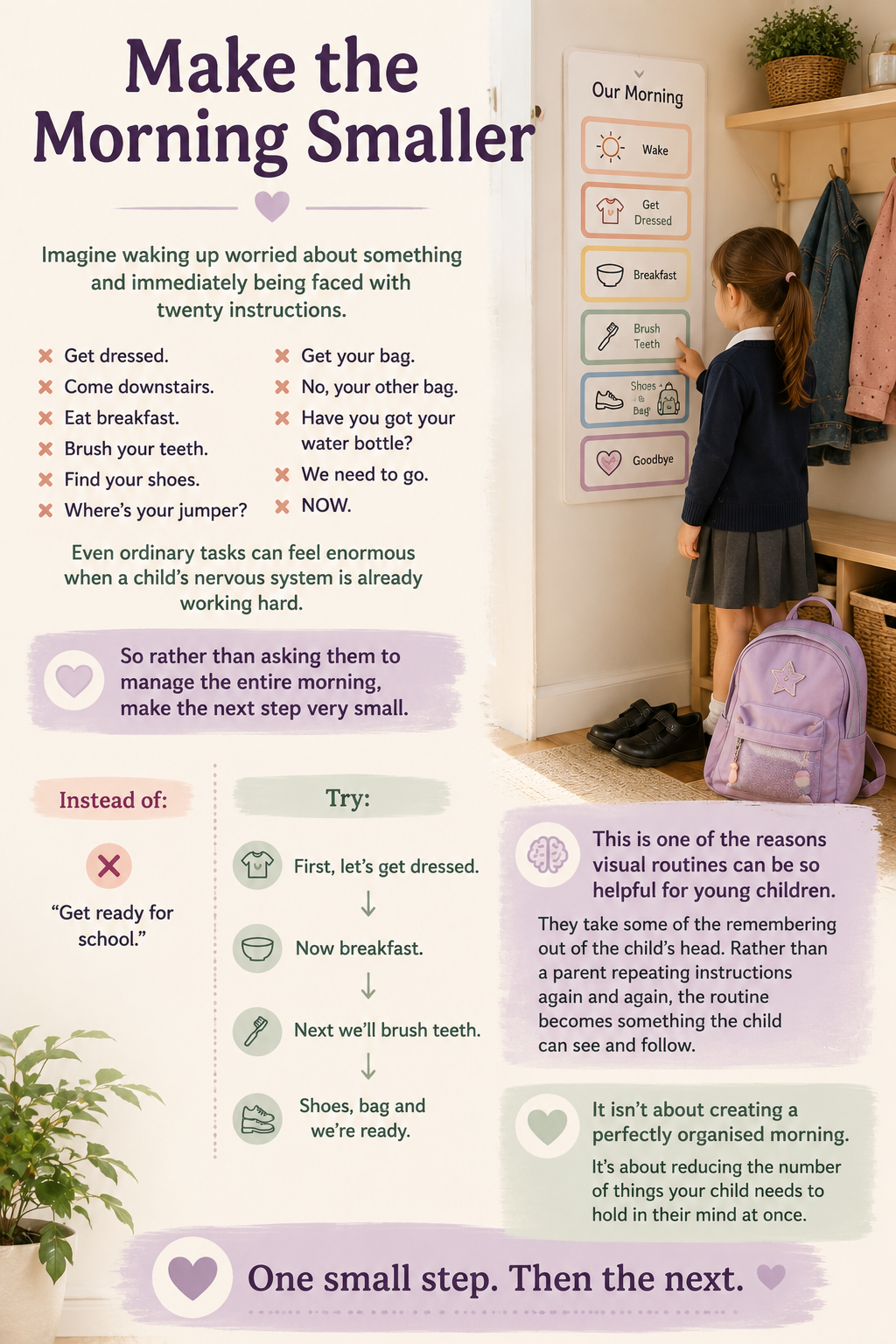
Imagine waking up worried about something and immediately being faced with twenty instructions.
Get dressed.
Come downstairs.
Eat breakfast.
Brush your teeth.
Find your shoes.
Where's your jumper?
Get your bag.
No, your other bag.
Have you got your water bottle?
We need to go.
Now.
Even ordinary tasks can feel enormous when a child's nervous system is already working hard.
So rather than asking them to manage the entire morning, make the next step very small.
Instead of:
“Get ready for school.”
Try:
“First, let's get dressed.”
Then:
“Now breakfast.”
Then:
“Next we'll brush teeth.”
Then:
“Shoes, bag and we're ready.”
This is one of the reasons visual routines can be so helpful for young children.
They take some of the remembering out of the child's head.
Rather than a parent repeating instructions again and again, the routine becomes something the child can see and follow.
It isn't about creating a perfectly organised morning.
It's about reducing the number of things your child needs to hold in their mind at once.
One small step. Then the next.
4. Create one predictable goodbye
When separation is difficult, it's tempting to keep extending the goodbye.
One more cuddle.
One more explanation.
One more promise.
One more wave through the window.
But long, uncertain goodbyes can sometimes make separation feel even bigger.
Instead, create a small goodbye ritual your child can predict.
It could be:
Cuddle. Kiss. “I love you. I'll see you after school.”
Every day.
The same words.
The same rhythm.
You could also create something tiny that connects you during the day.
A little heart drawn on their hand.
A note inside their lunchbox.
A tiny paper star tucked into a pocket.
Or perhaps you both squeeze each other's hands three times before saying goodbye — your secret code for I love you.
It doesn't need to be elaborate.
The comfort comes from knowing:
This is how we say goodbye. And we always come back together afterwards.
5. Give them something to look forward to after school
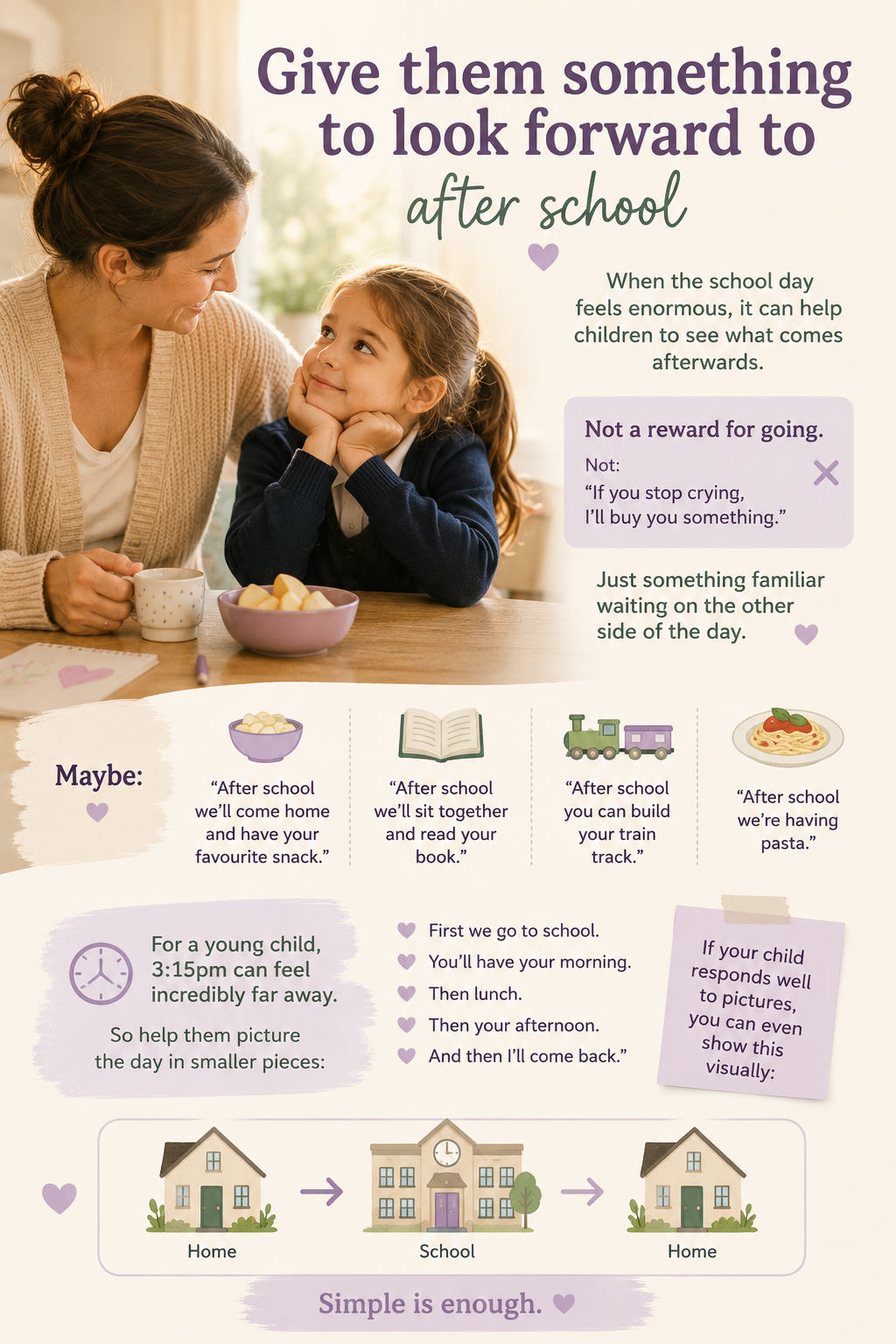
When the school day feels enormous, it can help children to see what comes afterwards.
Not a reward for going.
Not:
“If you stop crying, I'll buy you something.”
Just something familiar waiting on the other side of the day.
Maybe:
“After school we'll come home and have your favourite snack.”
“After school we'll sit together and read your book.”
“After school you can build your train track.”
“After school we're having pasta.”
For a young child, 3:15pm can feel incredibly far away.
So help them picture the day in smaller pieces:
“First we go to school.
You'll have your morning.
Then lunch.
Then your afternoon.
And then I'll come back.”
If your child responds well to pictures, you can even show this visually:
Home → School → Home
Simple is enough.
6. Don't make after-school conversation another demand
You finally collect them.
You've spent six hours wondering how they are.
Naturally, you want information.
“How was school?”
“Fine.”
“What did you do?”
“Nothing.”
“Who did you play with?”
“I don't know.”
“What did you have for lunch?”
“I can't remember.”
Sound familiar?
Your child may have spent the entire day listening, learning, remembering rules, navigating friendships, sitting when asked, moving when asked and managing a completely different environment.
The moment they see you, they may not be ready to provide a summary.
Sometimes connection comes before conversation.
Offer the snack.
Let them take off the shoes.
Let them sit quietly in the car.
Let them play.
Be nearby.
You may discover that twenty minutes later — when you're chopping vegetables or they're drawing at the table — a tiny piece of their day suddenly appears.
“Mummy, do you know what happened at playtime?”
There it is.
You don't have to pull every story out.
Sometimes you simply need to create somewhere safe for the stories to land.
7. Practise the difficult part when nobody is upset
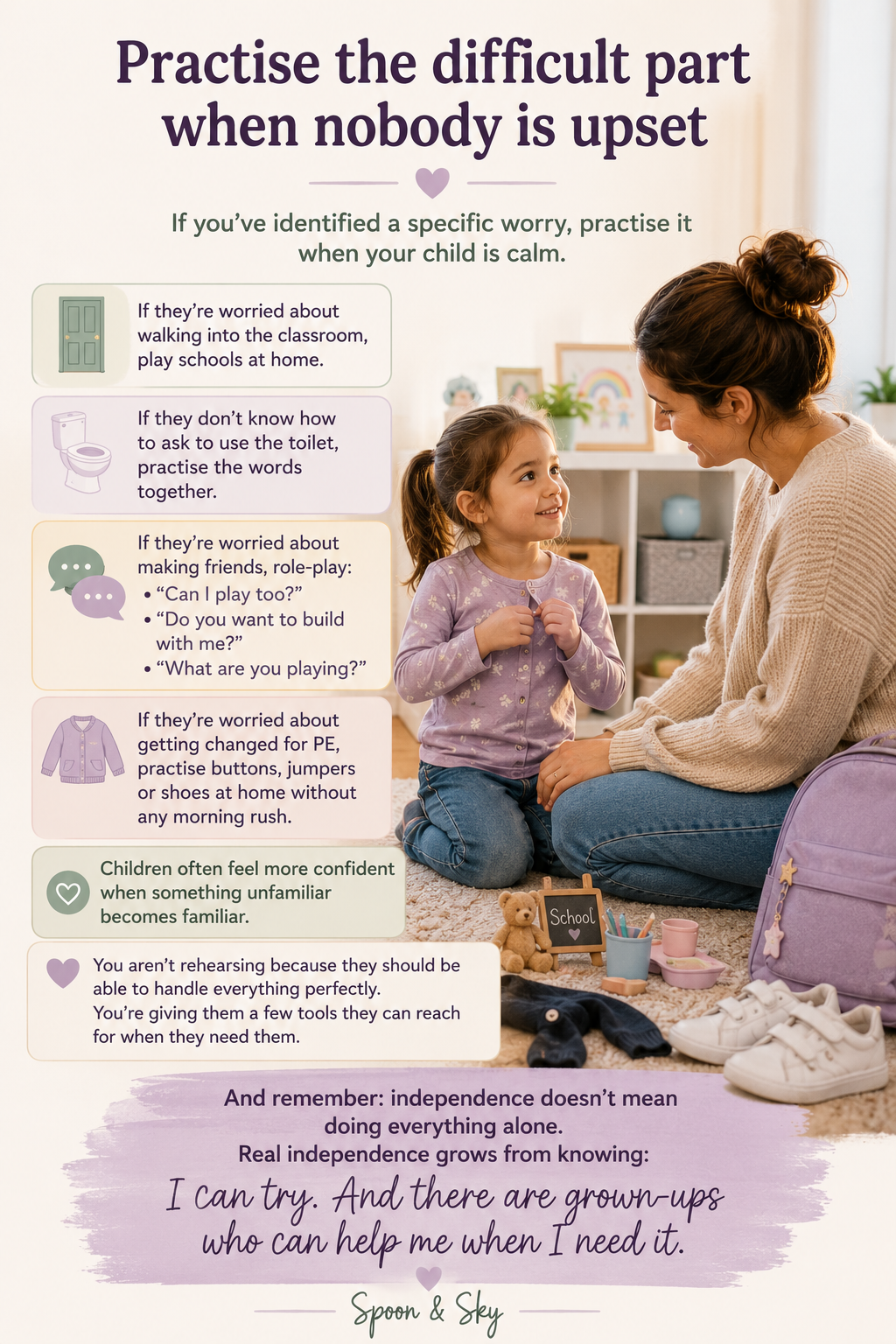
If you've identified a specific worry, practise it when your child is calm.
If they're worried about walking into the classroom, play schools at home.
If they don't know how to ask to use the toilet, practise the words together.
If they're worried about making friends, role-play:
“Can I play too?”
“Do you want to build with me?”
“What are you playing?”
If they're worried about getting changed for PE, practise buttons, jumpers or shoes at home without any morning rush.
Children often feel more confident when something unfamiliar becomes familiar.
You aren't rehearsing because they should be able to handle everything perfectly.
You're giving them a few tools they can reach for when they need them.
And remember: independence doesn't mean doing everything alone.
Real independence grows from knowing:
I can try. And there are grown-ups who can help me when I need it.
8. Keep home a little quieter while they adjust
September can be exciting.
New classes.
New teachers.
New clubs.
New routines.
New activities.
But new also requires energy.
A lot of it.
Your child may be coping wonderfully at school and still come home completely exhausted.
This might not be the moment to fill every afternoon.
Some children need football, swimming and playdates to release energy.
Others desperately need their own sofa.
Watch your child.
Perhaps for the first few weeks, afternoons can become a little softer.
Snack.
Home.
Comfortable clothes.
Free play.
Drawing.
A familiar programme.
Garden time.
A cuddle and a story.
Earlier bedtime.
There is no prize for creating the busiest childhood.
Sometimes the most useful thing we can give children after a demanding day is somewhere they don't have to perform at all.
9. Know when to bring the school into the conversation
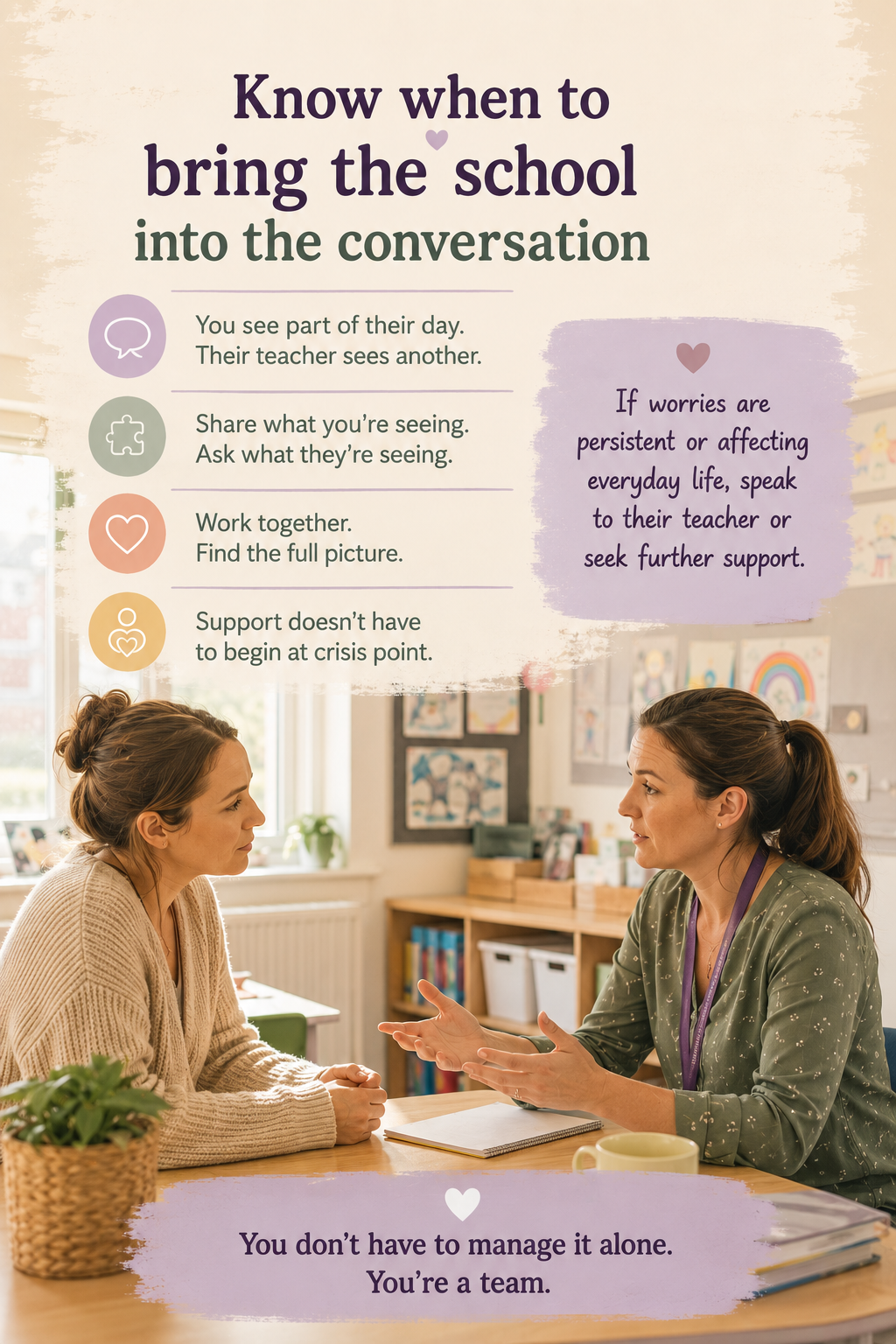
Some back-to-school nerves are part of adjusting.
But you don't have to manage persistent difficulties alone.
If your child's distress is continuing, getting stronger or significantly affecting everyday life, speak to their teacher or school.
You don't need to wait until things become unbearable.
You can simply say:
“We've noticed mornings have become quite difficult and they're telling us they're worried about school. Have you noticed anything during the day?”
Your child's teacher sees a part of their day that you don't.
And you see a part that the teacher doesn't.
Putting those two pictures together can be incredibly useful.
Perhaps your child settles five minutes after you leave.
Perhaps lunchtime is difficult.
Perhaps they're struggling with a friendship.
Perhaps they're finding a particular transition challenging.
Or perhaps they seem completely comfortable at school but are using enormous amounts of energy to manage the day.
If anxiety is persistent, severe, affecting sleep or eating, causing frequent physical symptoms, leading to significant school avoidance or affecting your child's everyday functioning, it's worth seeking further professional advice too.
Support doesn't have to begin at crisis point.
What Not to Say When Your Child Is Worried About School
There is no perfect sentence.
And every parent has said something in a rushed morning that wasn't quite what they intended.
But when possible, try moving away from:
“There's nothing to worry about.”
and towards:
“I can see you're worried. Let's work out which part feels hard.”
Instead of:
“You're a big boy/girl now.”
try:
“You can feel nervous and still do something brave.”
Instead of:
“But you love school!”
try:
“Something about school doesn't feel good today. Tell me about it.”
And instead of:
“Stop crying. We're going to be late.”
when you have enough capacity, try:
“I know. This morning feels hard. I'm going to help you through the next step.”
The aim isn't perfect parenting.
The aim is connection.
A Simple Calm School Morning
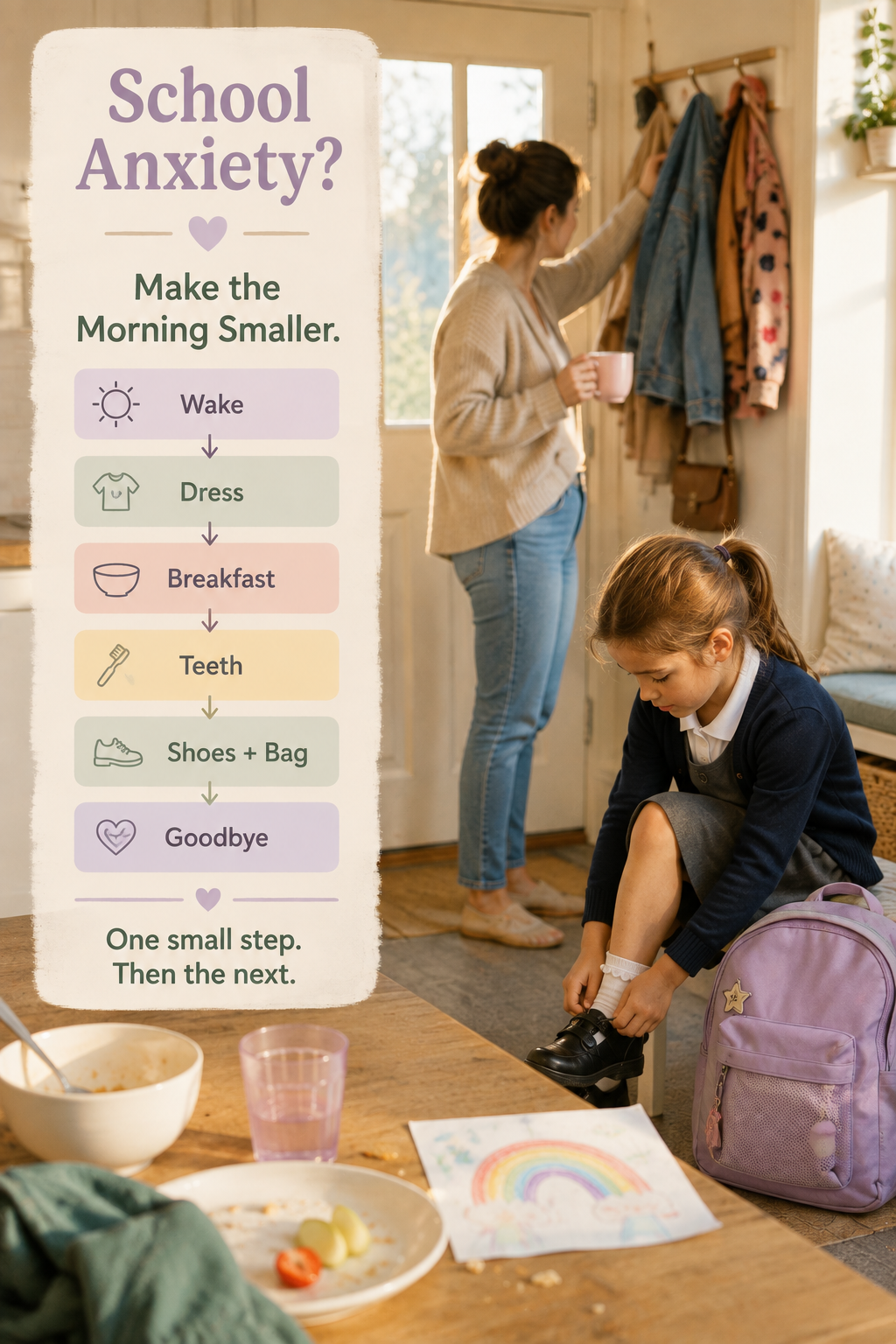
If school anxiety is making your mornings increasingly complicated, resist the urge to create an even more complicated routine.
Strip it back.
Try:
Wake → Dress → Breakfast → Teeth → Shoes & Bag → Goodbye
That's enough.
Prepare what you reasonably can the night before.
Put the bag in the same place.
Keep shoes together.
Let your child see what comes next.
Reduce unnecessary decisions.
And leave a little space for the unexpected sock crisis that somehow appears at 8:17am.
Because it will.
The goal isn't to create a morning where nobody ever becomes upset.
The goal is to create a morning that can hold the upset without completely falling apart.
Your Child Doesn't Need You to Remove Every Worry
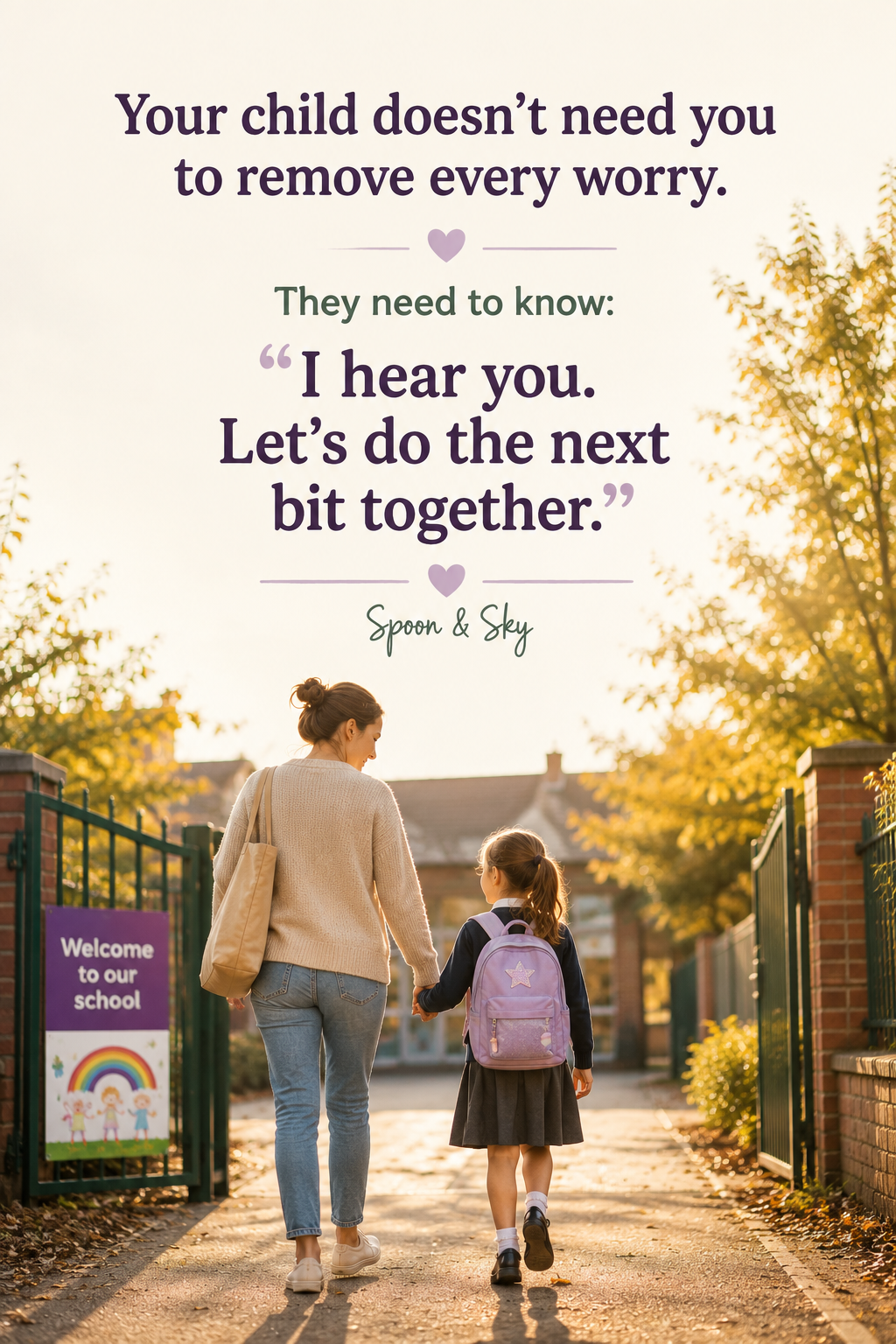
This may be the hardest part.
We love our children.
So naturally, when something hurts them, we want to remove it.
But confidence isn't built by never feeling worried.
It grows slowly through experiences like:
I was worried.
Someone listened to me.
I had help.
I did the difficult thing.
And I came through the other side.
Your job isn't to convince your child that school could never be difficult.
Friendships will sometimes be complicated.
They'll occasionally get something wrong.
There will be days they don't want to go.
There will be teachers they connect with immediately and others they take longer to understand.
Growing up contains uncomfortable moments.
What we can give our children is something much more useful than the promise that nothing difficult will happen.
We can give them the experience of knowing:
When something feels difficult, I don't have to face it alone.
And sometimes that begins with nothing more complicated than kneeling beside them on a September morning and saying:
“I hear you. Let's do the next bit together.”
If mornings are becoming a stream of “Get dressed… brush your teeth… where are your shoes?”, our Visual Routine Cards are designed to take some of that mental load away.
They give young children a simple visual reminder of what happens next, helping them practise independence without parents having to repeat every instruction.
Because the goal isn't a perfectly organised child.
It's a child who gradually begins to think:
“I know what comes next. I can do this.”
Explore more calm, practical tools for family life with Spoon & Sky.
Lily x