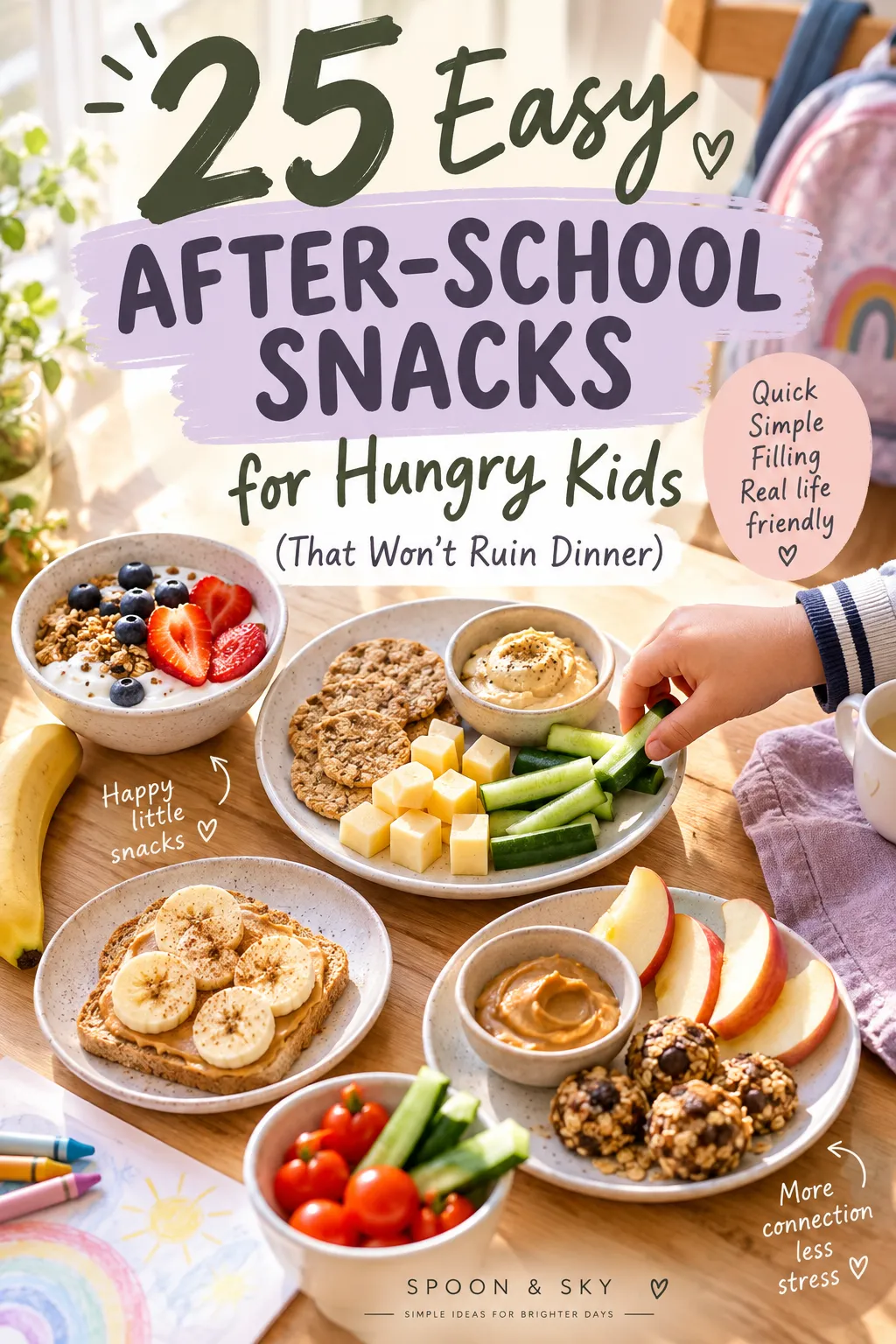
25 Easy After-School Snacks for Hungry Kids (That Won’t Ruin Dinner)
25 Easy After-School Snacks for Hungry Kids (That Won’t Ruin Dinner)
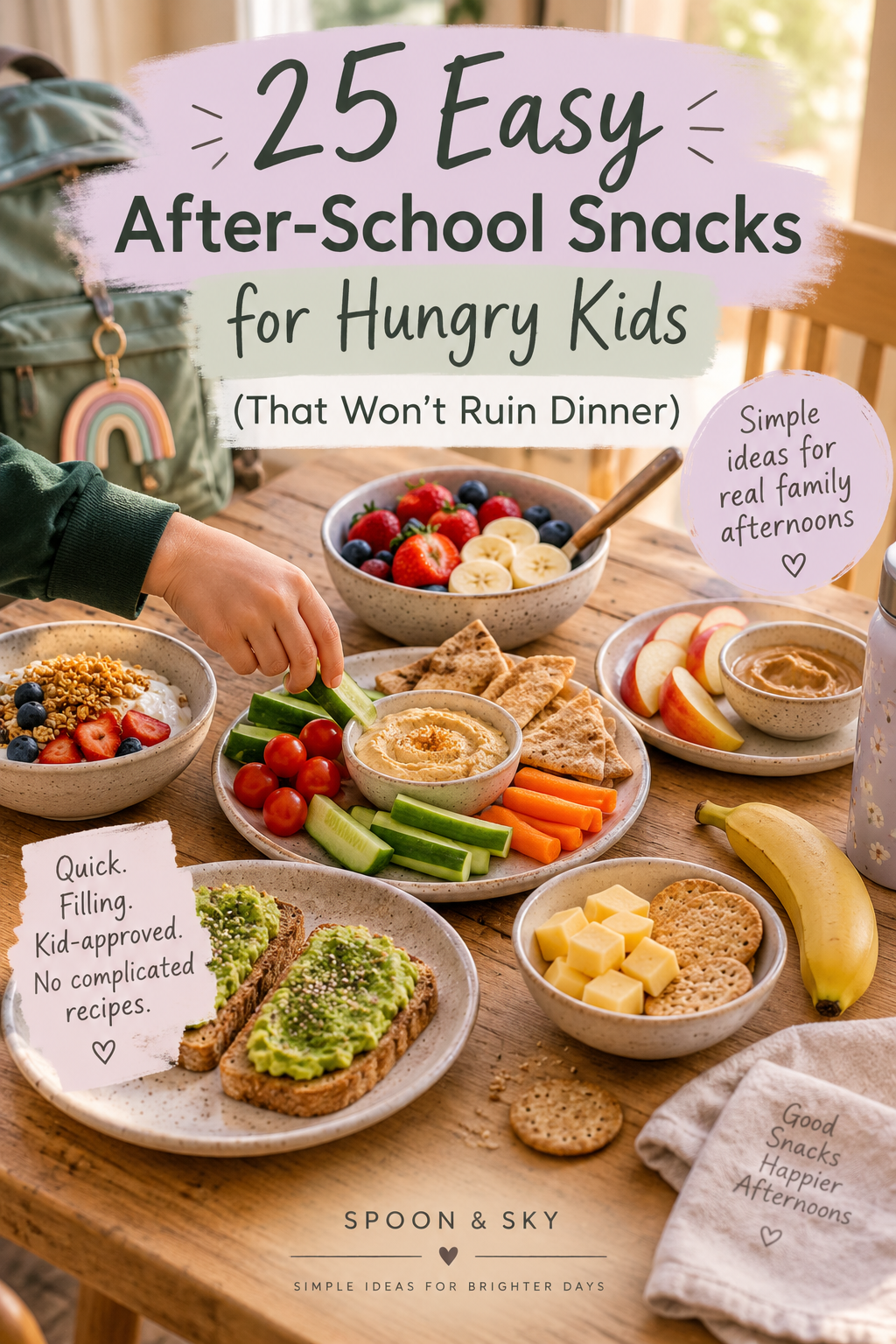
The school doors open.
Your child appears.
You barely have time to say hello before you hear it:
“I'm hungry.”
Not slightly peckish hungry.
Not I could probably eat something hungry.
Apparently, they haven't eaten since 2019.
You offer an apple.
“No.”
A yoghurt?
“No.”
Toast?
“No.”
Then, five minutes later, they're standing in the kitchen asking whether they can have biscuits while you're trying to work out how dinner is still an hour and a half away.
Welcome to the after-school hunger zone.
For children aged 3–8, the gap between lunch and dinner can feel enormous. They've spent the day learning, moving, playing, concentrating and navigating the surprisingly exhausting business of being a small person in a big school.
So yes — they're often genuinely hungry.
The challenge is finding something satisfying enough to carry them through until dinner without accidentally serving what is essentially a second lunch at 3:30pm.
The good news?
You don't need elaborate snack boxes, homemade protein balls shaped like woodland creatures or seventeen tiny compartments of beautifully chopped vegetables.
You need a handful of simple combinations you can make on repeat.
Here are 25 easy after-school snacks for hungry kids — including five-minute options, make-ahead ideas and several for those afternoons when the fridge appears to contain absolutely nothing useful.
First: Why Are Children So Hungry After School?
There are several reasons your child may arrive home ravenous.
Lunch may have been hours ago.
They may not have eaten much of it.
School lunchrooms can be noisy and distracting, and some children are far more interested in talking to their friends than eating.
Packed lunches sometimes return home mysteriously untouched.
And school itself uses energy.
Children are walking, running, climbing, thinking, listening, concentrating and playing throughout the day.
Add a growth spurt into the mix and you can suddenly find yourself living with a tiny person capable of eating three snacks while asking what's for dinner.
Rather than trying to prevent after-school snacking, it can be more helpful to plan for it.
A predictable snack can even make the rest of the afternoon easier.
Because sometimes the child dramatically collapsing onto the kitchen floor doesn't need a parenting strategy.
Sometimes they need toast.
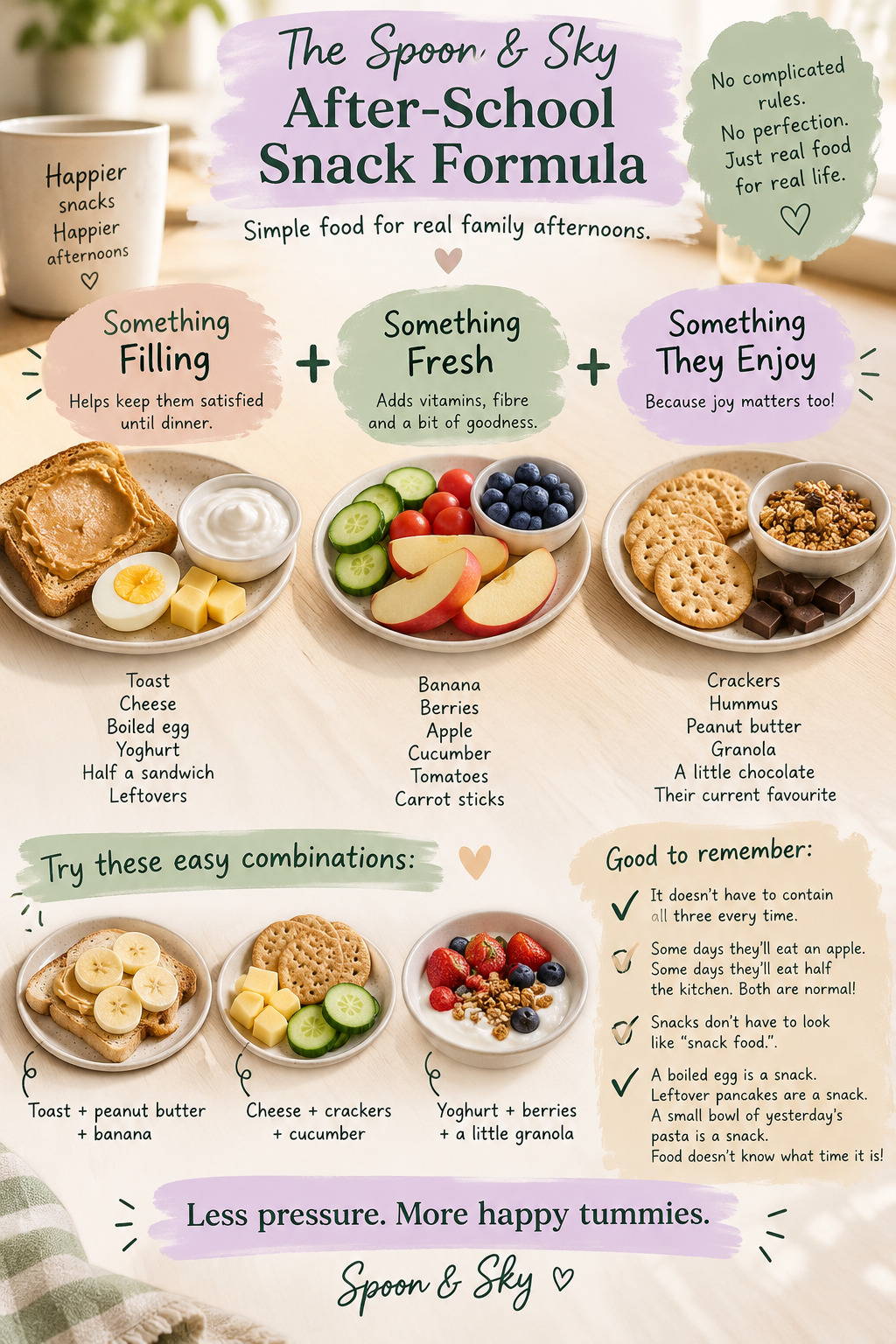
The Spoon & Sky After-School Snack Formula
You don't need to calculate macros or turn snack time into another complicated parenting task.
Instead, when possible, think:
Something filling + something fresh + something they enjoy.
For example:
Toast + peanut butter + banana
or
Cheese + crackers + cucumber
or
Yoghurt + berries + a little granola
It doesn't have to contain all three every time.
Some afternoons your child will eat an apple.
Some afternoons they'll eat half the kitchen.
Children's appetites naturally vary.
The idea is simply to make the snack satisfying enough to bridge the gap until dinner, rather than offering something tiny followed by six more requests for food.
And remember: snacks don't have to look like “snack food”.
A boiled egg is a snack.
Half a sandwich is a snack.
Leftover pancakes are a snack.
A small bowl of yesterday's pasta can be a snack.
Food doesn't know what time it is.
5-Minute After-School Snacks
Let's begin with the options you'll actually use on a rainy Tuesday when everybody is tired.
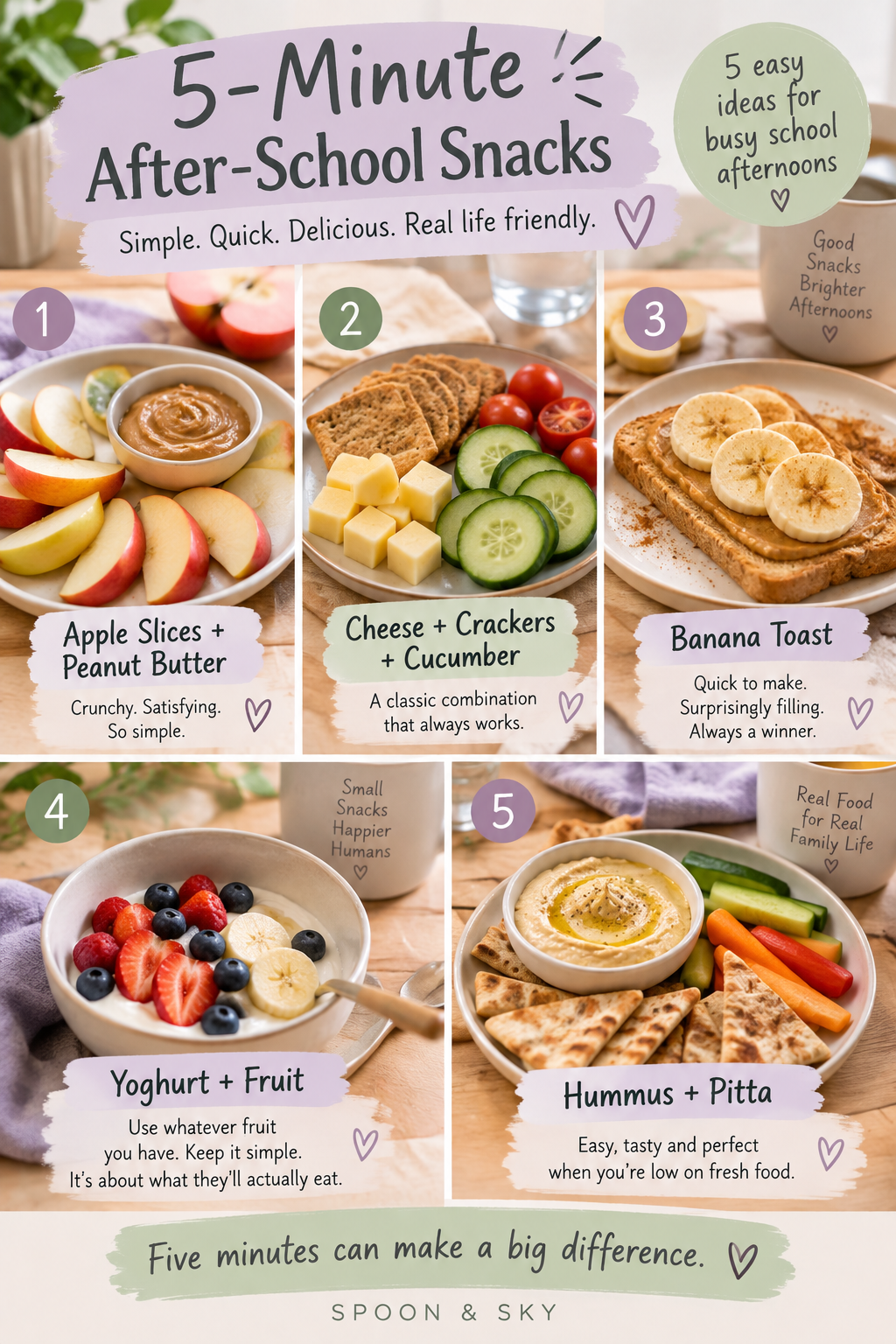
1. Apple Slices + Peanut Butter
Slice an apple and serve with a small spoonful of peanut butter for dipping.
Simple.
Crunchy.
Satisfying.
You could swap peanut butter for another nut or seed butter that works for your family.
Easy variation: Sprinkle a little cinnamon over the apple.
Always consider your child's individual allergy needs and your school or childcare setting's nut policies.
2. Cheese + Crackers + Cucumber
This is one of those combinations that somehow feels more exciting to children when you put everything on one plate.
Add:
A few wholegrain crackers
Sliced or cubed cheese
Cucumber
Done.
If you have tomatoes, grapes or pepper strips available, add those too.
For younger children, prepare foods such as grapes appropriately for their age to reduce choking risk.
3. Banana Toast
Toast a slice of bread.
Add a thin layer of peanut butter or another suitable spread.
Top with sliced banana.
For something that takes approximately three minutes, it's surprisingly filling.
You can also serve the banana beside the toast if your child objects strongly to foods touching each other — because sometimes peace is worth using another plate.
4. Yoghurt + Fruit
Add plain or Greek-style yoghurt to a small bowl and top with whatever fruit you already have.
Try:
Strawberries
Blueberries
Banana
Peach
Raspberries
Chopped apple
If your child prefers sweeter yoghurt, you can use their usual variety. This isn't about creating the nutritionally perfect bowl.
It's about creating a snack they'll actually eat.
5. Hummus + Pitta
Cut pitta bread into strips or triangles and serve with hummus.
Add cucumber, pepper or carrot sticks if you have them.
Warm the pitta for a few seconds if your child prefers it soft.
This also works brilliantly when you have very little fresh food left before shopping day.
Protein-Rich After-School Snacks
Protein can help make a snack feel more satisfying, particularly on days when dinner is still a while away.
Again, you don't need to turn this into a calculation.
Just keep a few easy options in rotation.
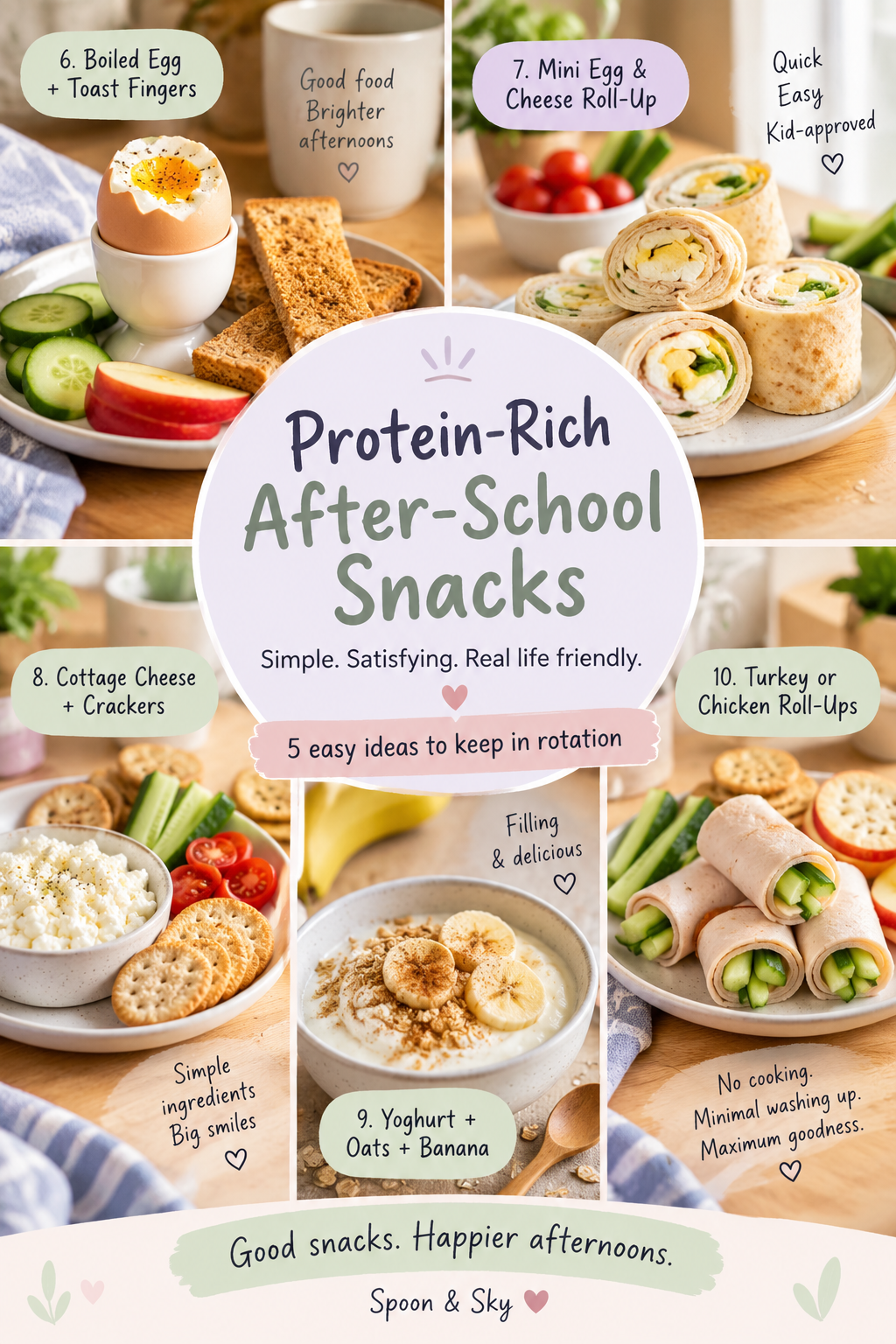
6. Boiled Egg + Toast Fingers
If you batch-boil a few eggs, this becomes incredibly quick.
Serve a boiled egg with toast fingers and some fruit or cucumber.
Simple enough for everyday life and substantial enough for particularly hungry afternoons.
7. Mini Egg & Cheese Roll-Up
Take a small tortilla or wrap.
Add sliced boiled egg or scrambled egg and a little grated cheese.
Roll it up.
You can serve it whole or slice it into little pinwheels.
This is particularly useful if your child barely touched lunch.
8. Cottage Cheese + Crackers
Cottage cheese isn't every child's favourite.
But if yours likes it, it makes an incredibly easy snack.
Serve with crackers and cucumber, tomatoes or fruit.
You could also spread it onto toast.
9. Yoghurt + Oats + Banana
Add a spoonful of oats to yoghurt and top with banana.
If your child prefers a softer texture, leave it for a few minutes so the oats absorb some moisture.
You can add cinnamon or a few berries too.
10. Turkey or Chicken Roll-Ups
Take slices of cooked turkey or chicken and roll them around cucumber sticks or a little cheese.
Serve with crackers or fruit.
No cooking.
Minimal washing up.
Exactly the sort of snack we like.
Fruit & Veg Snacks Children Might Actually Eat
There is a particular kind of optimism involved in presenting an exhausted four-year-old with six raw broccoli florets and expecting enthusiasm.
Fruit and vegetables absolutely belong at snack time.
But they don't have to arrive alone.
Pairing them with something more filling can make the snack more satisfying and, frankly, more appealing.
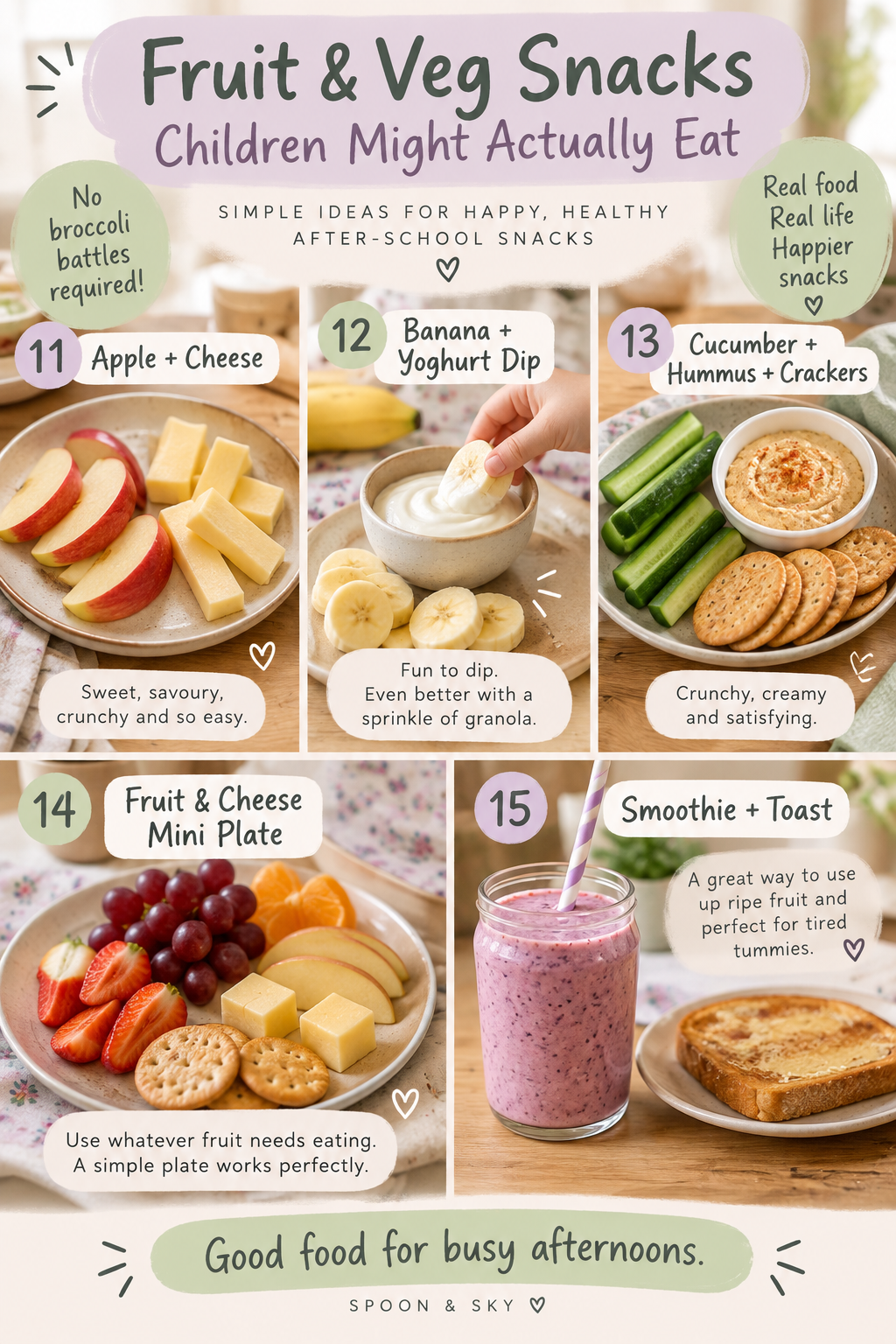
11. Apple + Cheese
Possibly one of the easiest snack combinations in existence.
Slice an apple.
Add cheese.
Finished.
Sweet, savoury, crunchy and easy to pack if you're going straight from school to somewhere else.
12. Banana + Yoghurt Dip
Slice a banana and give your child a little yoghurt for dipping.
For older children, you could add a sprinkle of granola.
There's something about dipping food that makes an ordinary snack approximately 47% more exciting.
We don't make the rules.
13. Cucumber + Hummus + Crackers
Fresh cucumber gives the crunch.
Hummus adds something more substantial.
Crackers make the whole thing feel like an actual snack rather than a plate of vegetables somebody is trying to convince them to enjoy.
Everyone wins.
14. Fruit & Cheese Mini Plate
Use whatever fruit needs eating.
Perhaps:
Apple.
Grapes prepared appropriately for your child's age.
Strawberries.
Pear.
Orange segments.
Add a little cheese and a few crackers.
Don't worry about arranging it beautifully.
A normal plate works perfectly well.
15. Smoothie + Toast
Smoothies can be useful when children are tired and not particularly interested in chewing anything.
Try blending:
Banana
Berries
Milk or a suitable alternative
Yoghurt
Serve a small glass alongside toast if they're particularly hungry.
It also works well for using fruit that's becoming slightly too soft to win any popularity contests in its original form.
Make-Ahead Snacks for Busy School Weeks
A little preparation can be useful.
But we're talking ten useful minutes, not spending Sunday afternoon producing 42 individually portioned snacks in matching glass containers.
Pick one or two things.
Make enough for a few days.
That's plenty.
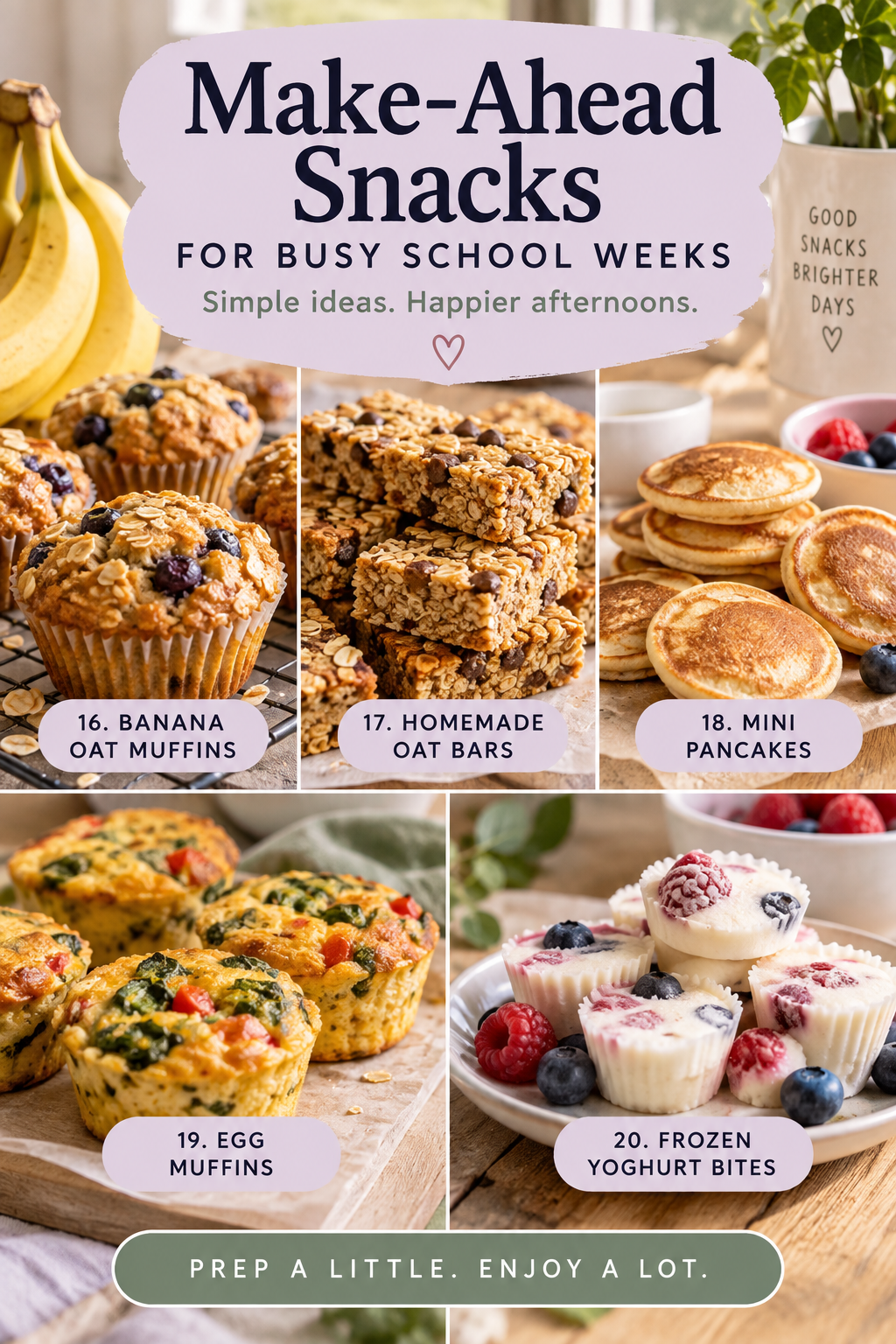
16. Banana Oat Muffins
Simple banana oat muffins are brilliant for after school because you can make a batch and freeze them.
Use your favourite recipe or a simple mixture containing ripe banana, oats, egg and your usual baking ingredients.
Add blueberries or a few chocolate chips if you like.
Freeze individually and take one out in the morning.
By school pick-up, it's usually ready to eat.
17. Homemade Oat Bars
Oat bars are another useful freezer or lunchbox staple.
Make them with oats, mashed banana or another binder and additions your family enjoys.
Cut them into child-sized squares before freezing.
The goal here isn't to create a “healthier version” of something your child likes.
It's simply to have a filling grab-and-go option available.
18. Mini Pancakes
Next time you're making pancakes, make extra.
Seriously.
Future-you will be delighted.
Freeze them with a little baking paper between layers.
You can reheat one or two quickly and serve with yoghurt, fruit, nut butter where appropriate or simply as they are.
Breakfast food at 4pm?
Absolutely.
19. Egg Muffins
Whisk eggs with a little grated cheese and finely chopped vegetables your child likes.
Pour into a muffin tin and bake until cooked through.
Keep in the fridge according to safe food-storage guidance and serve cold or reheated.
These are particularly useful for children who prefer savoury snacks.
20. Frozen Yoghurt Bites
Spoon small portions of yoghurt onto a lined tray, add chopped soft fruit and freeze.
Once frozen, transfer them into a freezer container.
They're particularly lovely while September is still giving us the occasional surprisingly warm afternoon.
Just remember they melt quickly — which is either part of the fun or an excellent reason to eat them outside.
“There Is Nothing in the House” Snacks
We've all been there.
It's Thursday.
The food shop is tomorrow.
There is one banana of questionable structural integrity, half a loaf of bread and something mysterious at the back of the vegetable drawer.
You can still make a snack.
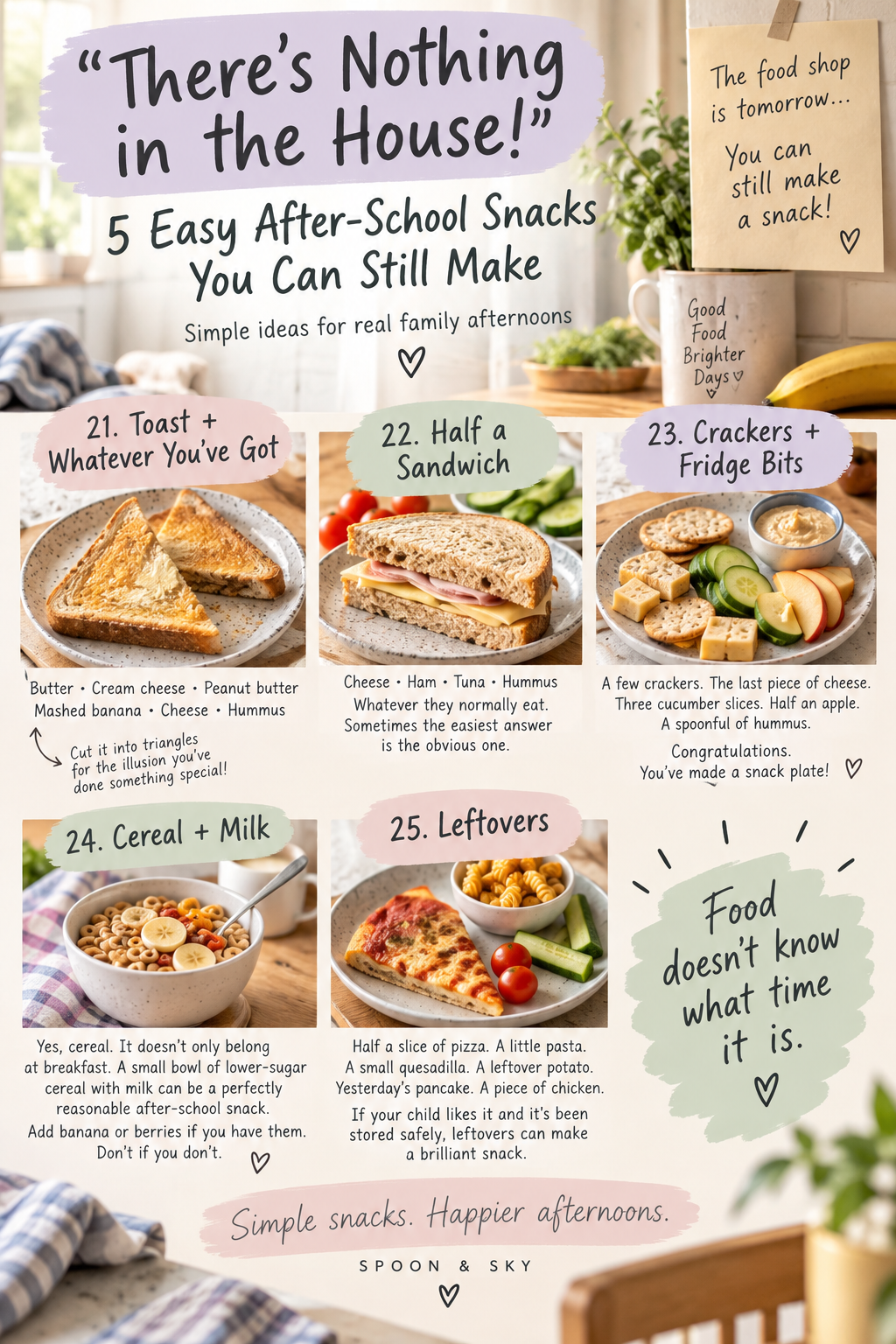
21. Toast + Whatever You've Got
Toast is one of the great parenting safety nets.
Try:
Butter
Cream cheese
Peanut butter or another suitable spread
Mashed banana
Cheese
Hummus
Cut it into triangles if you'd like to give the illusion that you've done something special.
22. Half a Sandwich
A snack does not have to be completely different from lunch.
If your child is genuinely hungry, make half a sandwich.
Cheese.
Ham.
Tuna.
Hummus.
Whatever they normally eat.
Sometimes the easiest answer is the obvious one.
23. Crackers + Fridge Bits
A few crackers.
The last piece of cheese.
Three cucumber slices.
Half an apple.
A spoonful of hummus.
Congratulations.
You've made a snack plate.
This is also a brilliant way to reduce little bits of food being forgotten at the back of the fridge.
24. Cereal + Milk
Yes.
Cereal.
It doesn't only belong at breakfast.
A small bowl of lower-sugar cereal with milk can be a perfectly reasonable after-school snack, particularly if dinner is still a while away.
Add banana or berries if you have them.
Don't if you don't.
25. Leftovers
This may be the most underrated children's snack.
Half a slice of homemade pizza.
A little pasta.
A small quesadilla.
A leftover potato.
Yesterday's pancake.
A piece of chicken.
If your child likes it and it's been stored safely, leftovers can make a brilliant snack.
Again:
Food doesn't know what time it is.
How Much Should I Give My Child?
This is where parents can become unnecessarily worried.
Should it be one cracker?
Three crackers?
Half a banana?
An entire banana?
The truth is that children's appetites aren't identical every day.
Some days your child may eat a small snack and run away to play.
Other days they'll finish it and immediately ask for more.
Growth, activity, lunch intake, sleep and countless other things can affect hunger.
Rather than trying to create one perfect portion, start with a reasonable amount and allow your child to tell you if they're still hungry.
You provide the food and the opportunities to eat.
They can listen to their body's hunger and fullness signals.
And if your child's eating, growth, appetite or food restriction is causing you concern, speak with an appropriate healthcare professional rather than relying on generic portion rules online.
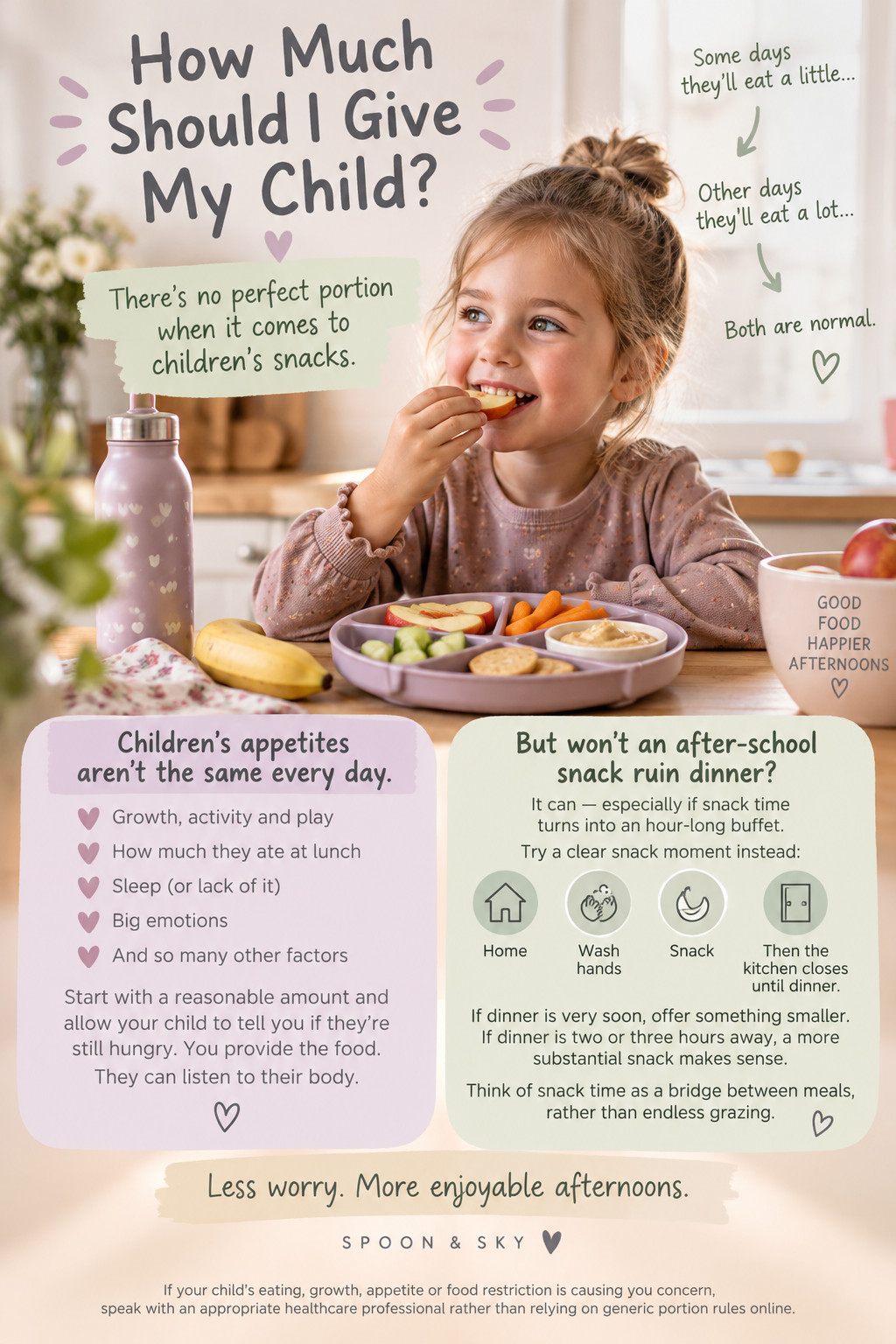
But Won't an After-School Snack Ruin Dinner?
It can.
Particularly if snack time becomes an hour-long buffet that continues until dinner appears.
The solution isn't necessarily removing the snack.
Try creating a clear snack moment instead.
For example:
Home.
Wash hands.
Snack.
Then the kitchen closes until dinner — while remaining responsive if your child is genuinely hungry.
If dinner is very soon, offer something smaller.
If dinner is two or three hours away, a more substantial snack makes sense.
Think of snack time as a bridge between meals, rather than endless grazing.
That simple shift can make afternoons much easier.
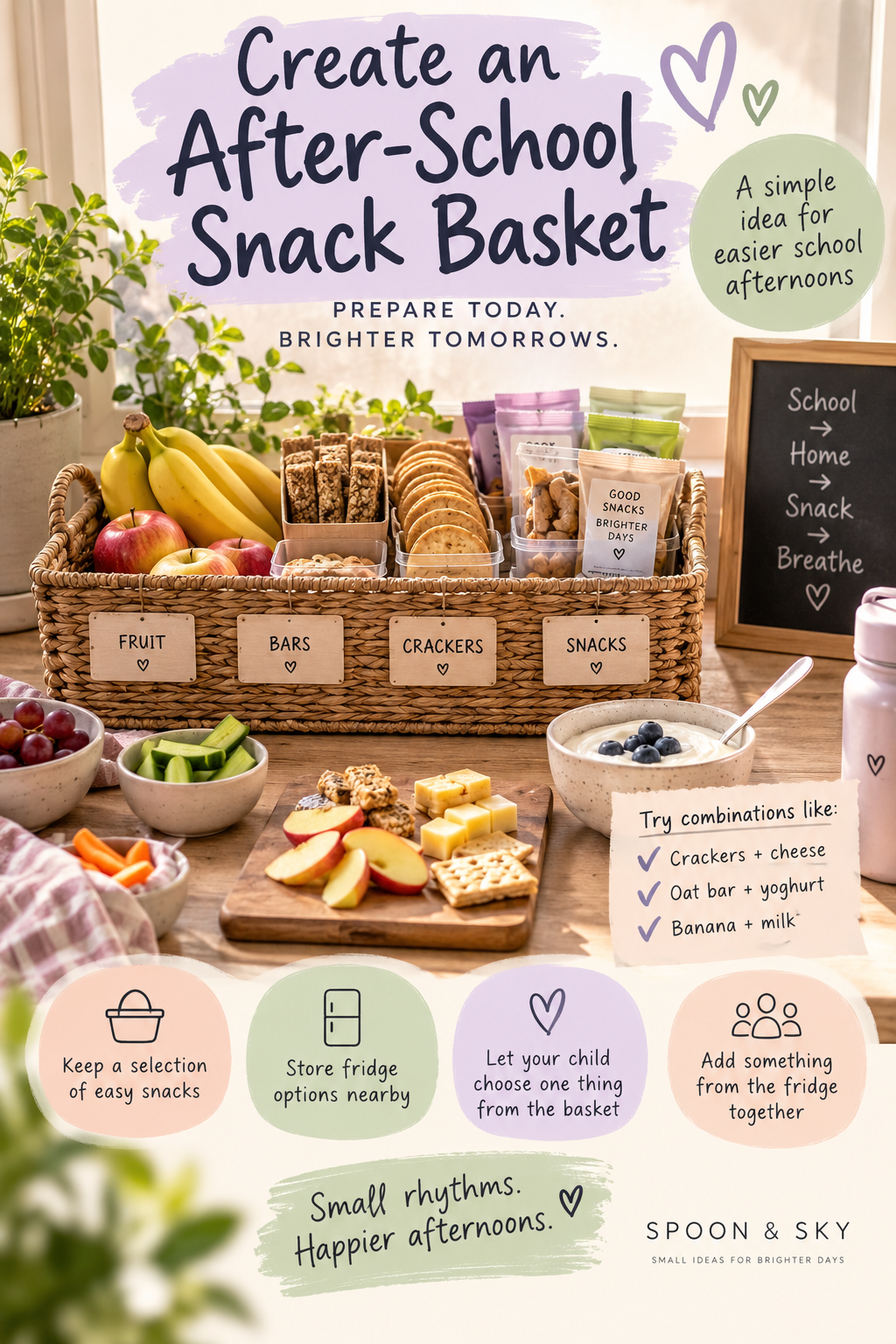
Create an After-School Snack Basket
If you want to make school afternoons easier, this is one small bit of preparation that can genuinely help.
Create a snack area children can access with appropriate supervision.
You might keep things such as:
Crackers.
Oat bars.
Fruit.
Small packets or containers of suitable snacks.
Then keep refrigerated options somewhere predictable too.
The goal isn't unrestricted access to the kitchen all afternoon.
It's helping children gradually participate in the routine.
You might say:
“Choose one thing from the basket, and we'll add something from the fridge.”
For example:
Crackers + cheese.
Oat bar + yoghurt.
Banana + milk.
This creates independence without giving a four-year-old responsibility for designing their entire nutritional intake.
Make Snack Time a Landing Place
After-school snacks aren't only about food.
They can become part of the transition between school and home.
Shoes come off.
Bag goes down.
Snack appears.
Nobody immediately asks twelve questions about phonics.
Your child gets a few minutes to simply arrive.
Maybe they tell you about their day.
Maybe they don't.
Maybe they eat in silence.
Maybe they suddenly remember seventeen extremely important things halfway through a yoghurt.
That's okay.
At Spoon & Sky, we talk a lot about creating small rhythms rather than perfect routines.
Snack time can be one of those rhythms.
Something your child knows is waiting for them.
A tiny anchor in the day.
School → Home → Snack → Breathe.
It doesn't have to be complicated to feel comforting.
A Final Reminder: It Doesn't Have to Be Pinterest-Perfect
Some days you'll make banana oat muffins.
Some days you'll offer yoghurt, berries and granola.
Some days you'll cut cucumber into neat little sticks.
And some days you'll hand your child a piece of toast while trying to cook dinner with one hand and empty a book bag with the other.
All of those days count.
Feeding children doesn't have to become another place where parents feel they're failing.
You don't need every snack to contain five food groups.
You don't need everything to be homemade.
You don't need a beautifully organised snack drawer.
And you certainly don't need to turn a strawberry into a ladybird.
Keep a few foods your child reliably eats.
Add variety when you can.
Offer something fresh when you have it.
Make it filling enough to get them to dinner.
And then get on with your afternoon.
Because the best family routines aren't necessarily the most impressive ones.
They're the ones that make everyday life a little easier to live.
At Spoon & Sky, we believe family life doesn't need more pressure disguised as inspiration.
It needs simple ideas that work on ordinary Tuesdays.
So forget the perfect snack board.
Find five or six combinations your family enjoys.
Keep the ingredients around when you can.
And let after-school snack become one small, predictable pause between the busy world of school and the comfort of home.
Simple food.
A familiar rhythm.
A little room to breathe.
Sometimes that's more than enough.
Lily x
Spoon & Sky