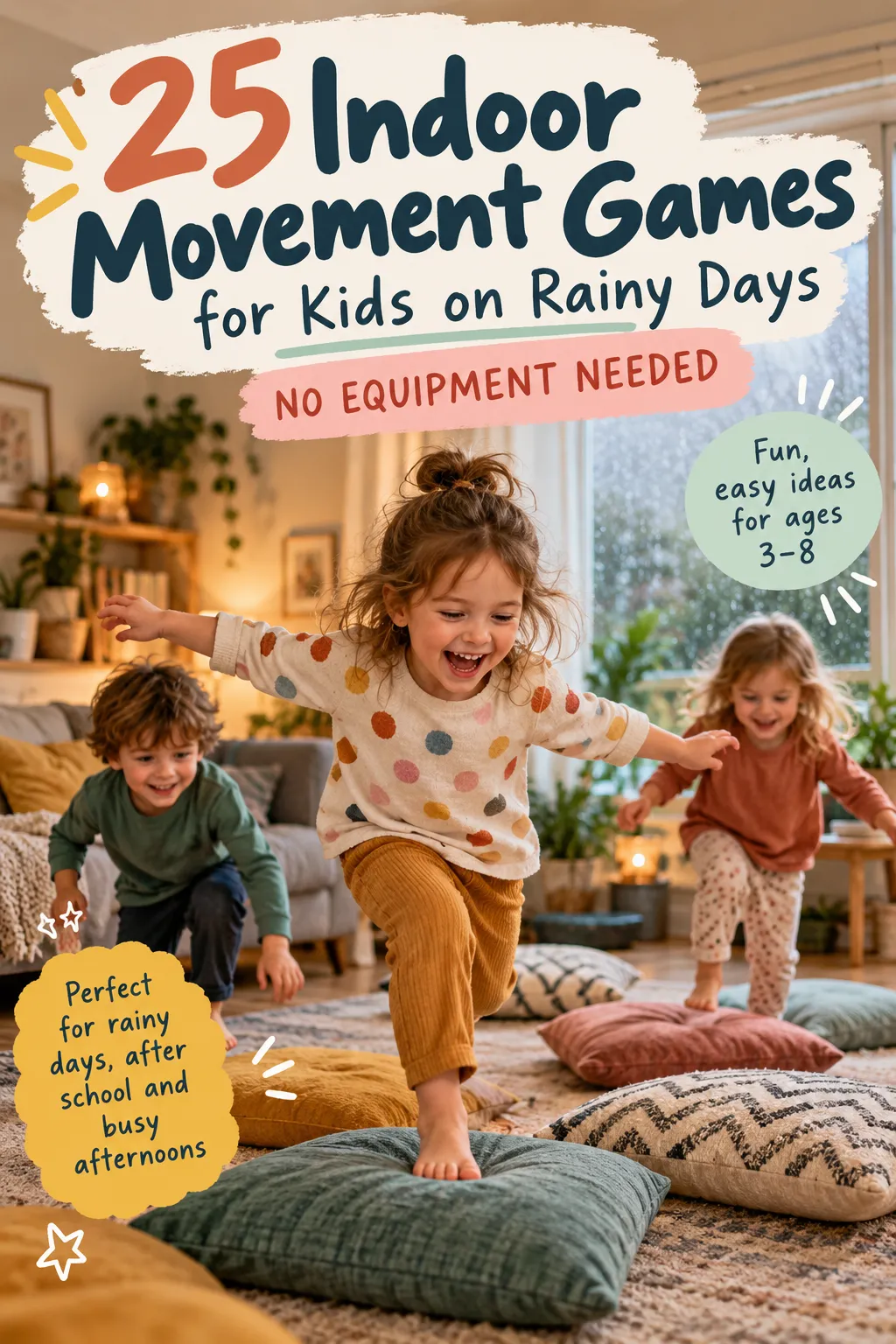
25 Indoor Movement Games for Kids on Rainy Days
25 Indoor Movement Games for Kids on Rainy Days — No Equipment Needed
It's raining.
They've been indoors for hours.
Everyone's getting louder.
And somehow the sofa has become a trampoline.
If you've ever reached that point in a rainy afternoon when your children quite clearly need to move, but going outside isn't particularly appealing, this list is for you.
Children don't always need an organised activity, a carefully planned craft or another thing for us to buy.
Sometimes they simply need somewhere for all that energy to go.
Indoor movement games are simple activities that help children get physically active inside through jumping, balancing, dancing, crawling, stretching and imaginative play. Easy games like animal walks, freeze dance, floor-is-lava and indoor scavenger hunts can give children a quick 5–15 minute movement break without special equipment.
Movement can be especially helpful after school, during long weekends at home, on wet autumn afternoons or in that slightly chaotic stretch before dinner when everyone seems to have run out of patience at exactly the same time.
And it doesn't have to mean rearranging the entire living room.
These simple indoor movement games are designed for children roughly 3–8 years old, require little or no preparation, and most can be played for 5–15 minutes.
Pick one.
Move a little.
Then carry on with your day.
Why movement can completely change a rainy afternoon
When children have been sitting, concentrating or contained for a long time, asking them to suddenly "play nicely" isn't always realistic.
Sometimes their bodies are telling us exactly what they need.
Run. Jump. Stretch. Push. Wiggle. MOVE.
A few minutes of physical play can provide a useful transition between different parts of the day.
It might be:
school → home
screen time → dinner
busy activity → quiet play
siblings arguing → something they can do together
or simply:
we've been stuck inside for far too long → everybody needs to get the sillies out.
You don't need to turn movement into a lesson.
You don't even need to call it exercise.
Just make a little space and play.
Here are 25 ideas to get you started.
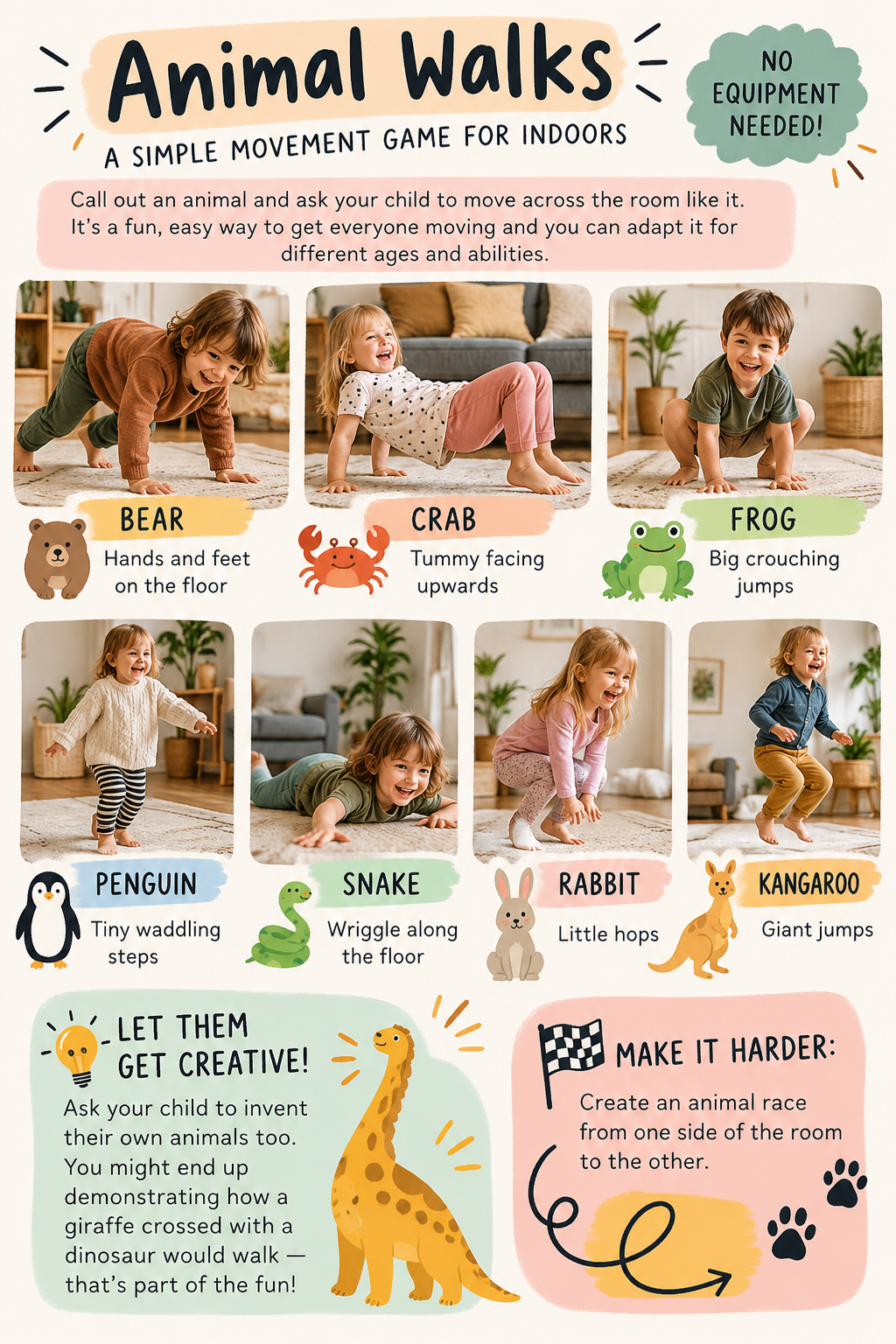
1. Animal Walks
One of the easiest movement games because you need absolutely nothing.
Call out an animal and ask your child to move across the room like it.
Try:
🐻 Bear — hands and feet on the floor
🦀 Crab — tummy facing upwards
🐸 Frog — big crouching jumps
🐧 Penguin — tiny waddling steps
🐍 Snake — wriggle along the floor
🐰 Rabbit — little hops
🦘 Kangaroo — giant jumps
Let children invent animals too.
You may eventually find yourself attempting to demonstrate how a giraffe crossed with a dinosaur would walk.
That's part of the fun.
Make it harder: create an animal race from one side of the room to the other.
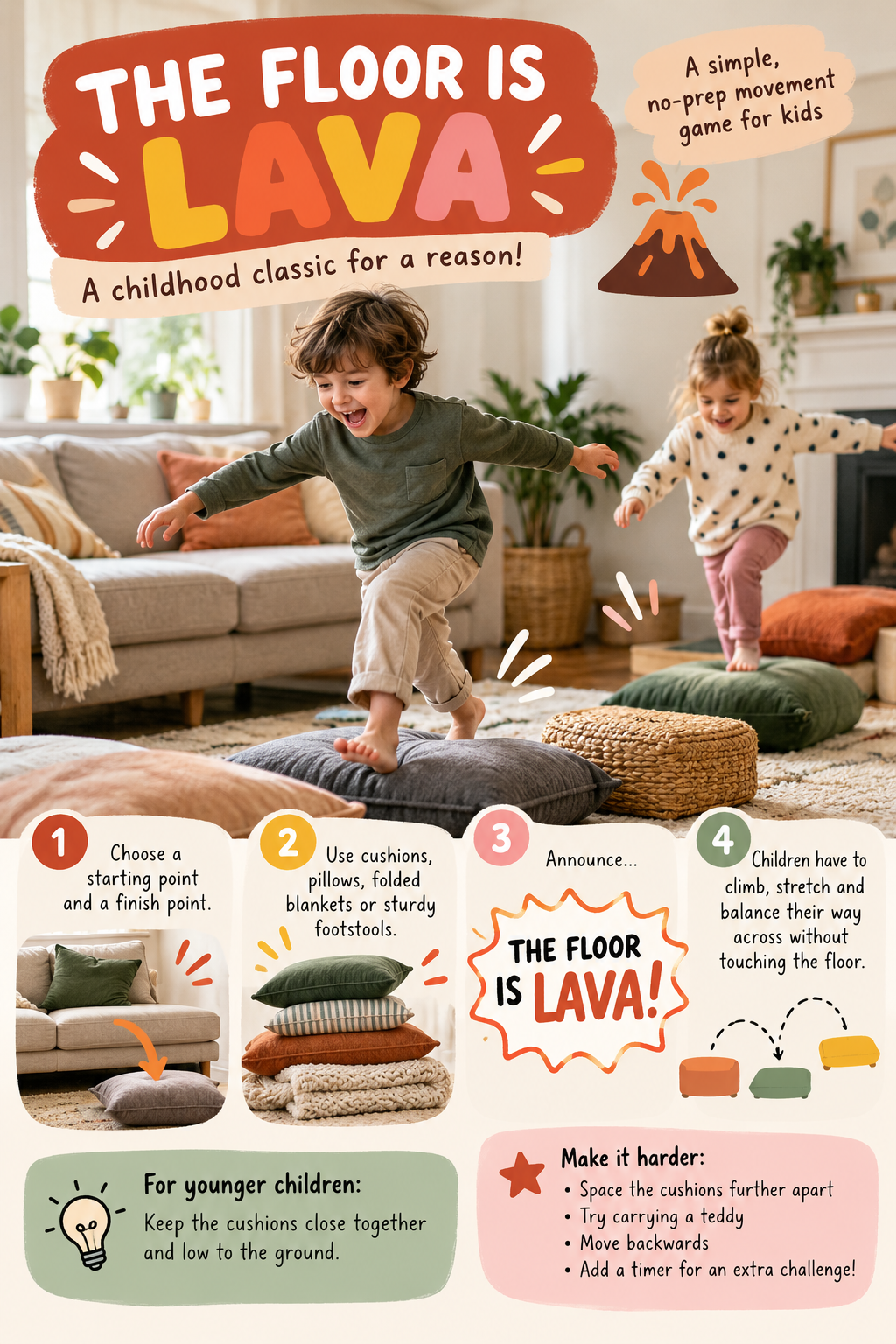
2. The Floor Is Lava
A childhood classic for a reason.
Choose a starting point and somewhere children need to reach without touching the floor.
Use things you already have, such as cushions, pillows, folded blankets or sturdy footstools.
Then announce:
"THE FLOOR IS LAVA!"
Children have to climb, stretch and balance their way across.
For younger children, keep everything close together and low to the ground.
And yes, your sofa cushions may never look quite the same afterwards.
3. Pillow Stepping Stones
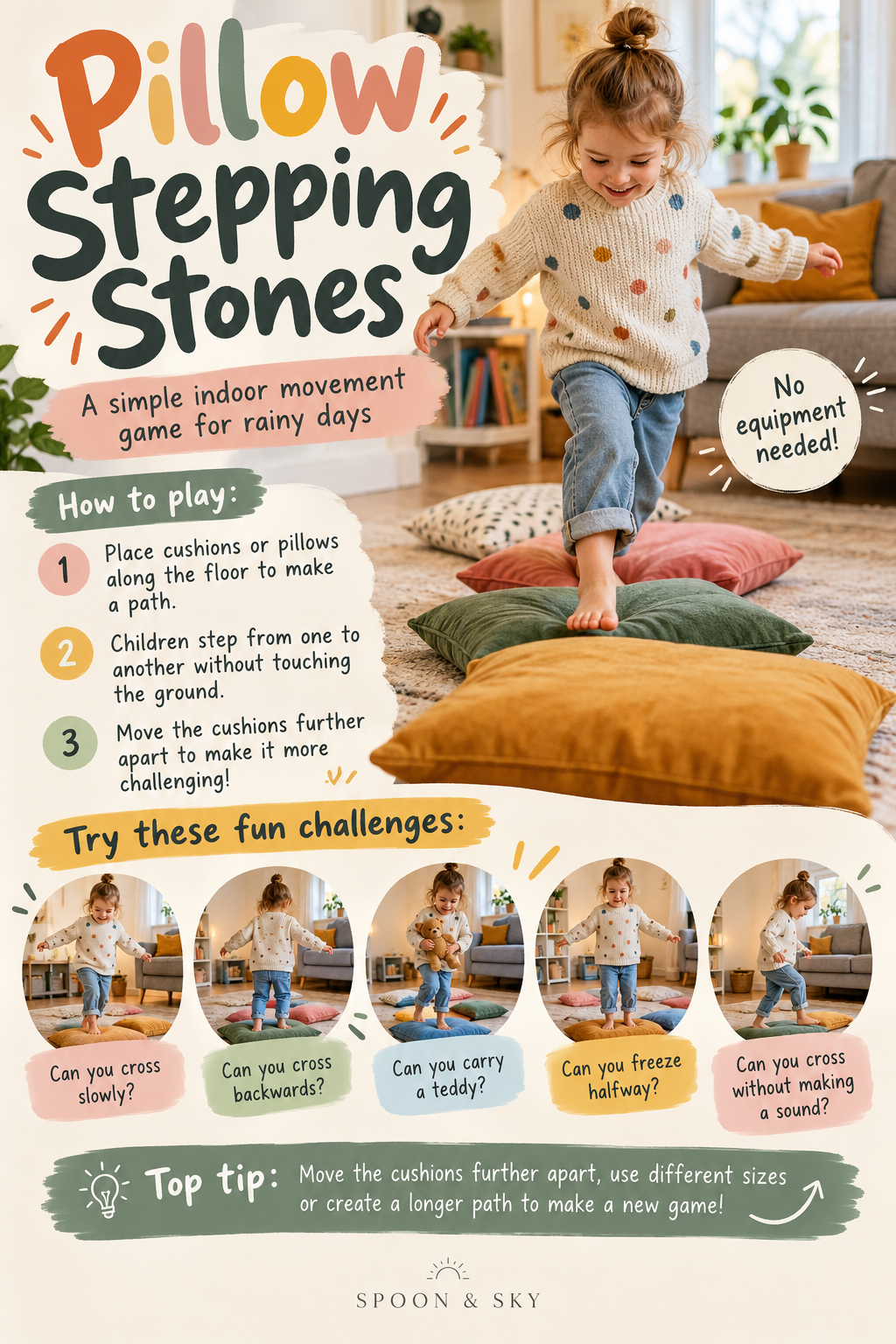
A calmer version of The Floor Is Lava.
Place cushions or pillows along the floor to make a path.
Children step from one to another without touching the ground.
Then change the challenge:
Can you cross slowly?
Can you cross backwards?
Can you carry a teddy?
Can you freeze halfway?
Can you cross without making a sound?
Moving the cushions further apart instantly creates a new game.
4. Freeze Dance
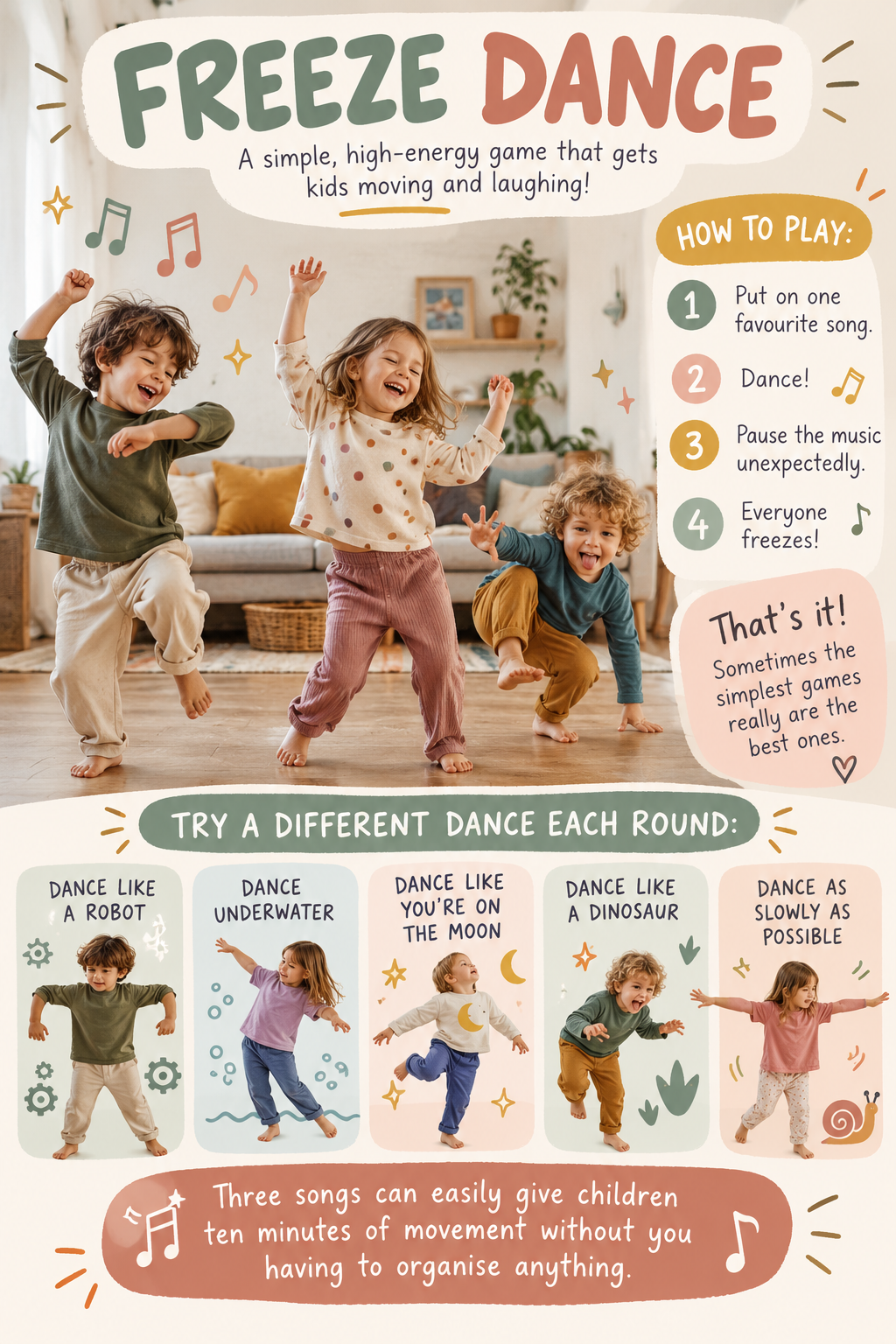
Put on one favourite song.
Dance.
Pause the music unexpectedly.
Everyone freezes.
That's it.
Sometimes the simplest games really are the best ones.
Try giving each round a different instruction:
Dance like a robot.
Dance underwater.
Dance like you're on the moon.
Dance like a dinosaur.
Dance as slowly as possible.
Three songs can easily give children ten minutes of movement without you having to organise anything.
5. Follow the Leader
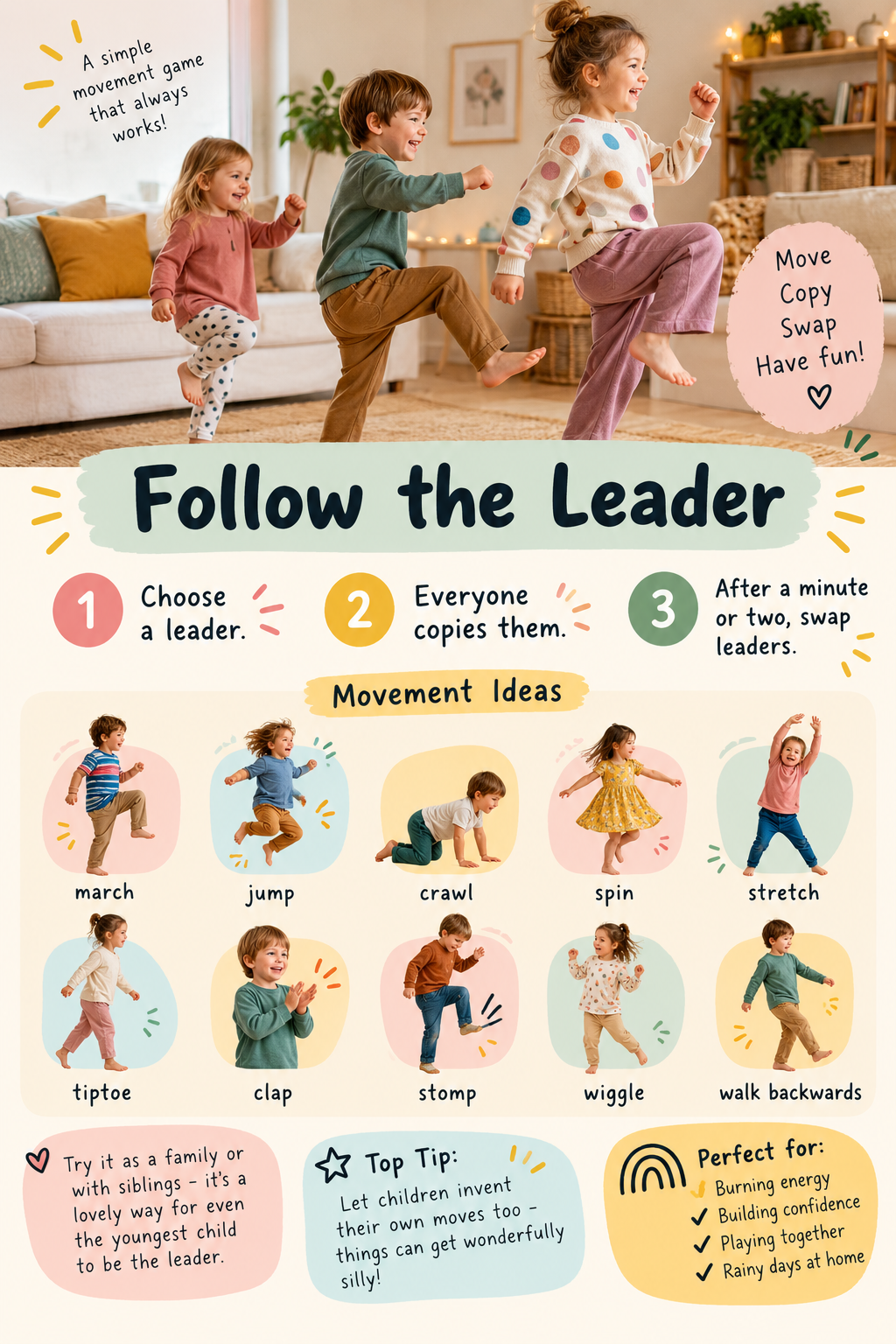
Choose a leader.
Everyone copies them.
The leader might:
march
jump
crawl
spin
stretch
tiptoe
clap
stomp
wiggle
or walk backwards.
After a minute or two, swap leaders.
This is especially lovely with siblings because even the youngest child gets a turn being the person everyone else follows.
6. Traffic Lights
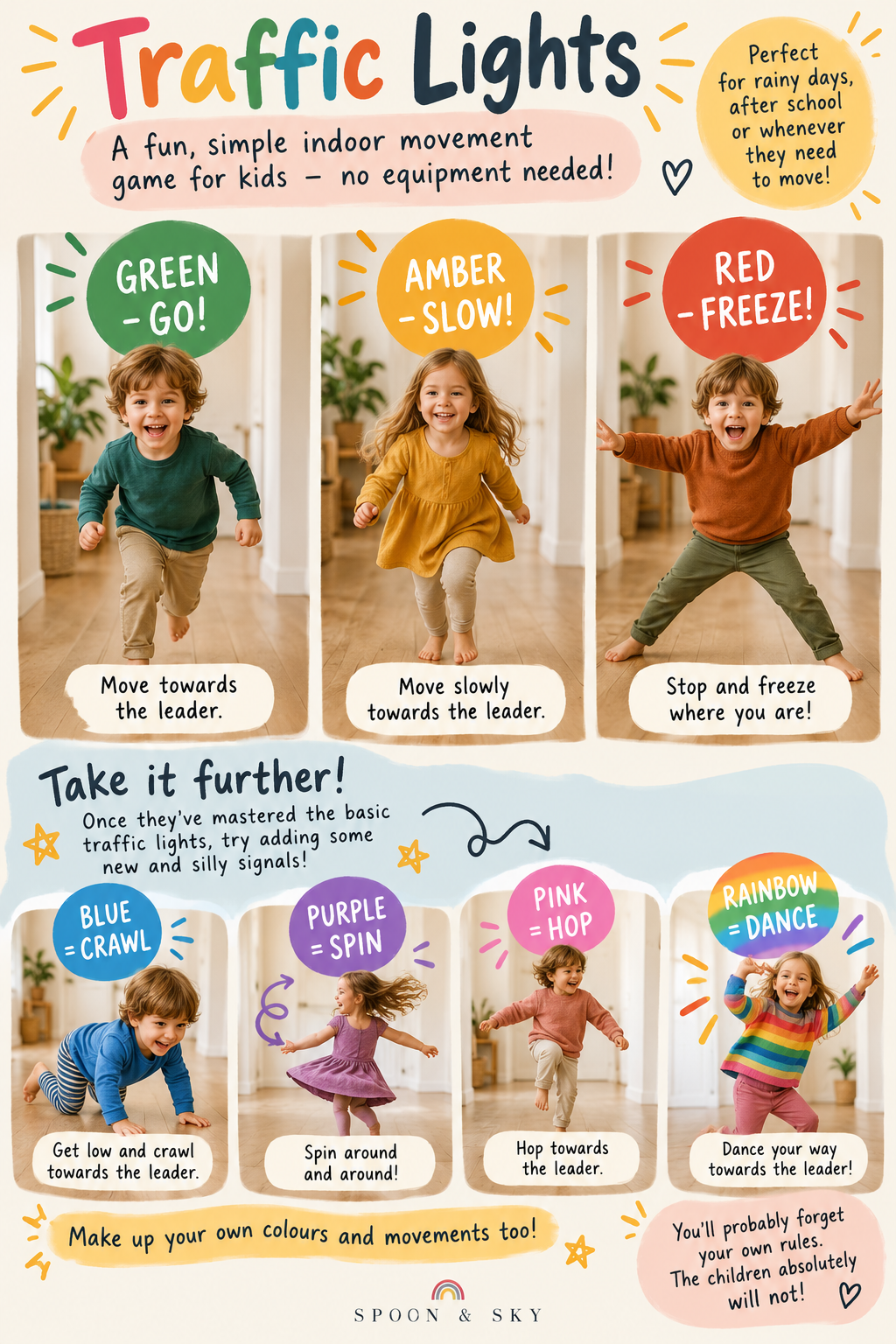
Stand at one end of the room or hallway.
Call:
🟢 GREEN — GO!
🟠 AMBER — SLOW!
🔴 RED — FREEZE!
Children move towards you while following the instructions.
Once they've mastered that, start adding ridiculous new traffic signals.
Blue = crawl.
Purple = spin.
Pink = hop.
Rainbow = dance.
You'll probably forget your own rules.
The children absolutely will not.
7. Colour Hunt
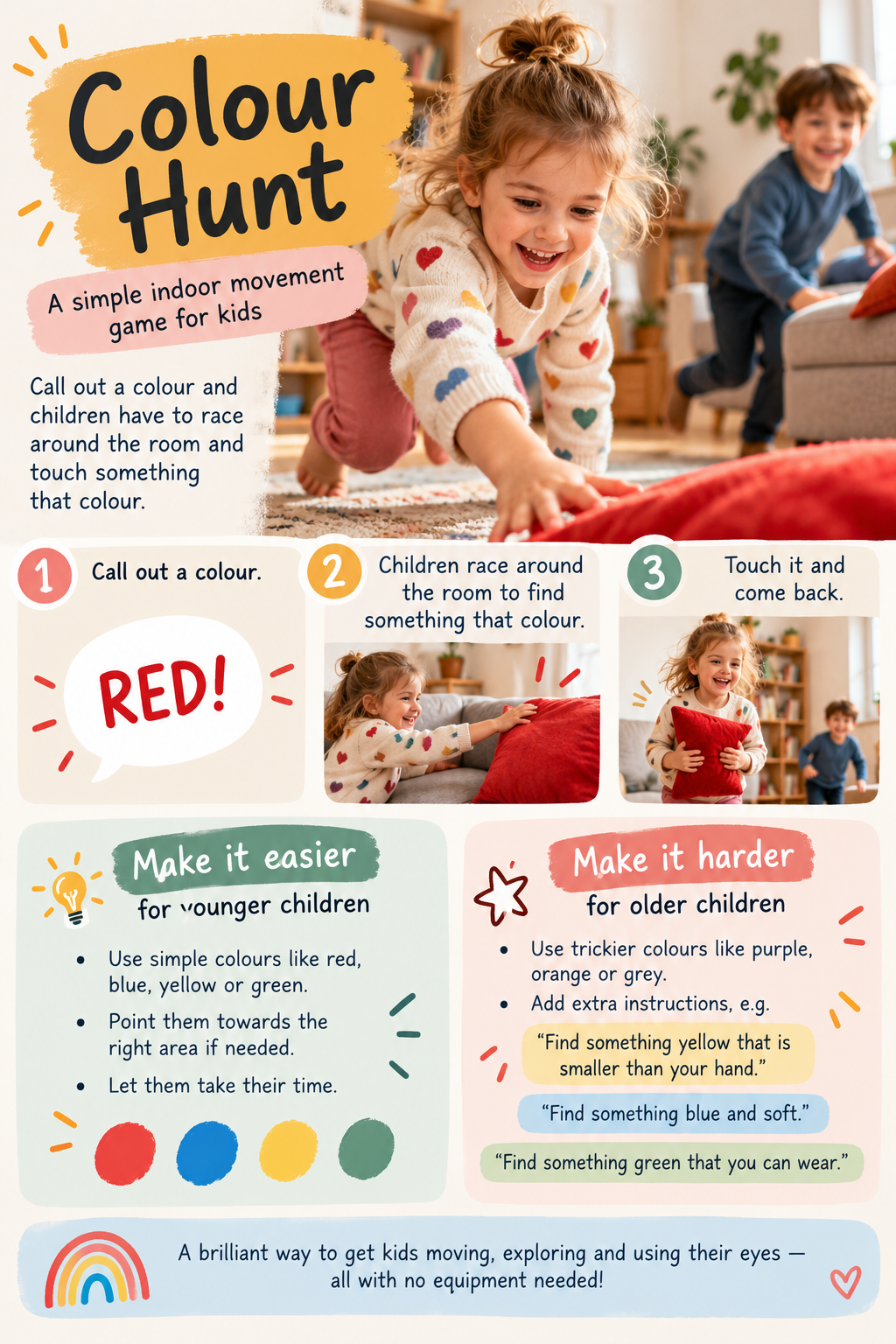
Call out a colour.
Children have to race around the room and touch something that colour.
"RED!"
Run.
Touch.
Come back.
"BLUE!"
Off they go again.
You can make this easier for younger children by pointing them towards the right area or make it more challenging for older children:
"Find something yellow that is smaller than your hand."
8. Balloon Keep-Up
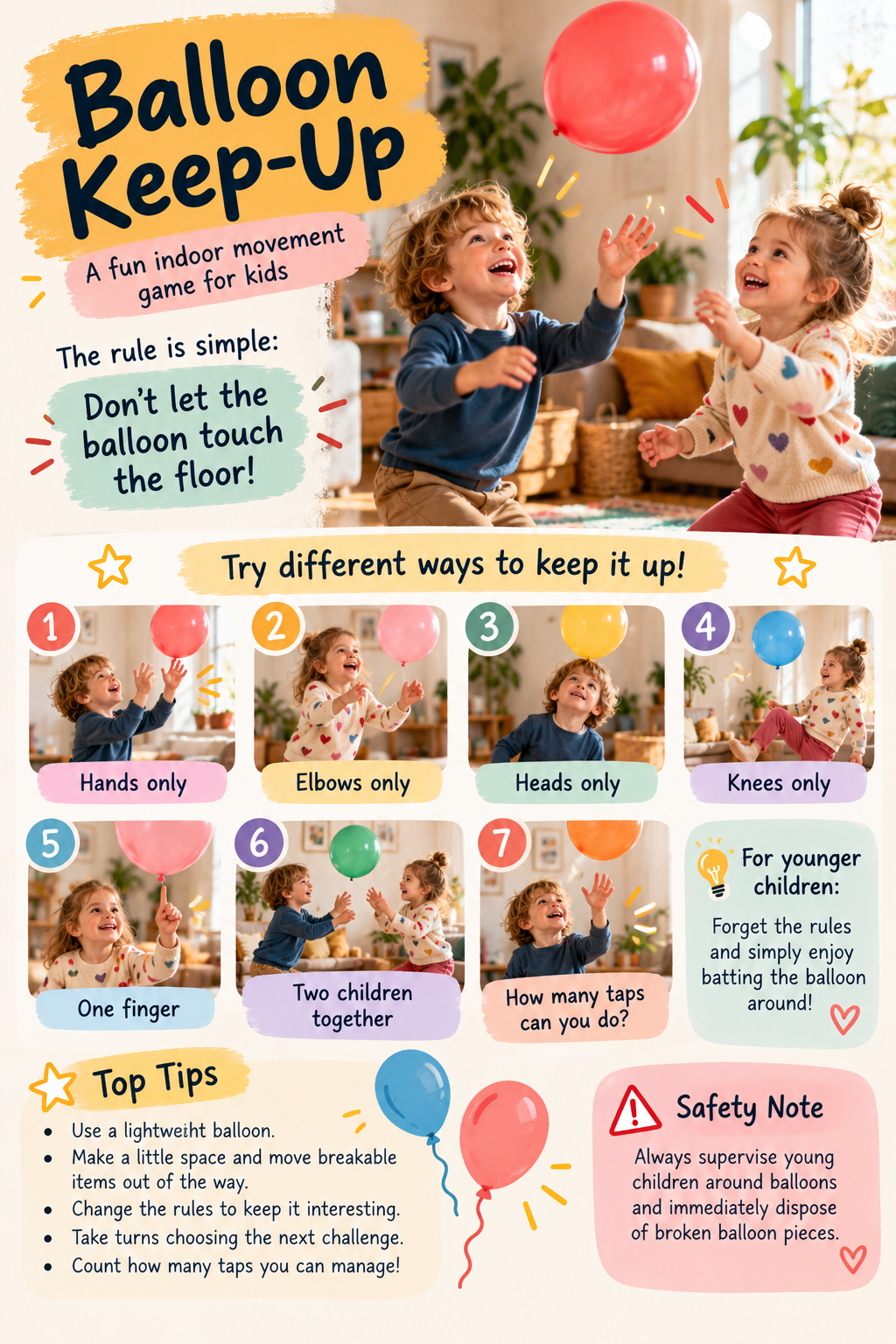
If you happen to have a balloon in the house, this can occupy children for surprisingly long periods.
The rule is simple:
Don't let the balloon touch the floor.
Start with hands.
Then try:
elbows only
heads only
knees only
one finger
two children working together
or counting how many taps you can manage.
For younger children, forget the rules and simply enjoy batting it around.
Always supervise young children around balloons and immediately dispose of broken balloon pieces.
9. Hallway Races
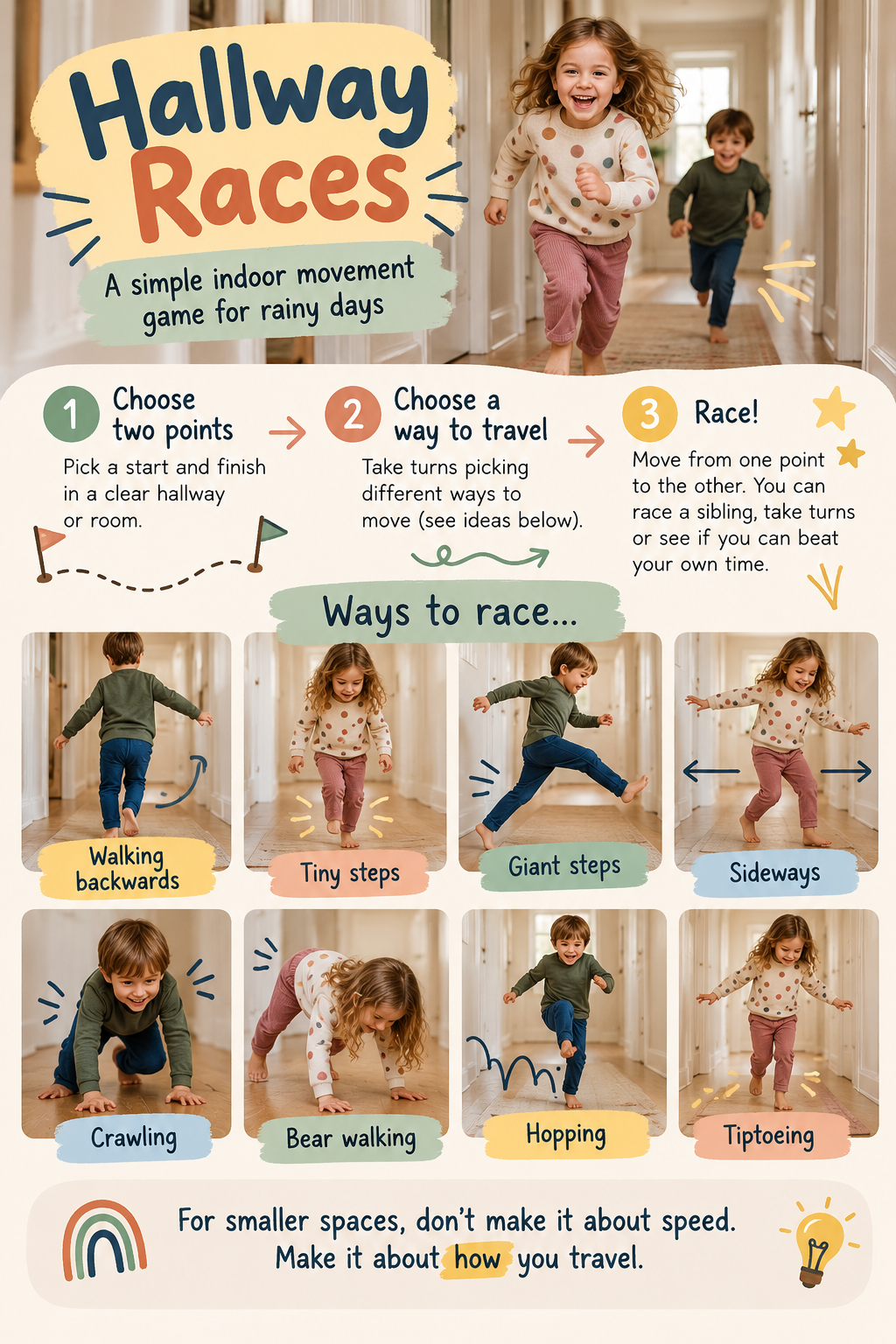
You don't need much space to race.
Choose two points in a clear hallway or room and race between them in different ways.
Try:
walking backwards
tiny steps
giant steps
sideways
crawling
bear walking
hopping
tiptoeing.
For smaller spaces, don't make it about speed.
Make it about how you travel.
10. Shadow Copying
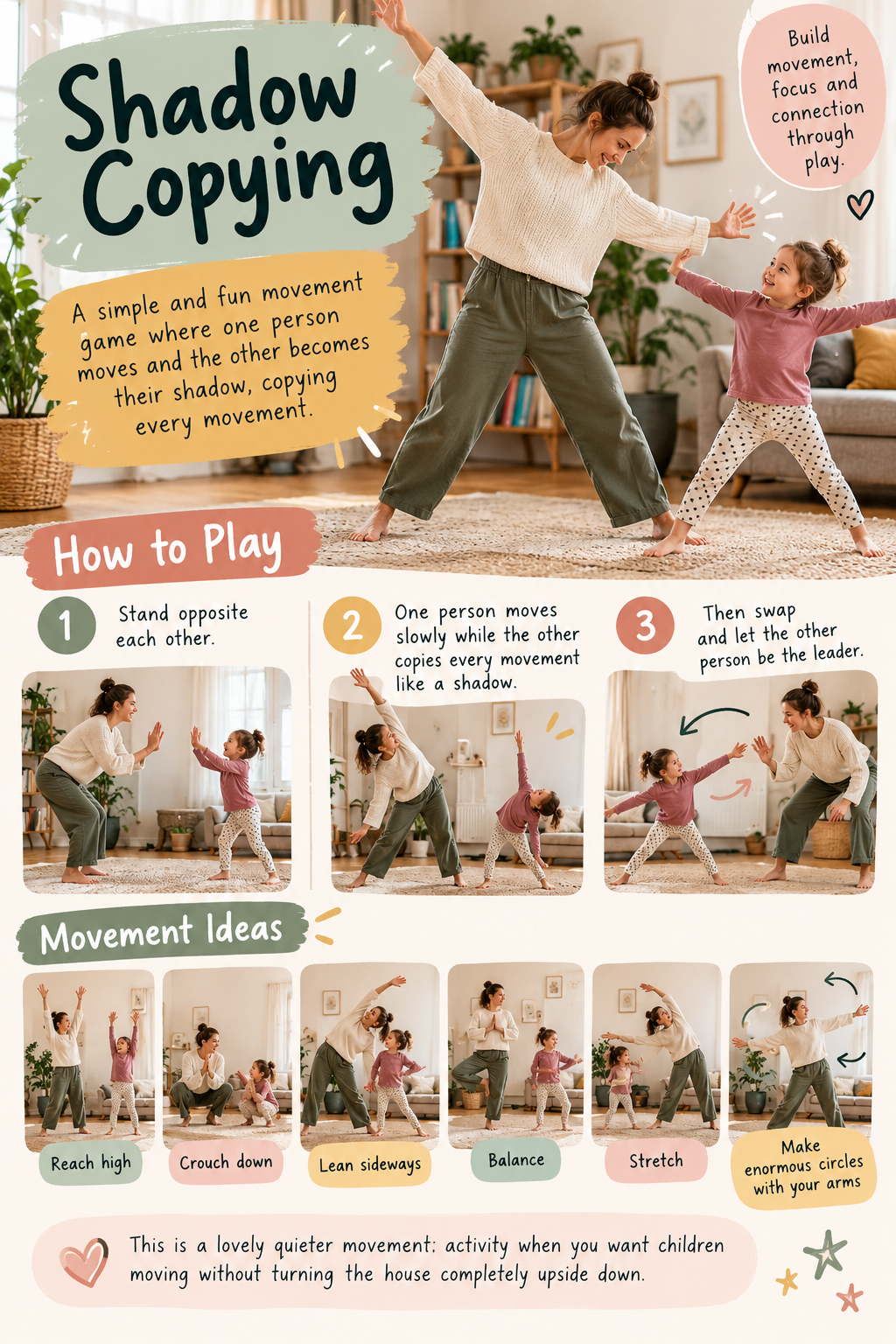
Stand opposite each other.
One person moves slowly while the other becomes their "shadow" and copies every movement.
Reach high.
Crouch down.
Lean sideways.
Balance.
Stretch.
Make enormous circles with your arms.
Then swap.
This is a lovely quieter movement activity when you want children moving without turning the house completely upside down.
11. Don't Wake the Bear
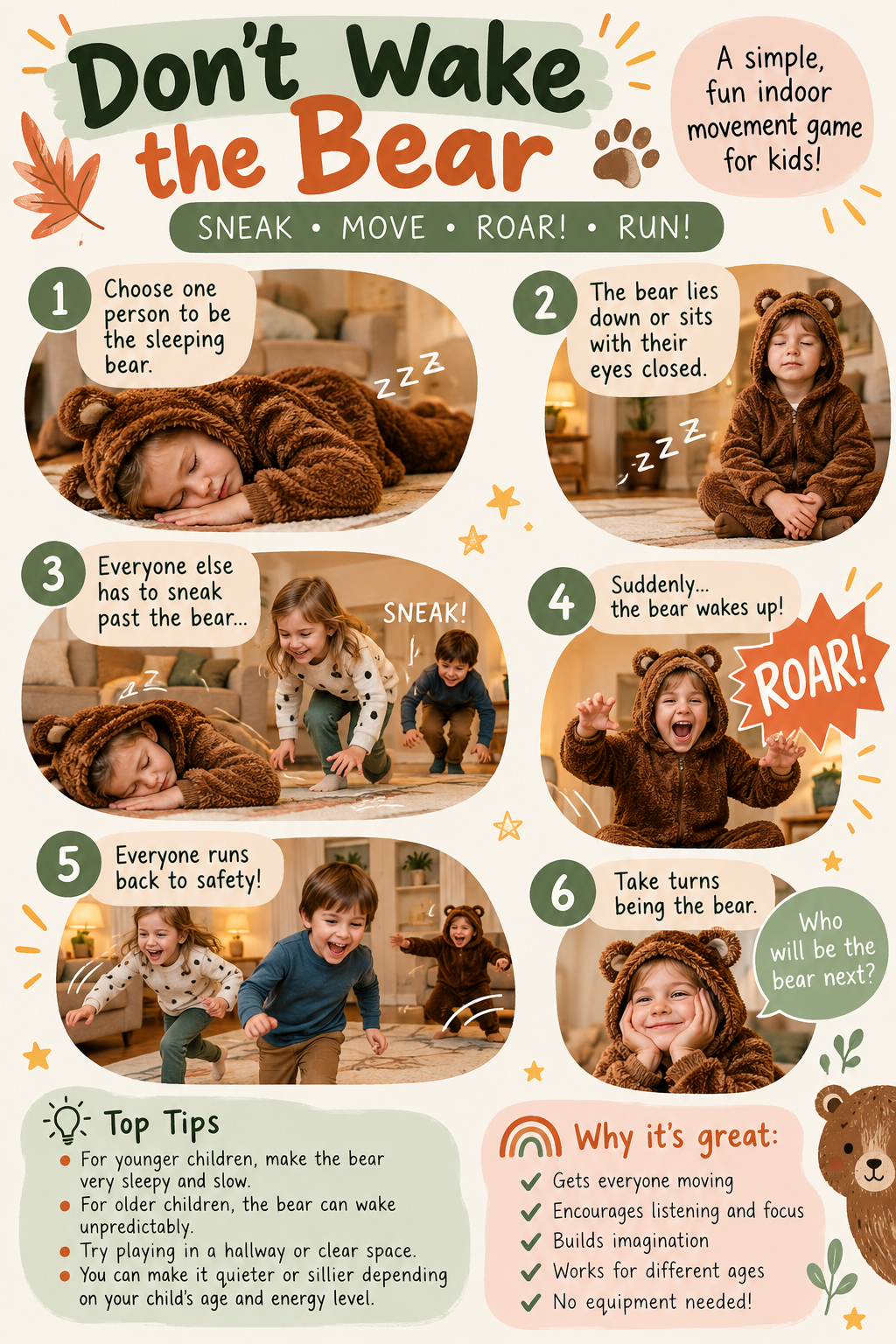
Choose one person to be the sleeping bear.
They lie down or sit with their eyes closed.
Everyone else has to sneak past.
Suddenly the bear wakes up.
ROAR!
Everyone runs back to safety.
Take turns being the bear.
For younger children, make the bear very sleepy and very slow. For older children, the bear can wake unpredictably.
12. Superhero Training
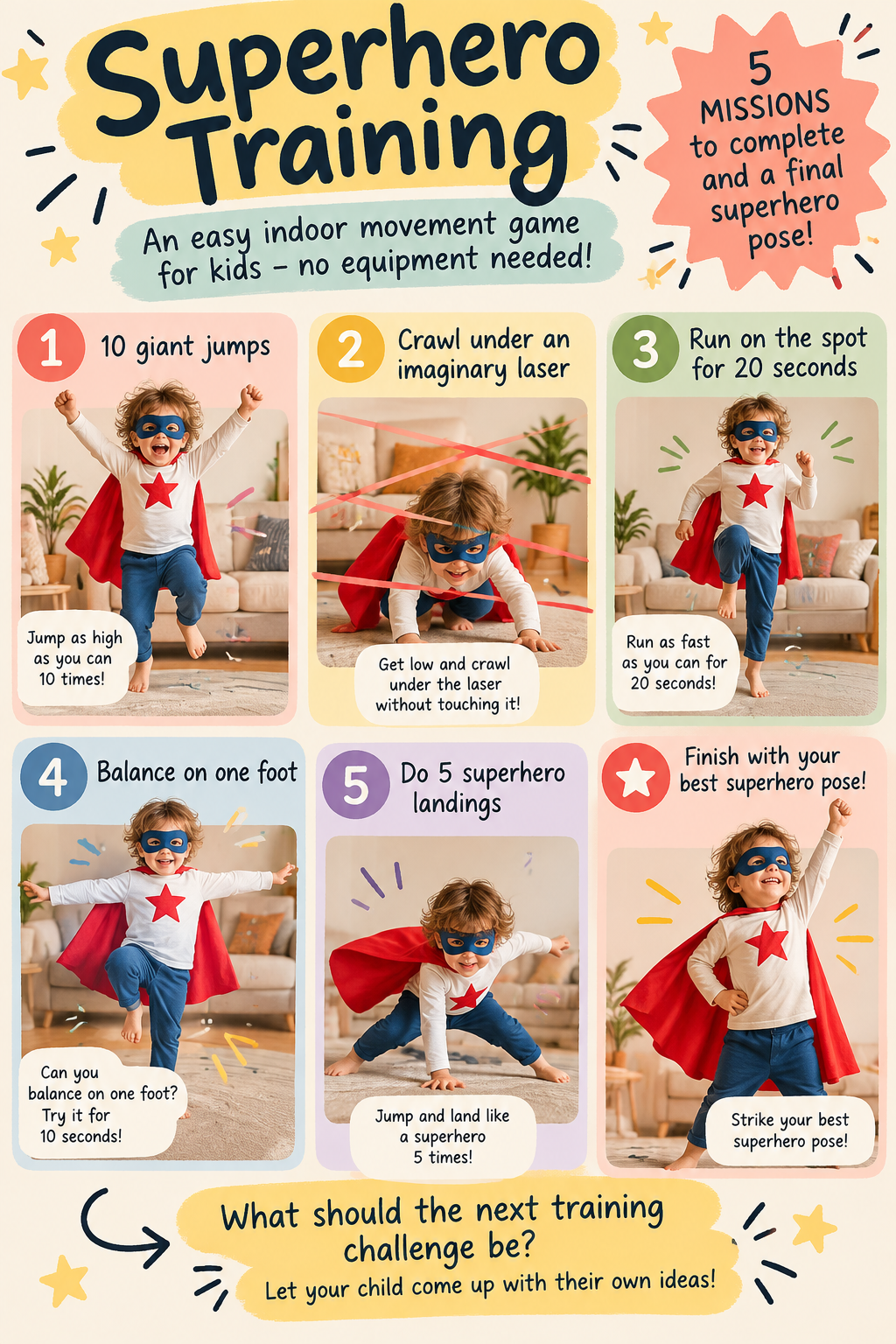
Announce that superhero training is beginning.
Your young superheroes need to complete five missions:
10 giant jumps
crawl under an imaginary laser
run on the spot for 20 seconds
balance on one foot
do 5 superhero landings
Then finish with their best superhero pose.
Ask:
"What should the next training challenge be?"
Children will usually take over from there.
13. Indoor Scavenger Race
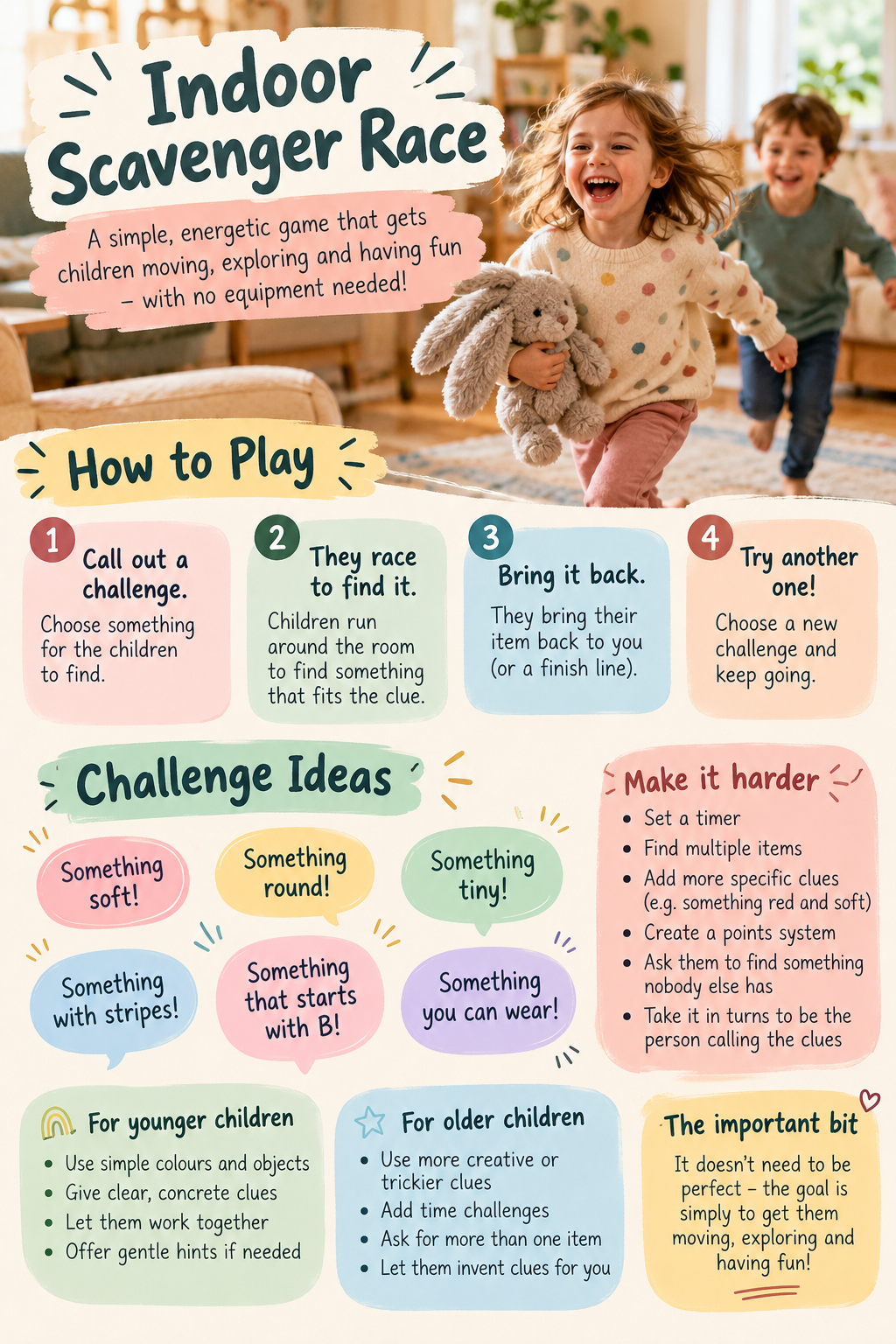
Call out something children need to find and bring back.
"Something soft!"
"Something round!"
"Something tiny!"
"Something with stripes!"
"Something that starts with B!"
"Something you can wear!"
For younger children, use simple colours and objects.
For older children, make the clues more complicated.
The important part?
They have to move to find it.
14. Move Like the Weather
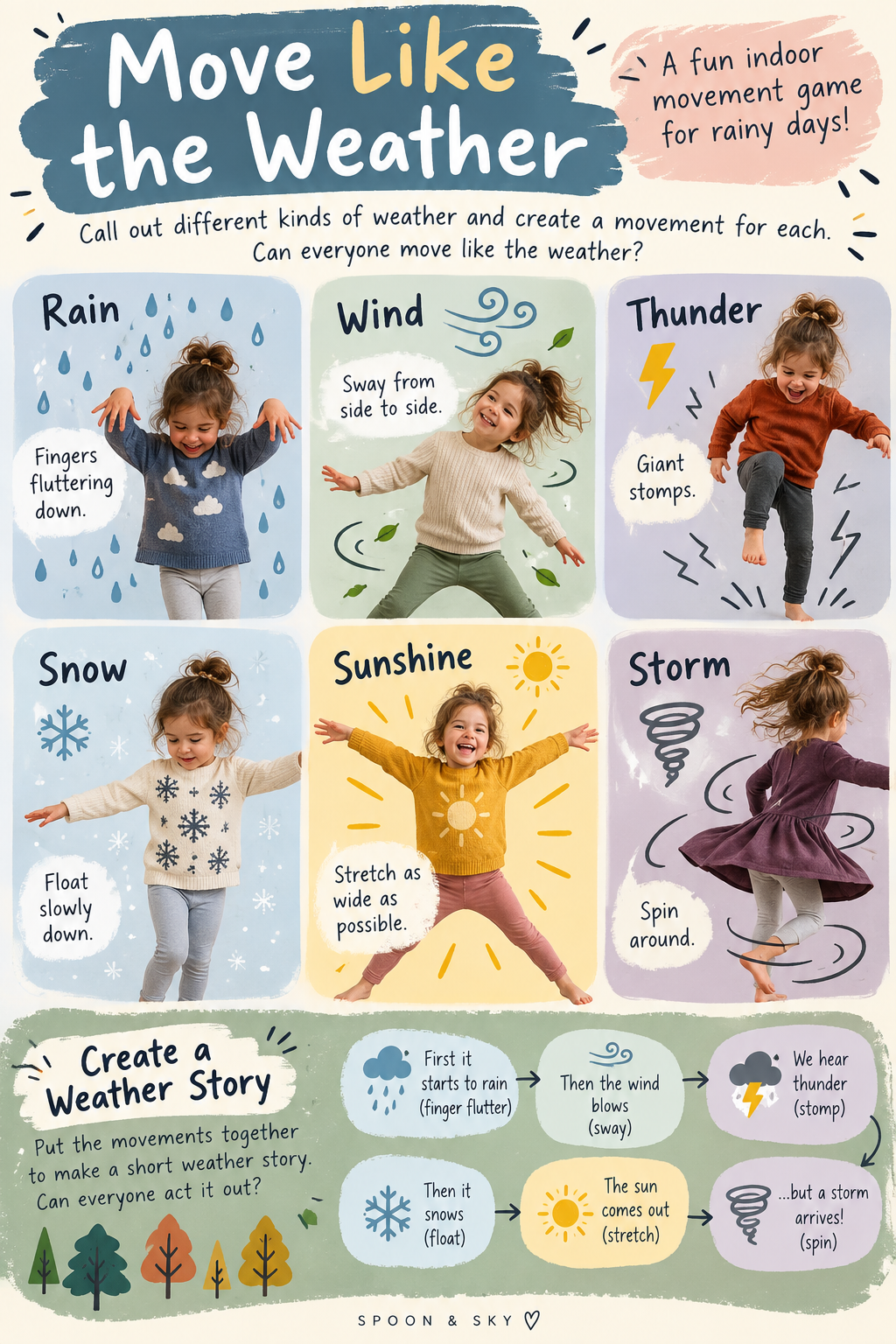
Perfect for an appropriately miserable rainy day.
Call out different kinds of weather and create a movement for each.
🌧️ Rain — fingers fluttering down
💨 Wind — sway from side to side
⛈️ Thunder — giant stomps
❄️ Snow — float slowly down
☀️ Sunshine — stretch as wide as possible
🌪️ Storm — spin around
Then tell a tiny weather story and let children perform it.
15. Autumn Animal Moves
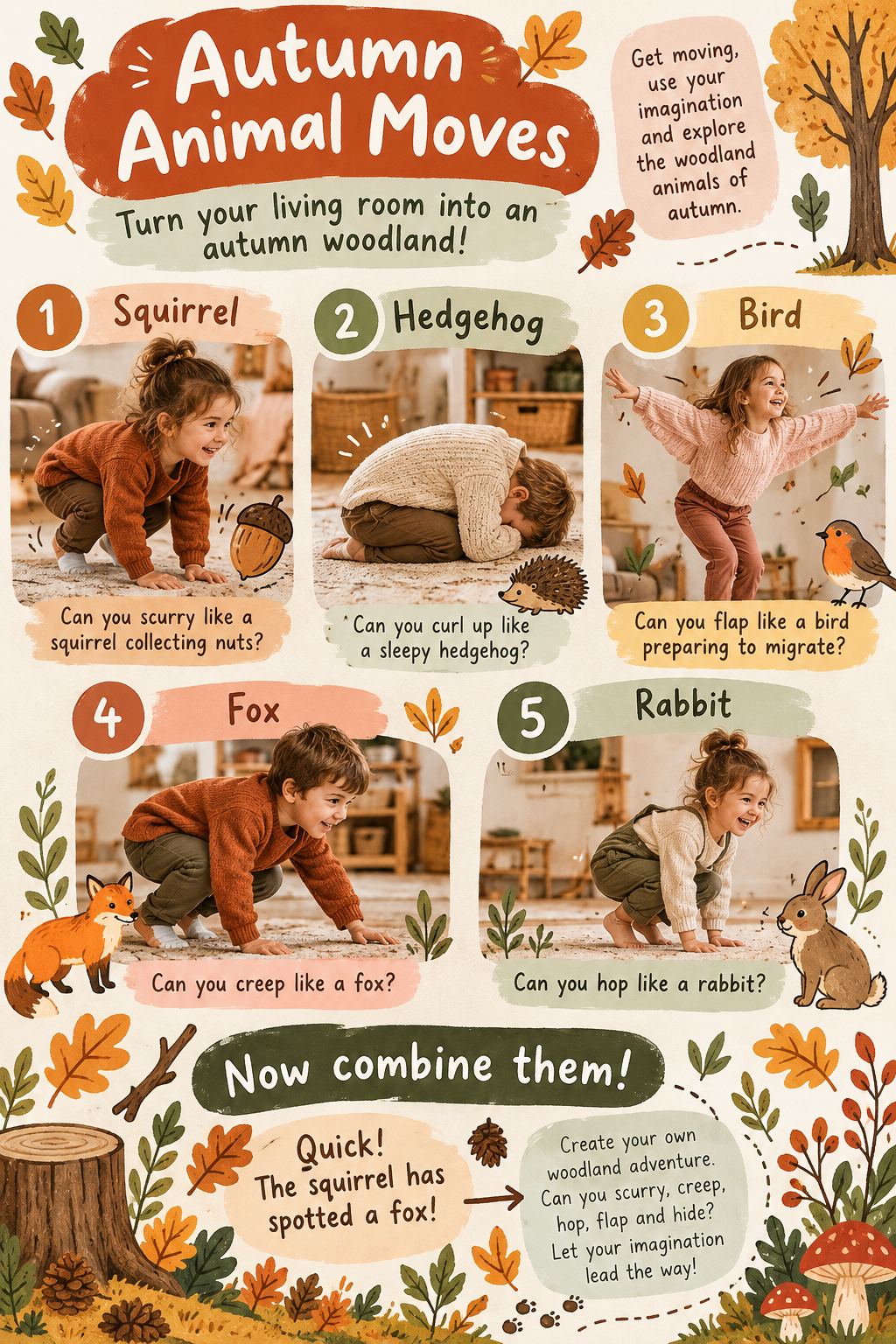
Turn your living room into an autumn woodland.
Ask:
Can you scurry like a squirrel collecting nuts?
Can you curl up like a sleepy hedgehog?
Can you flap like a bird preparing to migrate?
Can you creep like a fox?
Can you hop like a rabbit?
Then combine them:
"Quick! The squirrel has spotted a fox!"
Suddenly you've got an entire woodland adventure happening in your lounge.
16. Pumpkin Roll
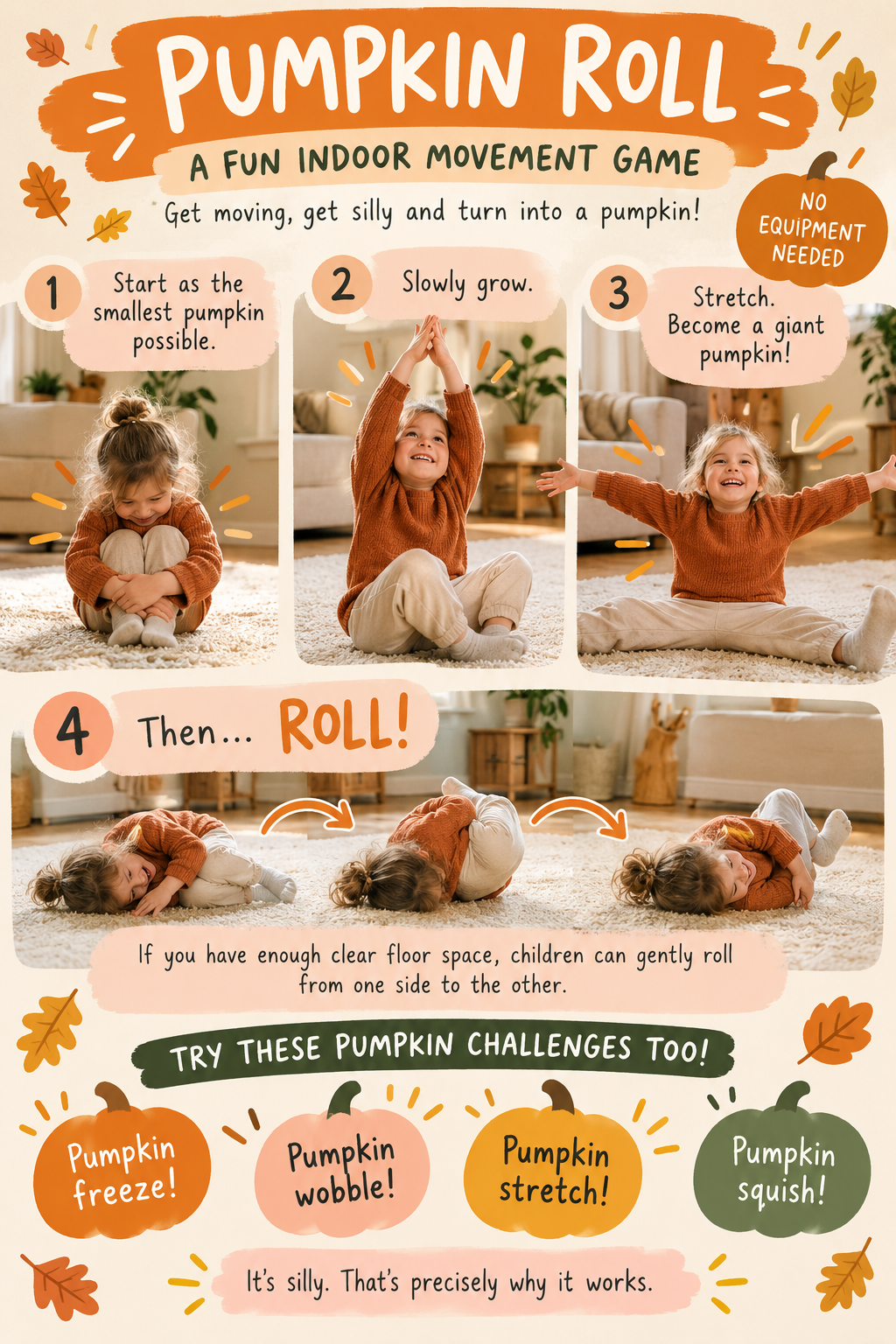
Pretend everyone is a pumpkin.
Start by curling into the smallest pumpkin possible.
Then slowly grow.
Stretch.
Become a giant pumpkin.
Then...
ROLL!
If you have enough clear floor space, children can gently roll from one side to the other.
You can also call:
"Pumpkin freeze!"
"Pumpkin wobble!"
"Pumpkin stretch!"
"Pumpkin squish!"
It's silly.
That's precisely why it works.
17. Leaf-Blowing Race
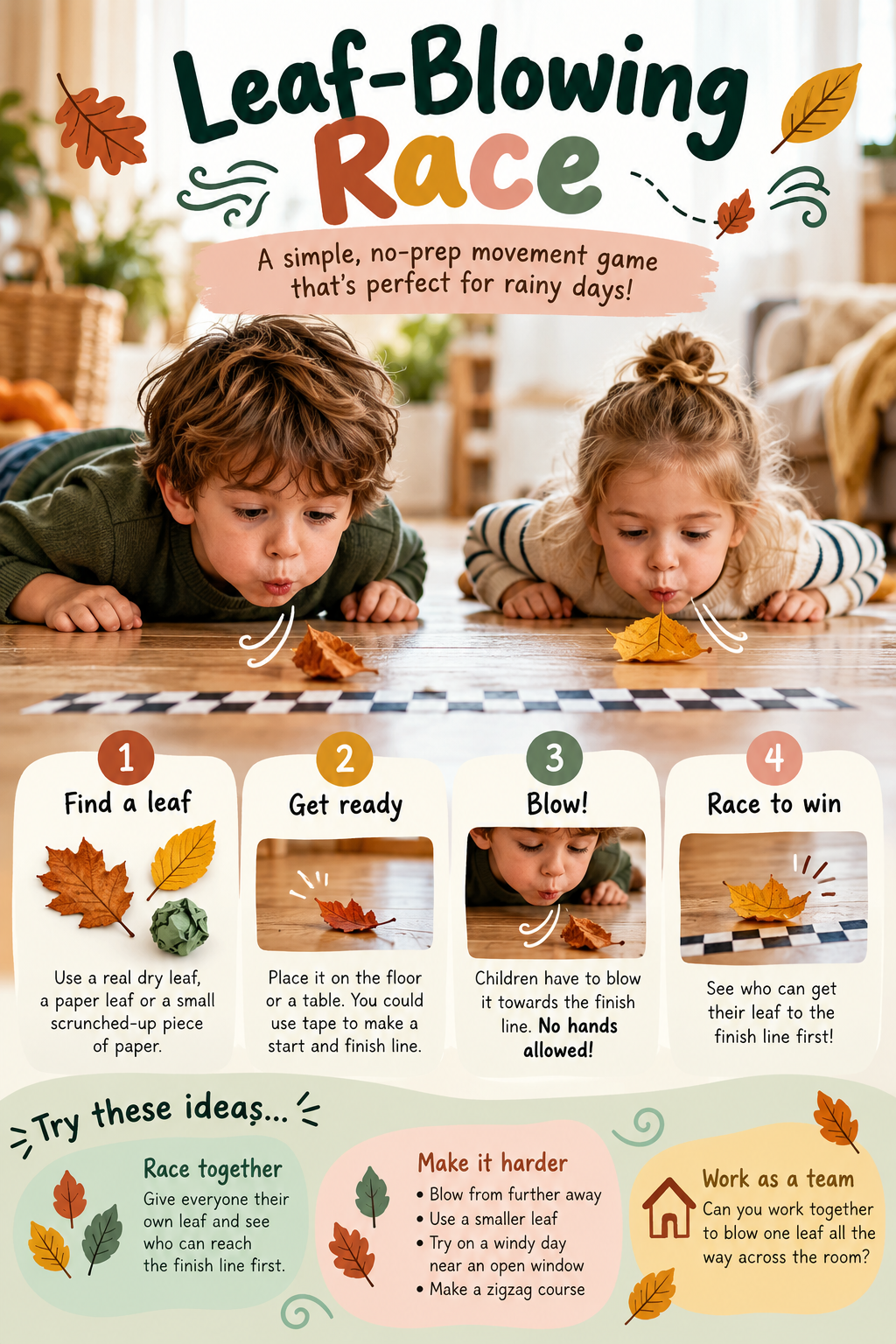
You can use a real dry leaf, a paper leaf or simply a small scrunched-up piece of paper.
Place it on the floor or table.
Children have to blow it towards a finish line.
No hands allowed.
For siblings, give everyone their own leaf and race.
Or work together to get one leaf all the way across the room.
18. The Invisible Obstacle Course
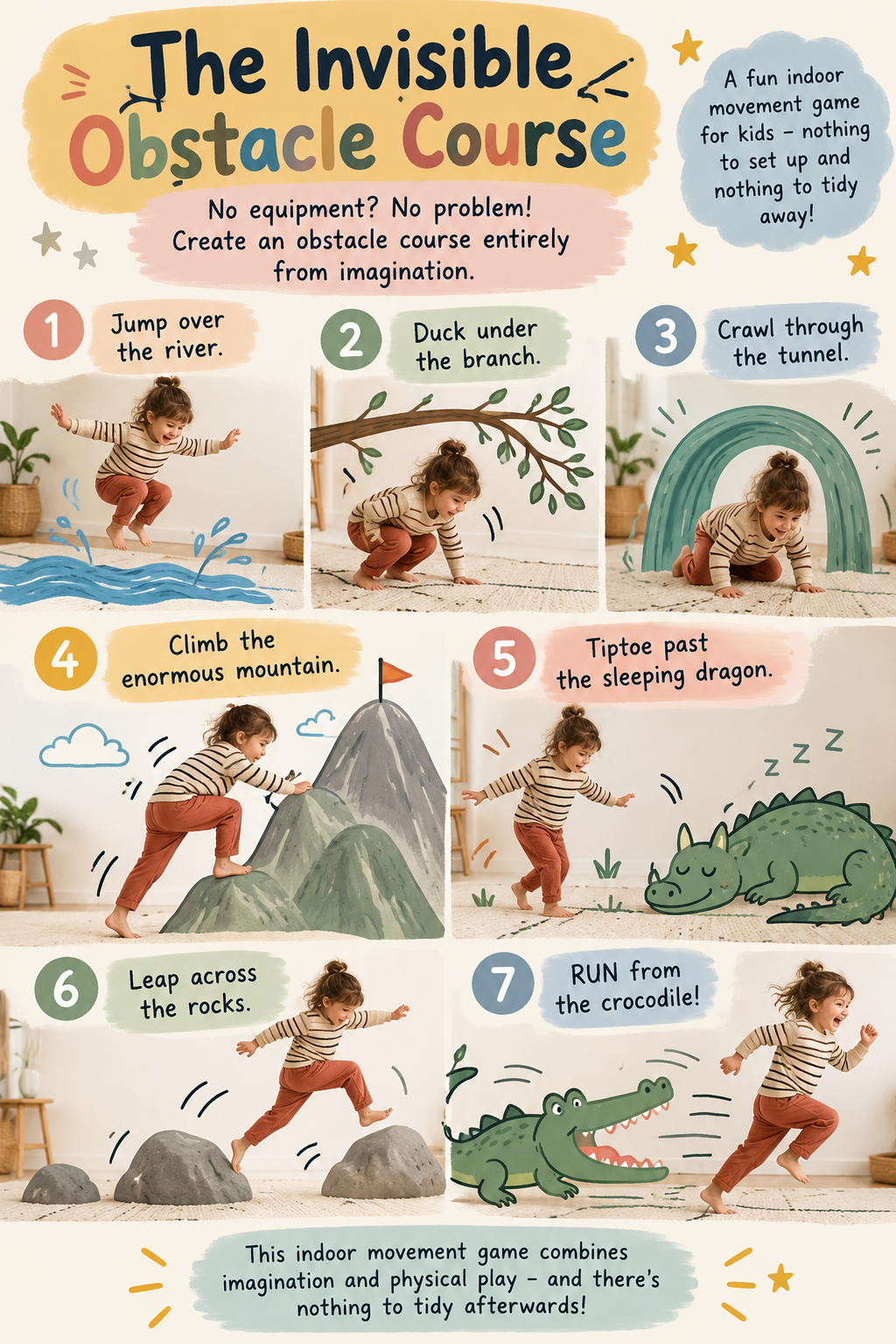
No equipment?
No problem.
Create an obstacle course entirely from imagination.
Jump over the river.
Duck under the branch.
Crawl through the tunnel.
Climb the enormous mountain.
Tiptoe past the sleeping dragon.
Leap across the rocks.
RUN from the crocodile!
This one combines movement and imaginative play beautifully — and there's nothing to tidy afterwards.
19. Movement Dice
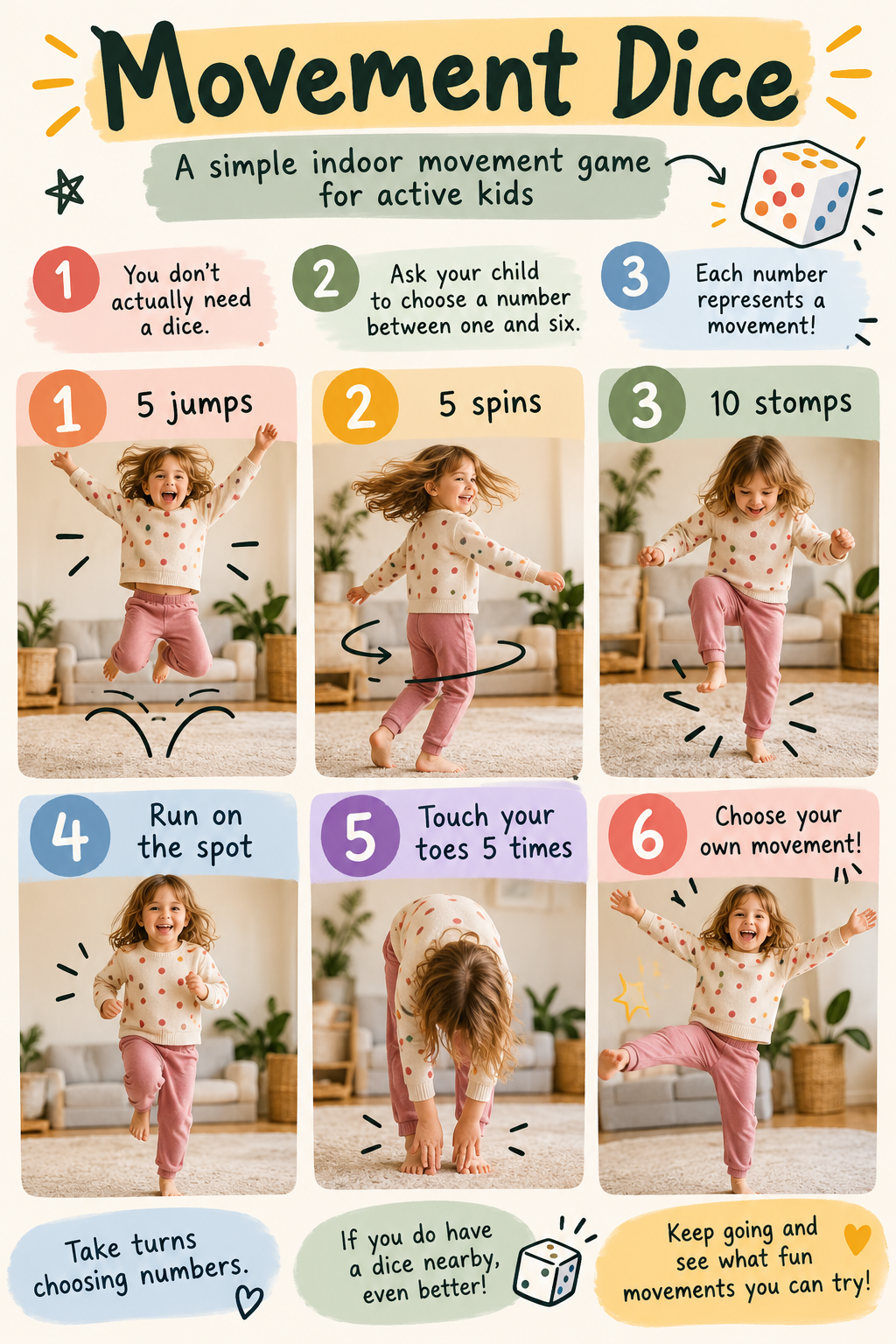
You don't actually need a dice.
Ask your child to choose a number between one and six.
Each number represents a movement:
1 — 5 jumps
2 — 5 spins
3 — 10 stomps
4 — run on the spot
5 — touch your toes 5 times
6 — choose your own movement
Take turns choosing numbers.
If you do have a dice nearby, even better.
20. Copy My Pattern
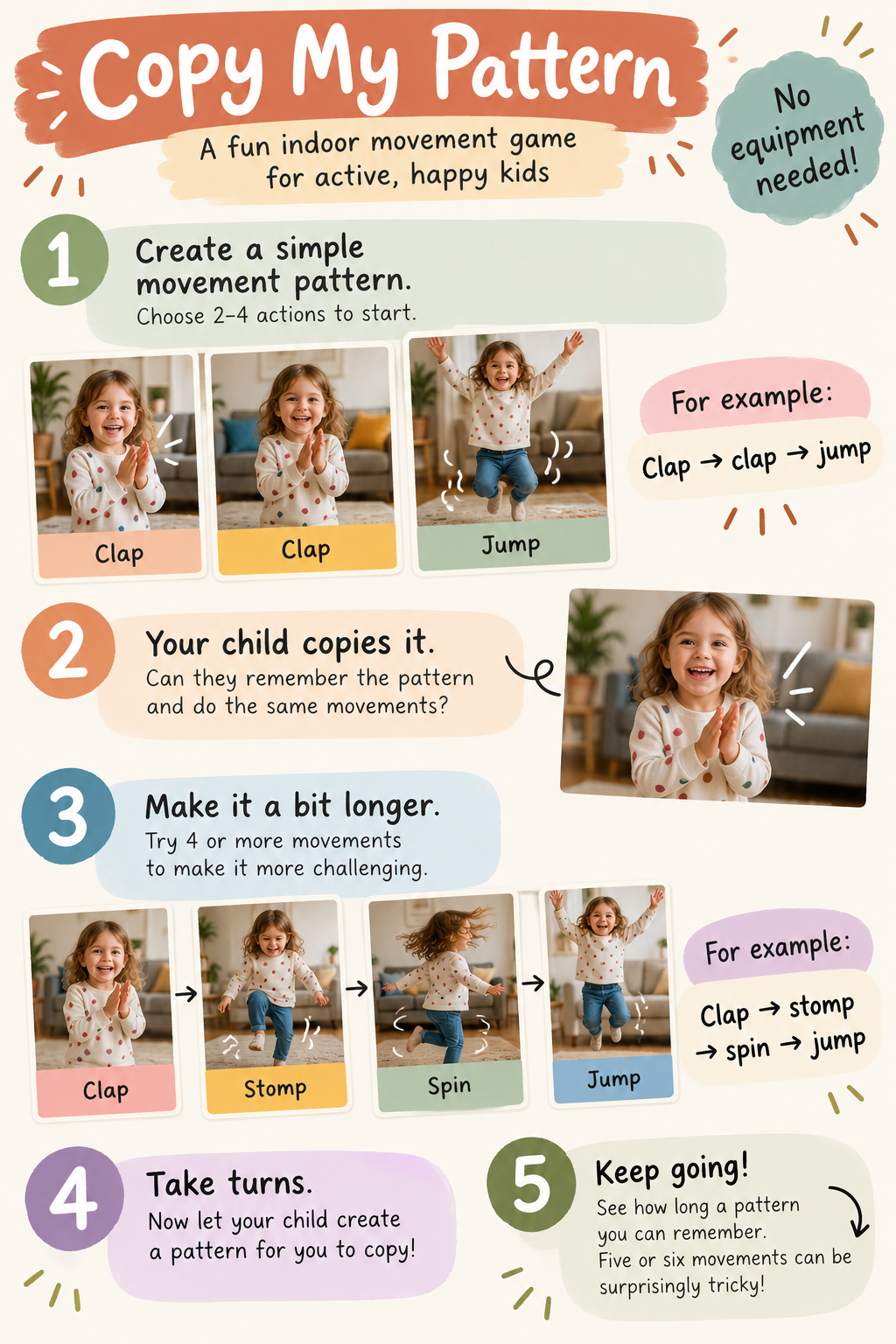
Create a short sequence of movements.
For example:
Clap → clap → jump.
Your child copies it.
Then make it slightly longer:
Clap → stomp → spin → jump.
Take turns creating sequences for each other.
It becomes surprisingly challenging once there are five or six movements to remember.
21. Slow-Motion Race
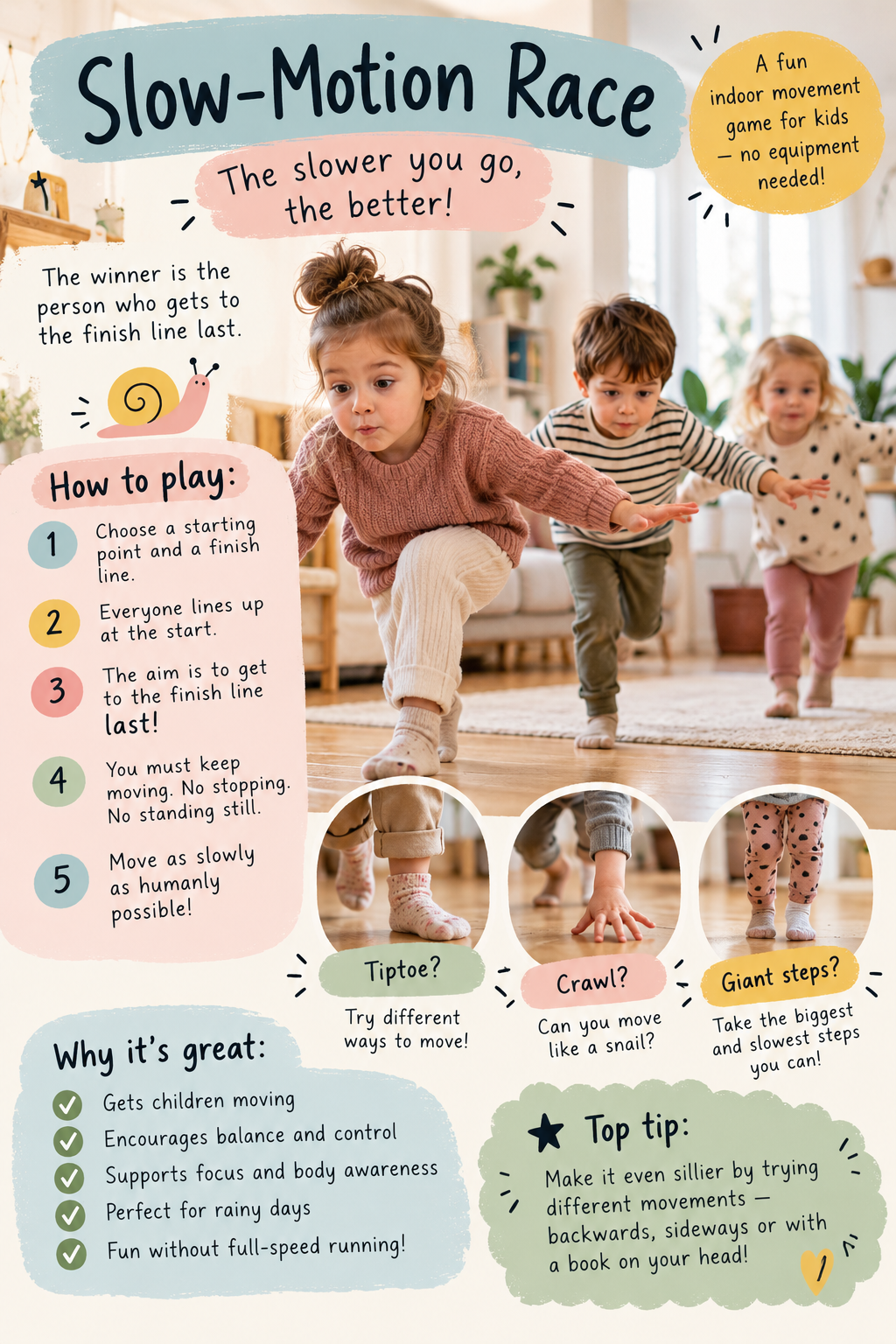
The winner is the person who gets to the finish line last.
There's only one rule:
You must keep moving.
No stopping.
No standing still.
Move as slowly as humanly possible.
This usually results in some extremely dramatic facial expressions and is particularly useful when you want movement without encouraging full-speed running around the house.
22. Mission Impossible
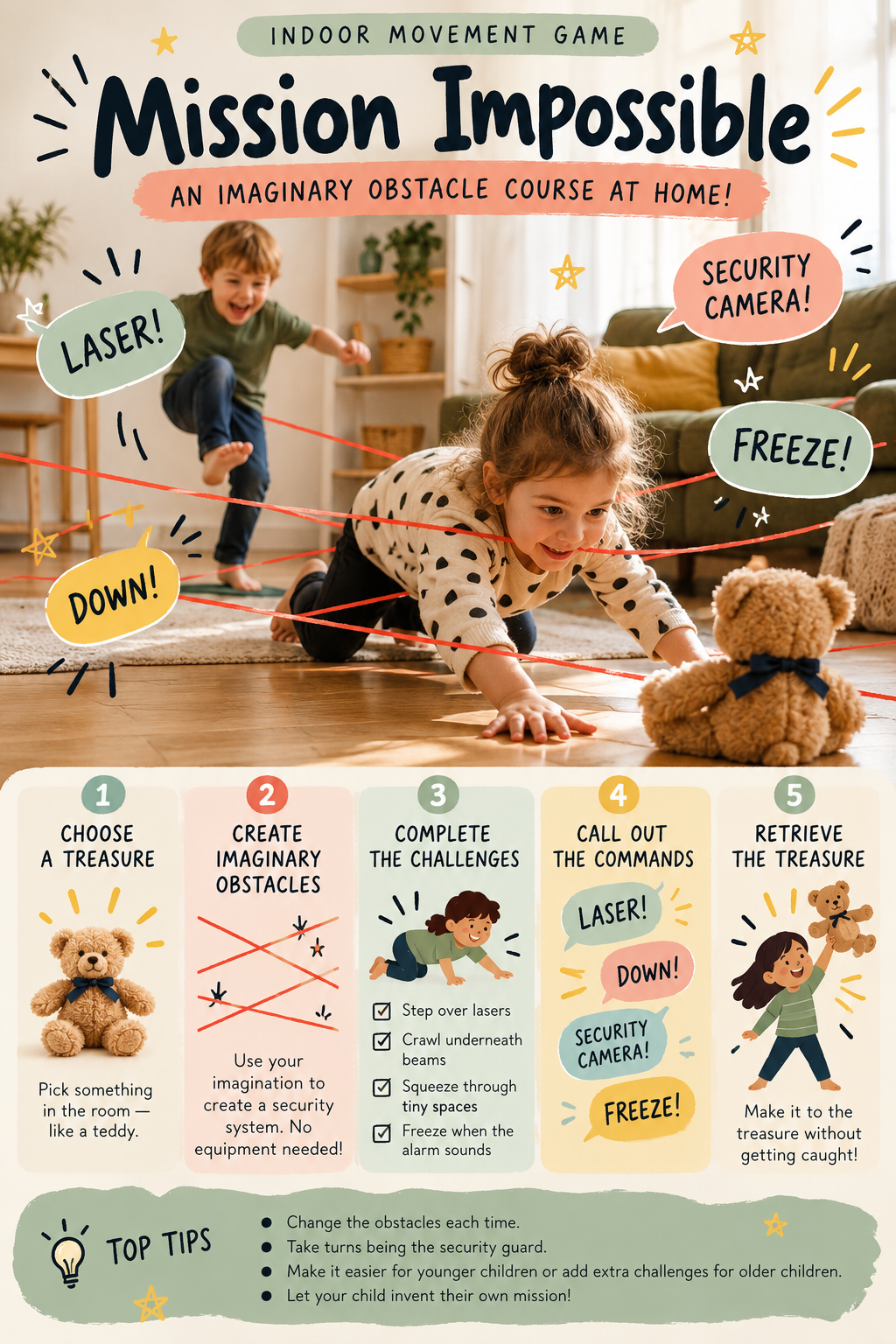
Choose something in the room — perhaps a teddy.
That's the treasure.
Now create an imaginary security system around it.
Children must:
step over lasers
crawl underneath beams
squeeze through tiny spaces
freeze when the alarm sounds
and retrieve the treasure.
You can simply point to imaginary obstacles as they move.
"LASER!"
"Down!"
"Security camera!"
"FREEZE!"
No preparation required.
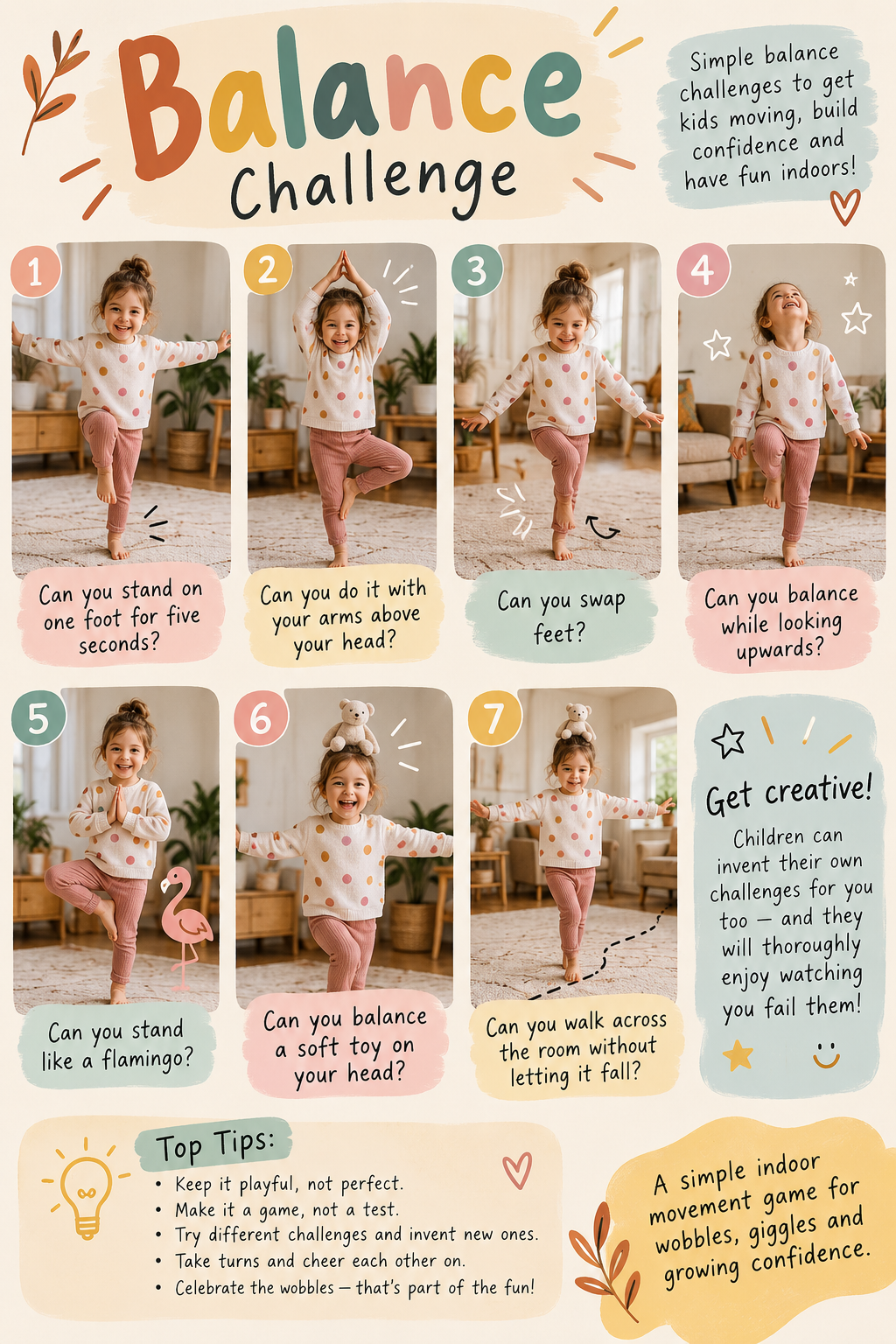
23. Balance Challenge
Start with:
Can you stand on one foot for five seconds?
Then:
Can you do it with your arms above your head?
Can you swap feet?
Can you balance while looking upwards?
Can you stand like a flamingo?
Can you balance a soft toy on your head?
Can you walk across the room without letting it fall?
Children can invent challenges for you too.
And they will thoroughly enjoy watching you fail them.
24. The Movement Story
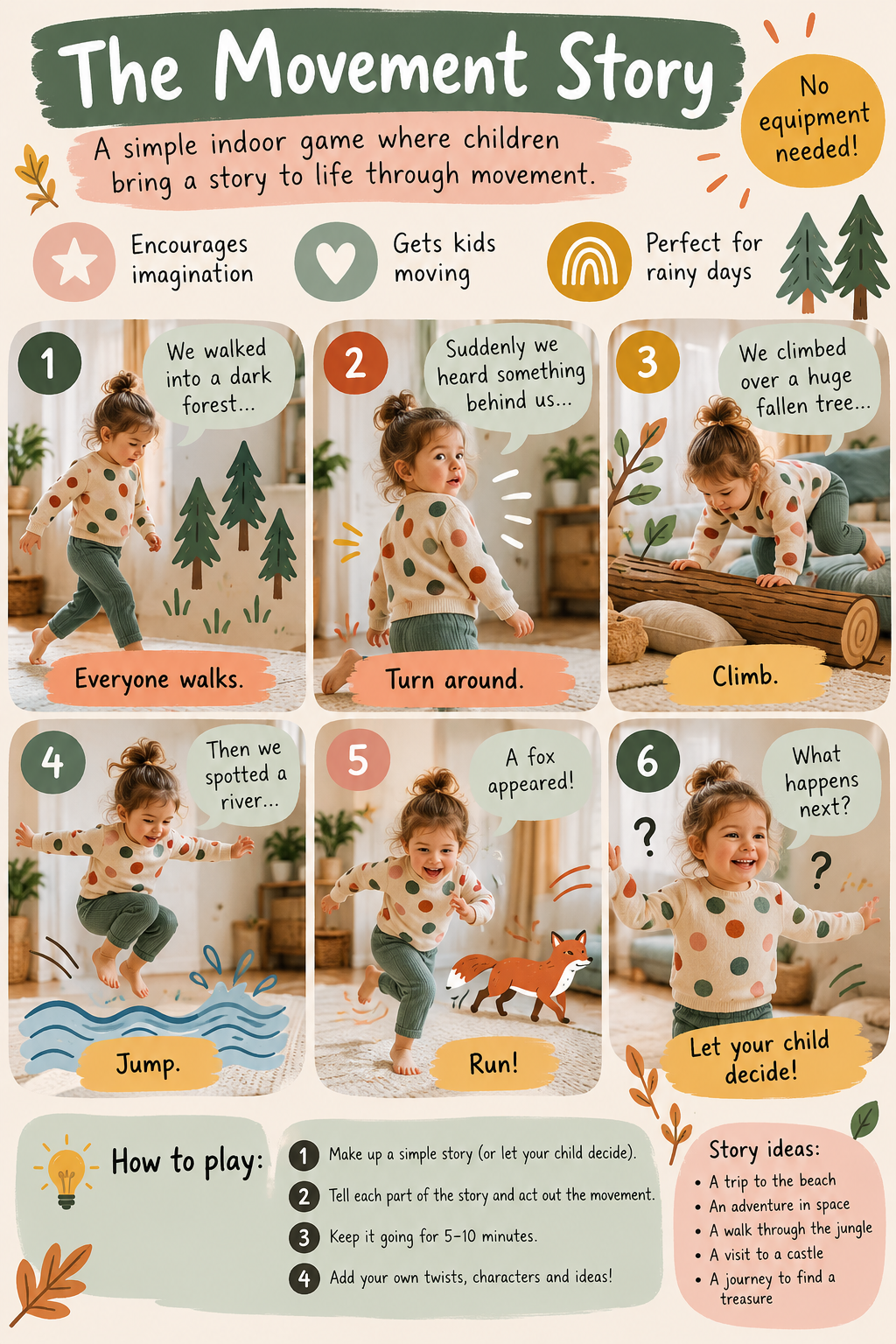
Tell a story that children have to physically act out.
It doesn't need to be complicated.
"We walked into a dark forest..."
Everyone walks.
"Suddenly we heard something behind us."
Turn around.
"We climbed over a huge fallen tree."
Climb.
"Then we spotted a river."
Jump.
"A fox appeared!"
Run!
You don't need a prepared story.
Make it up as you go.
Better still, let your child decide what happens next.
25. The Five-Minute Movement Jar
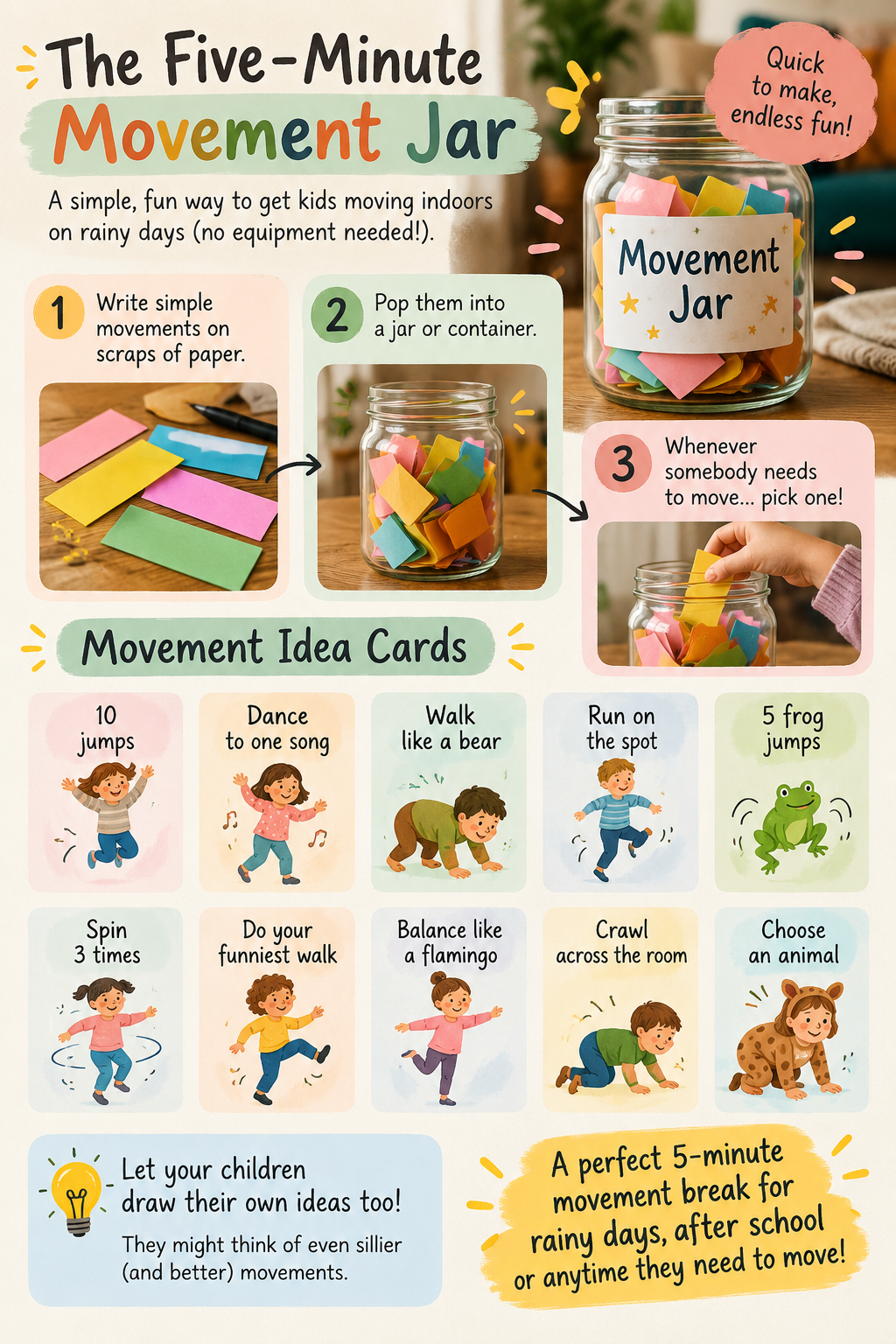
This one takes a tiny bit of preparation once and then becomes something you can return to again and again.
Write simple movements on scraps of paper:
10 jumps
Dance to one song
Walk like a bear
Run on the spot
5 frog jumps
Spin 3 times
Do your funniest walk
Balance like a flamingo
Crawl across the room
Choose an animal
Put them into a jar or little container.
Whenever somebody needs to move:
Pick one.
That's your movement break.
You can also let your children draw pictures of movements and add their own ideas.
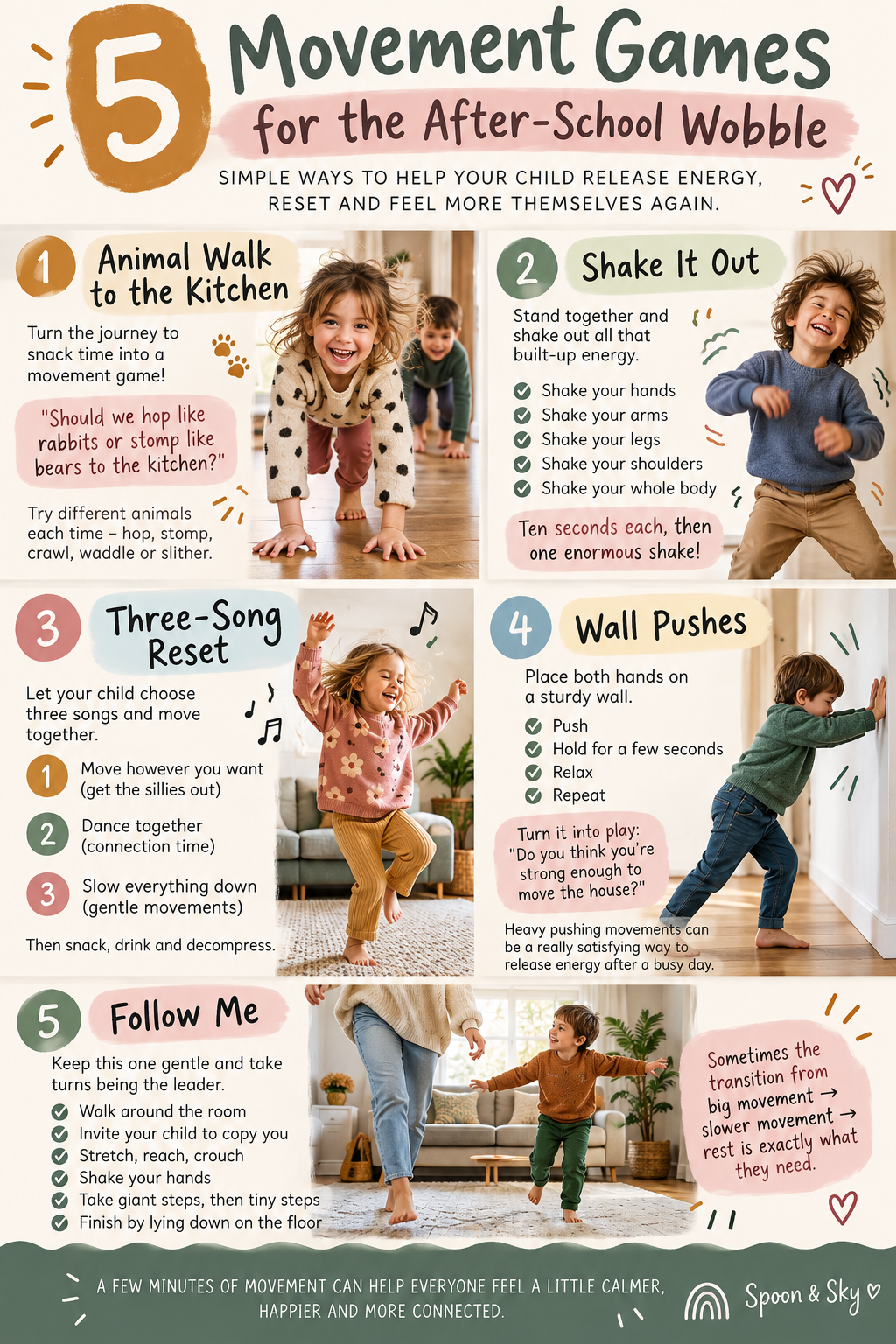
5 Movement Games for the After-School Wobble
There is one time of day when I particularly love having simple movement ideas available:
after school.
Children can spend an enormous amount of energy listening, sitting, concentrating, following instructions, navigating friendships and managing themselves throughout the school day.
Then they come home.
And sometimes...
Everything falls apart.
The shoes won't come off.
The wrong snack is apparently devastating.
A sibling breathes in the wrong direction.
Suddenly everyone is crying.
If your child sometimes struggles after school, they may not need another question or instruction straight away.
They might need food, connection, quiet, movement — or some combination of all four.
So rather than asking:
"What do you want to do?"
Try offering one very simple option.
1. Animal Walk to the Kitchen
Instead of:
"Come and get your snack."
Try:
"Should we hop like rabbits or stomp like bears to the kitchen?"
A tiny playful transition can sometimes shift the mood completely.
2. Shake It Out
Stand together and shake:
hands
arms
legs
shoulders
whole body.
Ten seconds each.
Finish with one enormous shake.
No winners.
No instructions to remember.
Just movement.
3. Three-Song Reset
Let your child choose three songs.
Song one: move however you want.
Song two: dance together.
Song three: slow everything down.
Then snack, drink and decompress.
4. Wall Pushes
Place both hands against a sturdy wall.
Push.
Hold.
Relax.
Repeat.
You can turn it into play:
"Do you think you're strong enough to move the house?"
Heavy pushing movements can be a satisfying physical outlet after a day when children have had to keep their bodies relatively controlled.
5. Follow Me
Keep this one gentle.
Walk around the room and invite your child to copy you.
Stretch.
Reach.
Crouch.
Shake your hands.
Take giant steps.
Take tiny steps.
Finish by lying down on the floor.
Sometimes the transition from big movement → slower movement → rest is exactly what they need.
You Don't Have to Entertain Them All Afternoon
This is perhaps the most important part.
These games aren't supposed to become another list of 25 things you should be doing with your children.
You don't need to organise an elaborate indoor obstacle course every time it rains.
You don't have to spend the entire afternoon entertaining them.
And you certainly don't have to work your way through all 25 activities.
Think of these as little reset buttons.
Five minutes of animal walks before independent play.
Ten minutes of dancing after school.
A scavenger race while dinner cooks.
A silly game of Don't Wake the Bear when everyone is beginning to get irritable.
Sometimes a small amount of intentional movement is enough to change the direction of the afternoon.
Then you can step back again.
Save This for the Next Rainy Day
The next time rain is tapping against the windows and the children are beginning to bounce off the furniture, don't feel like you need to invent an entire afternoon.
Choose one game.
Give it five minutes.
See where it goes.
Because play doesn't need to be complicated to count.
Sometimes it's cushions scattered across the floor.
Sometimes it's pretending to be squirrels.
Sometimes it's dancing badly in the kitchen while you're supposed to be making dinner.
And sometimes those tiny, ordinary moments are the ones that make home feel a little lighter.
Here's to rainy windows, silly games and giving all that little-person energy somewhere to go.
Lily x
Spoon & Sky — simple ideas for more creativity, connection and calm.