
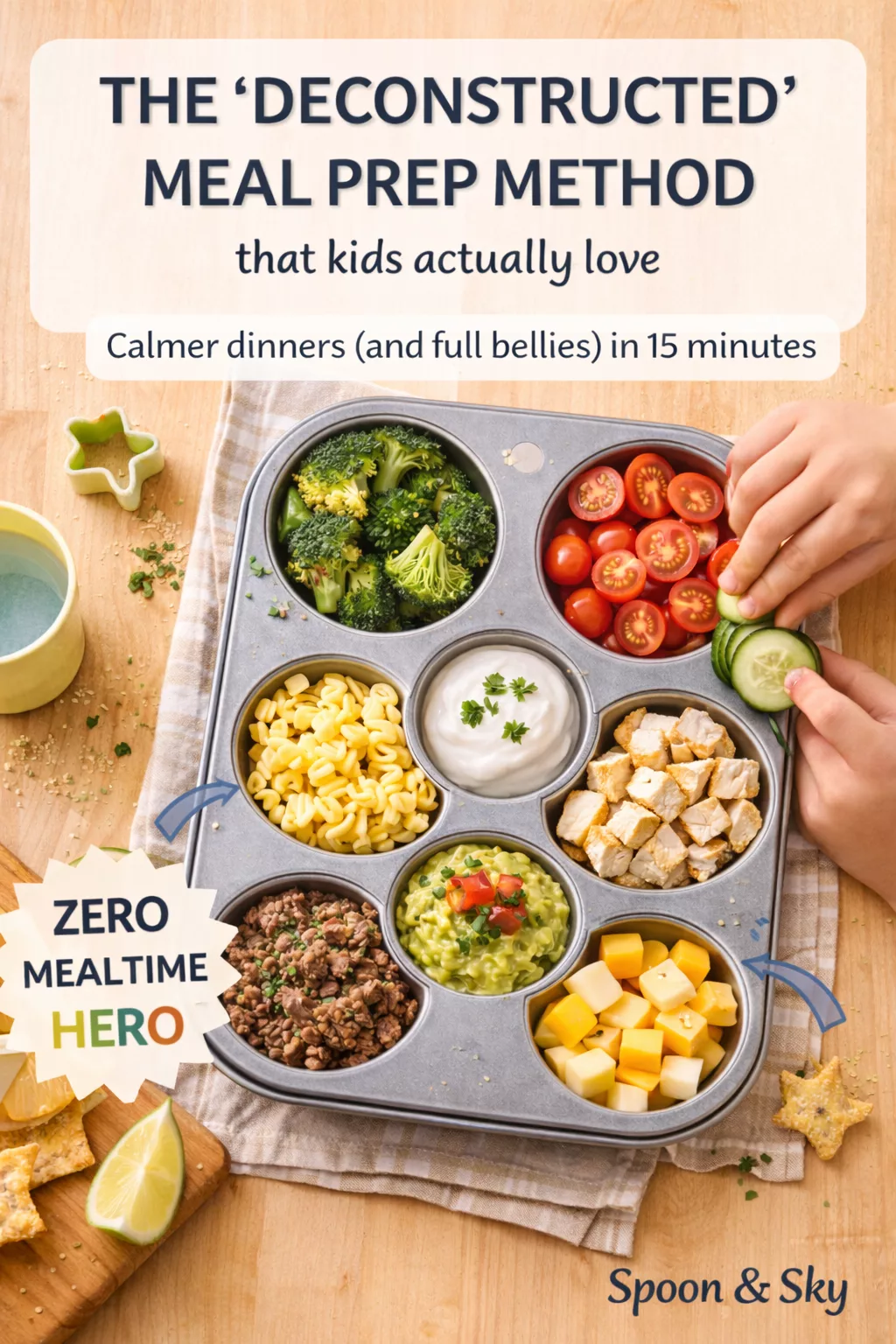
Stop the mealtime power struggle by letting them build it themselves
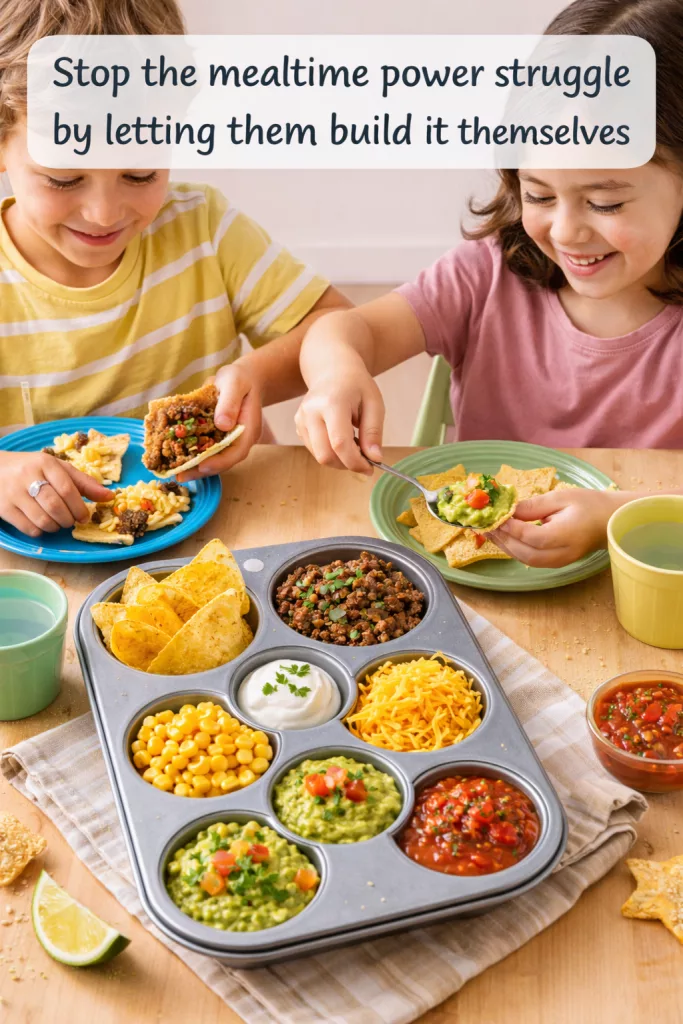
If dinner time in your home sometimes feels like a negotiation, you’re not alone. Many parents discover that children between ages three and eight suddenly become very particular about how their food is served. Mixed meals get pushed aside, sauces become suspicious, and familiar dishes are suddenly rejected. This is exactly where deconstructed meal prep can help. Instead of serving a fully assembled meal, you offer the ingredients separately and allow children to build their own plates. It’s a surprisingly simple shift that gives kids a sense of control while still allowing you to provide balanced, nourishing food.
Somewhere between the toddler years and early school age, a curious shift happens at the dinner table.
A meal your child happily ate last month suddenly becomes… suspicious.
Pasta with sauce?
Rejected.
Casserole?
Examined like evidence in a courtroom.
Anything mixed together?
Absolutely not.
Many parents of children ages 3–8 know this moment well. You prepare dinner with care, place the plate down hopefully, and within seconds your child begins carefully separating everything you combined.
The pasta is pushed to one side.
The vegetables are extracted like hidden treasure.
And heaven help the sauce that dared touch anything.
It can feel frustrating. Confusing even. Especially when the exact same meal was accepted happily just weeks before.
But this phase is actually very normal.
And once you understand why it happens, you can shift your approach in a way that makes dinner calmer, easier, and even a little bit fun again.
Today we’re going to explore a simple strategy many families quietly rely on:
The Deconstructed Meal Method.
Instead of serving a finished dish, you offer the components.
Instead of building the plate for your child, you let them build it themselves.
And surprisingly, that small shift can turn dinner from a negotiation into something that feels more like exploration.
The Battle of the Plate (And Why It Happens)
If you’ve ever watched a young child investigate a plate of mixed food, it’s almost scientific.
They poke.
They sniff.
They ask questions.
Sometimes they push things apart with intense concentration.
It’s not rebellion.
It’s curiosity mixed with a strong desire for predictability.
Between ages 3 and 8, children go through a stage where food suddenly becomes about control and understanding.
They want to see exactly what they are eating.
Mixed foods remove that clarity.
A casserole hides ingredients.
A pasta dish blends textures.
A stir-fry combines everything together.
To a developing brain, that lack of clarity can feel overwhelming.
Children often prefer foods that are:
• Visually simple
• Easy to identify
• Served separately
• Predictable in taste and texture
This is why many kids suddenly gravitate toward:
- Plain pasta
- Cut fruit
- Crackers
- Simple sandwiches
- Foods served side by side
And this is exactly where the deconstructed method shines.
The Deconstructed Method: A Simpler Way to Serve Dinner
The deconstructed method isn’t a complicated cooking technique.
In fact, it’s almost the opposite.
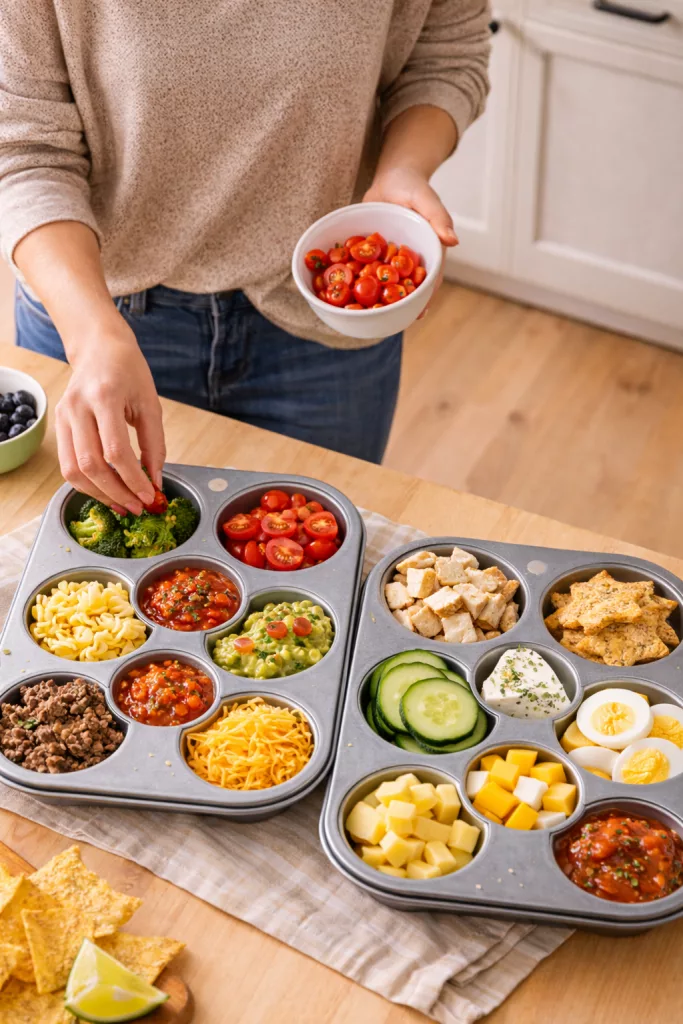
Instead of assembling the finished meal yourself, you simply provide the building blocks.
For example:
Instead of serving tacos fully assembled, you offer:
- Tortilla chips
- Ground beef or beans
- Cheese
- Corn
- Yogurt or guacamole
Your child chooses how to combine them.
Or if they prefer, they can simply enjoy each element separately.
The same idea works for:
- Pasta
- Sandwiches
- Rice bowls
- Snack plates
- Even breakfast
When children are given the freedom to construct their own bites, something interesting happens.
Resistance often fades.
Because the meal now belongs to them.
The Hero of the Week: The Muffin Tin Meal
If there were a single tool that perfectly supports this approach, it might be the humble muffin tin.
Yes — the same one used for baking muffins.
Used at the dinner table, a muffin tin becomes something entirely different.
It becomes a mini tasting tray.
A place where small portions of different foods can sit side by side, waiting to be explored.
For many children, this instantly changes the experience.
It’s not a plate anymore.
It feels like a sampler menu.
A little collection of choices.
And that novelty alone can make dinner feel less intimidating.
Why Muffin Tin Meals Work So Well
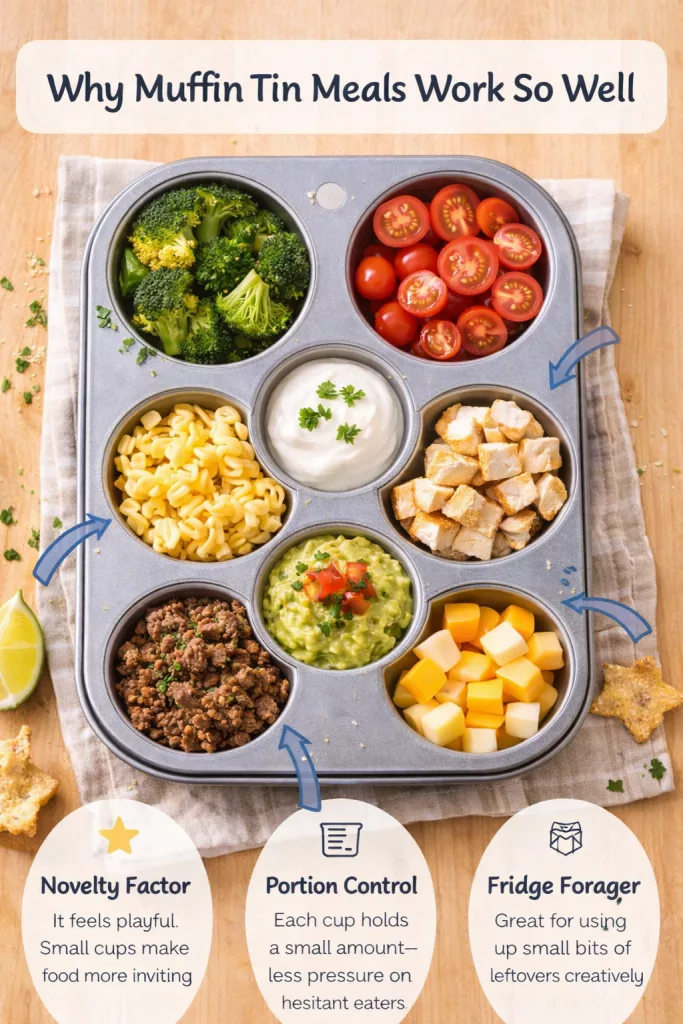
There are three reasons families love this method.
1. The novelty factor
A muffin tin makes food feel playful.
Each little cup becomes its own tiny world.
Children often become curious about what’s in each section and naturally begin tasting.
2. Built-in portion control
Each section holds a small amount of food, which keeps the plate from looking overwhelming.
For hesitant eaters, this matters a lot.
A mountain of food can feel intimidating.
Six small cups feel manageable.
3. The ultimate “fridge forager” tool
Parents often discover an unexpected bonus.
Muffin tins are fantastic for using up small leftovers.
Three grapes.
Two slices of deli turkey.
Half a carrot.
A little piece of cheese.
Suddenly these small odds and ends become a colorful little meal rather than random leftovers.
It’s practical and surprisingly satisfying.
The Rule of Six: How to Balance a Muffin Tin Meal
A standard muffin tin usually has six cups or twelve cups.
For younger children, six is often perfect.
Think of each cup as a tiny category.
A balanced muffin tin meal might include:
Protein (1–2 cups)
Examples:
- Hard-boiled egg slices
- Rolled turkey or ham
- Grilled chicken pieces
- Chickpeas
- Cheese cubes
- Black beans
Protein helps keep kids full longer and supports steady energy.
Crunch (1 cup)
Crunchy textures make meals more engaging.
Options include:
- Whole grain crackers
- Tortilla chips
- Toast triangles
- Rice cakes
- Bread stars (made with cookie cutters)
Crunch adds fun.
Fruit or Vegetables (2–3 cups)
Colorful produce is where the plate becomes exciting.
Ideas:
- Apple matchsticks
- Cucumber coins
- Cherry tomatoes
- Carrot sticks
- Strawberries
- Bell pepper strips
Small portions lower the pressure.
The Dip (1 cup)
Dips are magic with children.
They transform vegetables and crackers into something interactive.
Some favorites include:
- Hummus
- Greek yogurt
- Cream cheese
- Mild salsa
- Guacamole
- Ranch dressing
Even reluctant eaters often try foods when dipping is involved.
Three Deconstructed Meal Ideas Kids Love
Let’s look at three simple setups that work beautifully for both preschoolers and early primary school children.
These are quick, balanced, and easy to adapt.
1. The Build-Your-Own Bistro
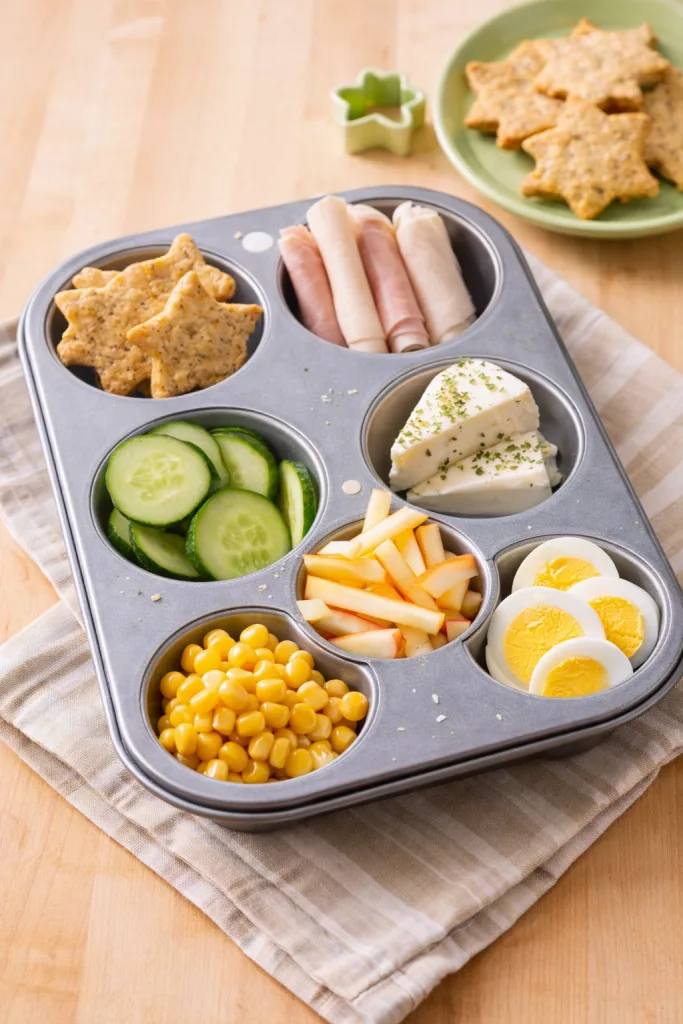
A playful alternative to the classic sandwich lunch.
Instead of assembling everything yourself, you give children the pieces.
They design their own bites.
Ingredients
- Whole grain crackers or bread cut into stars
- Sliced turkey or ham
- 1 hard-boiled egg, sliced
- 1 small apple cut into matchsticks
- ½ cucumber sliced into coins
- 2 tablespoons cream cheese or a soft cheese wedge
Instructions
- Place crackers or bread shapes into one muffin cup.
- Add rolled turkey or ham slices into another.
- Arrange egg slices in a third cup.
- Fill one section with apple matchsticks.
- Add cucumber coins to another section.
- Place cream cheese or cheese wedge in the final cup.
Encourage your child to stack and build their own mini sandwiches.
You might see combinations like:
Cracker + turkey + cucumber.
Or bread star + egg + cream cheese.
It becomes a little food experiment.
And that playful element often encourages more tasting.
2. The Deconstructed Taco Mountain
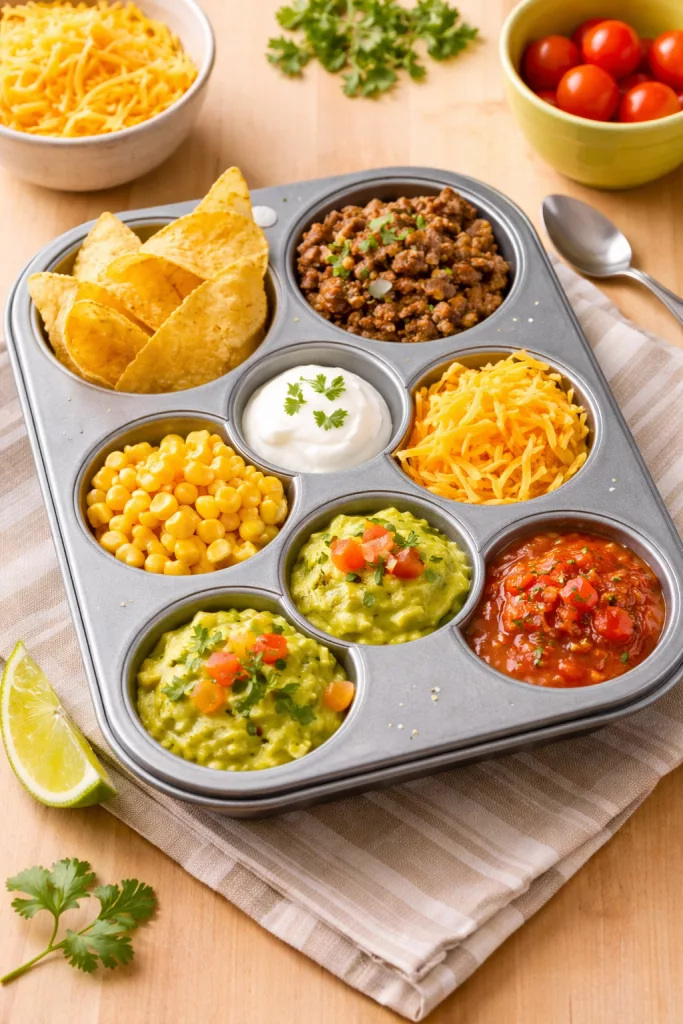
Tacos are delicious but notoriously messy for younger children.
Shells break.
Fillings fall out.
Everything ends up on the floor.
Serving the ingredients separately keeps the flavors while removing the frustration.
Ingredients
- ½ cup seasoned ground beef or black beans
- Handful of tortilla chips or broken taco shells
- ¼ cup corn kernels
- ¼ cup shredded cheese
- 2 tablespoons mild salsa
- 2 tablespoons Greek yogurt or mild guacamole
Instructions
- Place tortilla chips in one muffin cup.
- Add warm ground beef or black beans to another section.
- Fill one cup with shredded cheese.
- Add corn kernels to another.
- Spoon mild salsa into one cup.
- Add Greek yogurt or guacamole into the final section.
Children can scoop, stack, dip, and experiment.
Some bites might be:
Chip + beef + cheese.
Chip + corn + yogurt.
Or simply a chip dipped in salsa.
And yes — sometimes they just eat the cheese.
That’s okay too.
3. The Pasta Bar Tasting Plate
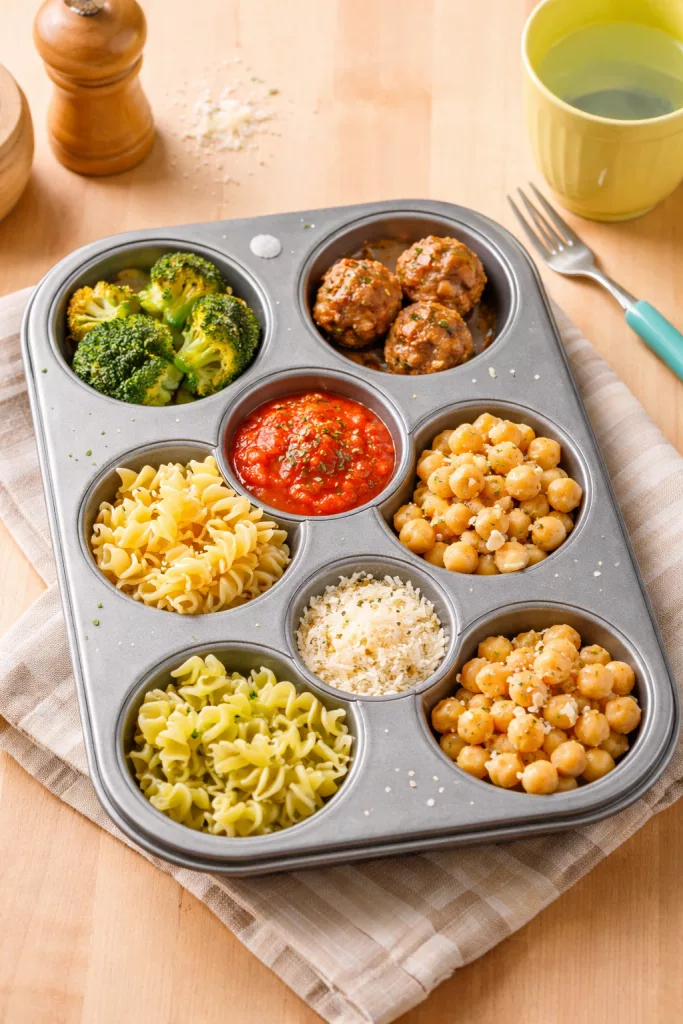
Pasta is one of the most loved meals for kids, but preferences can change daily.
One day they want sauce.
The next day they refuse it.
Serving pasta components separately keeps everyone happy.
Ingredients
- 1 cup cooked rotini or bowtie pasta
- ¼ cup marinara sauce
- ½ cup roasted broccoli florets
- 3–4 meatballs or ½ cup chickpeas
- 2 tablespoons grated Parmesan cheese
- 1 teaspoon olive oil
Instructions
- Toss cooked pasta with olive oil to prevent sticking.
- Place pasta into one muffin cup.
- Add marinara sauce to another cup for dipping.
- Fill one section with roasted broccoli “trees.”
- Add meatballs or chickpeas to another section.
- Place Parmesan cheese in the final cup for sprinkling.
Children can dip noodles into sauce, sprinkle cheese themselves, or keep everything separate.
That little sense of choice often makes dinner smoother.
Pro Tips for Deconstructed Meal Success
Over time, many families discover a few simple habits that make this method even more effective.
The “One New Food” Rule
Trying a completely new vegetable can feel intimidating.
Instead of presenting several unfamiliar foods at once, include just one new item in the muffin tin.
The other cups contain foods your child already enjoys.
This lowers the pressure dramatically.
Children are far more likely to try something new when surrounded by familiar favorites.
Color Coding for Ownership
If you have more than one child, small visual differences can help avoid confusion.
You might use:
- Silicone muffin liners in different colors
- Small stickers
- Different colored trays
Letting each child choose their color gives them a sense of ownership over the meal.
It’s a tiny detail that can make dinner feel more personal.
Let Go of the “Clean Plate” Myth
Many of us grew up hearing that a clean plate was the goal.
But research now shows that forcing children to finish meals can interfere with their ability to recognize hunger and fullness cues.
With muffin tin meals, a child might eat:
4 out of 6 sections.
Maybe 3.
Maybe all of them.
The goal is not perfection.
The goal is exposure and curiosity.
Seeing a food repeatedly — even if it’s not eaten every time — helps build familiarity.
And familiarity eventually leads to acceptance.
A Gentle Reminder for Parents

Feeding children can feel surprisingly emotional.
You want them to grow well.
You want them to enjoy healthy food.
You want dinner to feel peaceful rather than stressful.
But childhood eating patterns are rarely linear.
Preferences change.
Appetites fluctuate.
And phases come and go.
The deconstructed meal method doesn’t promise perfection.
What it offers is something much more valuable:
A calmer table.
More curiosity.
Less pressure.
And sometimes, a moment where a child quietly tries something new when no one is watching.
Those small moments are where the magic happens. If you want your kids to get more hands on during meal times check out this blog post.
The Bigger Picture
Food is not just fuel.
It’s connection.
It’s conversation.
It’s the quiet ritual of gathering at the end of the day.
And when we make mealtimes feel safe and flexible, children learn something deeper than just how to eat vegetables.
They learn that the table is a place where they belong.
Where their preferences are respected.
Where exploration is welcome.
And that kind of atmosphere stays with them far longer than any single recipe.
If tonight’s dinner feels complicated, try this instead.
Six small cups.
A handful of simple foods.
And the freedom to build the meal one bite at a time.
You might be surprised what happens.
With a full tin and a little curiosity,
Lily Luz
Spoon & Sky 🌿


✨ Get Your Free Printable ✨
Looking for a simple way to bring a little more calm, structure, or creativity into your day?
Enter your email below and get instant access to your free printable from Spoon & Sky — made to spark joy, imagination, and gentle rhythms at home. 🌿
We’ll send your printable and a few kind, helpful ideas to your inbox. No spam — just calm, creative family tools.
Leave a Reply