
Surviving Christmas Gatherings with Kids: A Parent's Guide


A gentle, practical guide to making family celebrations feel a little calmer, more connected and enjoyable for everyone.
The Christmas decorations are up.
The presents are wrapped.
The family is gathering, the food smells wonderful, and you're looking forward to a lovely afternoon together.
Then, approximately twelve minutes after arriving...
One child refuses to say hello.
Another is upset because their cousin touched their toy.
Someone has spilled a drink.
And a well-meaning relative has just asked why your child won't give them a hug.
Welcome to Christmas with young children!
Family gatherings can be wonderful. They're filled with traditions, excitement, familiar faces and little moments that turn into lovely memories.
But they can also be a lot for children to manage.
Different surroundings, unfamiliar routines, lots of people, noise, excitement, expectations...
And sometimes, a very long day.
If you're heading into the festive season wondering how to keep everyone happy, here's something worth remembering:
Your children don't need to behave perfectly for your family to have a wonderful Christmas.
A little preparation, realistic expectations and some gentle boundaries can make celebrations feel much easier.
Let's explore how.
1. Prepare Your Child Before the Big Day
Imagine someone taking you to an unfamiliar house, filled with people you haven't seen for months, and expecting you to know exactly what to do.
You don't know how long you're staying.
You don't know when you'll eat.
And everyone keeps asking you questions.
It might feel a little overwhelming.
For young children, knowing what to expect can make new or busy situations feel much more manageable.
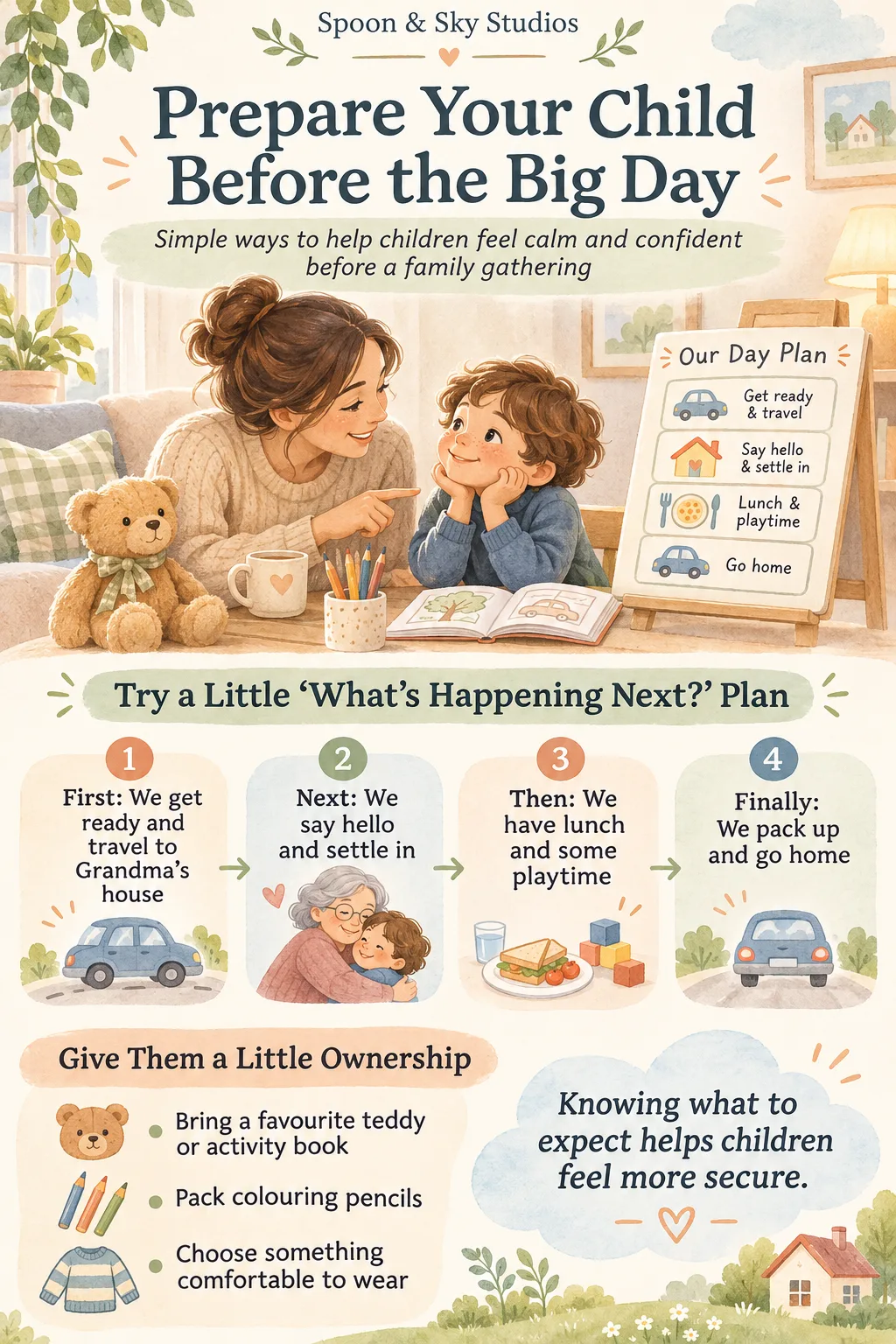
A day or two before the gathering, talk through the plan together.
Keep it simple.
"We're going to Grandma's house on Sunday."
"Your cousins will be there."
"We'll have lunch, play some games and come home after the afternoon."
For younger children, a few pictures can help.
You might show them a photograph of the house, remind them who will be there or draw a simple sequence of the day's activities.
Try a Little 'What's Happening Next?' Plan
Create four simple steps:
First: We get ready and travel to Grandma's house.
Next: We say hello and settle in.
Then: We have lunch and some playtime.
Finally: We pack up and go home.
For some children, this will be enough.
Others may benefit from a more detailed visual schedule, especially if changes in routine make them anxious.
Don't promise an exact departure time unless you're able to keep it.
Instead, explain the plan in a way your child can understand, and let them know if it changes.
Give Them a Little Ownership
Ask your child:
"Would you like to bring your favourite teddy or a little activity book?"
"Shall we take your colouring pencils?"
"Would you like to choose something comfortable to wear?"
Small choices can help children feel more involved in a day that might otherwise feel full of decisions made by adults.
2. Protect the Basics: Food, Sleep and Little Breaks
It's easy to forget just how much excitement Christmas can bring.
And sometimes, the very things children enjoy most can leave them feeling completely exhausted.
There's so much to see.
So much to do.
So many people wanting their attention.
Add a late lunch, a missed nap or a long journey, and even a usually easygoing child might struggle.
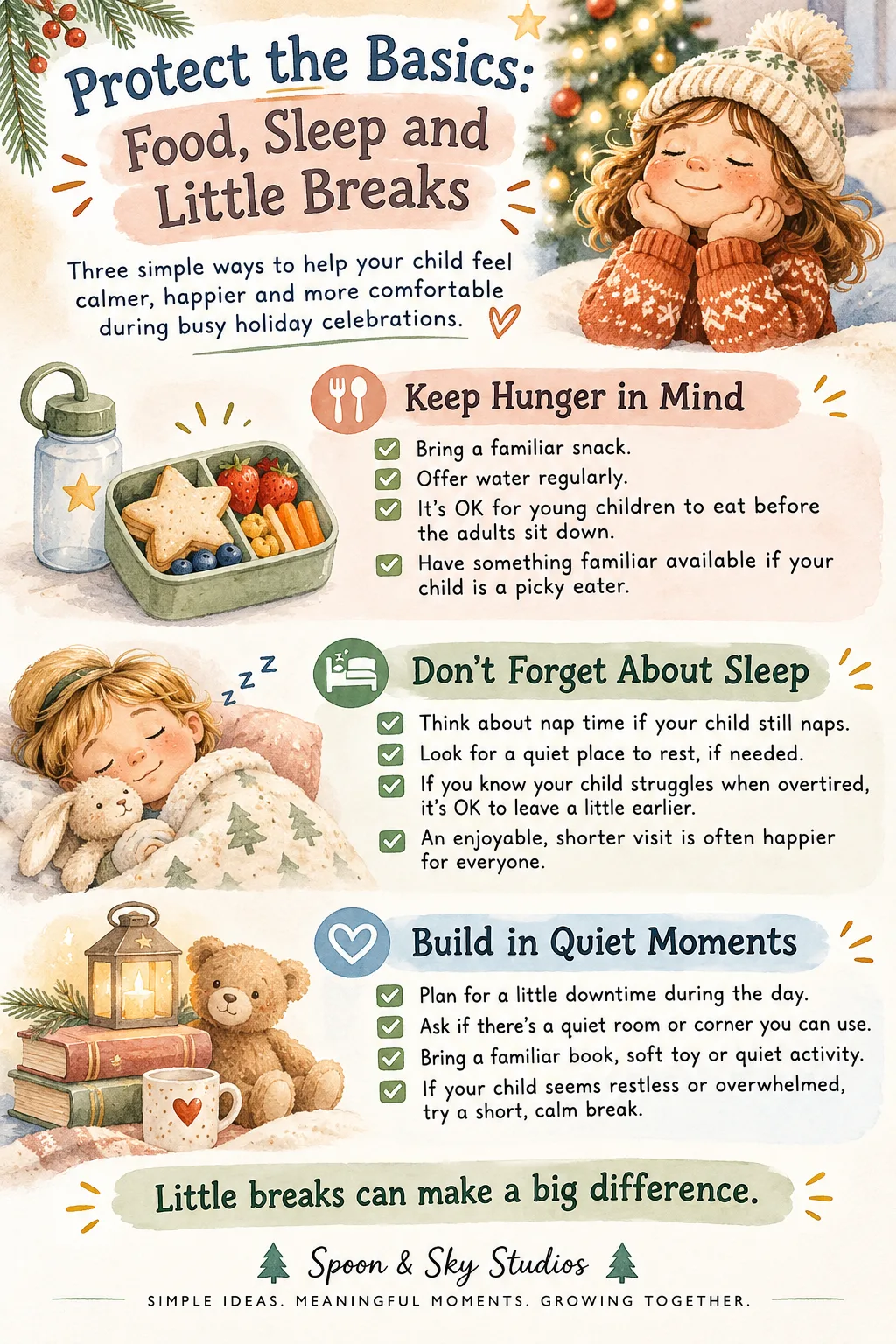
Before the festivities begin, think about three essentials.
Keep Hunger in Mind
If the main meal is happening later than your child normally eats, don't expect them to wait happily for hours.
Bring a familiar snack.
Offer water regularly.
And remember that it's perfectly fine for young children to eat something before the adults sit down.
Christmas lunch doesn't have to be a test of patience.
If your child is a picky eater, having something familiar available can be particularly reassuring.
Don't Forget About Sleep
Some children manage a late night surprisingly well.
Others find even a small disruption difficult.
If your younger child still naps, think about whether there's a suitable quiet place to rest.
If you know your child becomes very overwhelmed when they're overtired, you may decide to leave a little earlier.
A lovely afternoon that finishes before everyone is exhausted can be much more enjoyable than a long celebration that ends in tears.
Build in Quiet Moments
Sometimes children need a break from the excitement.
Not because they're being antisocial.
Simply because they've had enough stimulation for a little while.
Ask your host whether there's a quiet room or corner you can use if needed.
Bring a familiar book, soft toy or quiet activity.
And if you notice your child becoming restless, tearful or unusually irritable, consider a break before everything becomes too much.
You might say:
"There's lots happening today. Shall we find somewhere quiet for a few minutes?"
You don't need to wait until there's a full meltdown.
Little breaks can make a big difference.
3. "You Don't Have to Hug": Teaching Children About Personal Boundaries
This is one of the most important conversations we can have with our children, especially during family celebrations.
You arrive at a relative's house.
Someone opens their arms and says:
"Come on, give me a big Christmas cuddle!"
But your child hides behind your legs.
Or shakes their head.
Or simply says, "No."
Now what?
For many parents, the immediate reaction is to encourage the hug.
"Go on, it's only Grandma!"
"Don't be rude."
"Give Auntie a kiss."
Usually, we just want our children to be polite and avoid hurting anyone's feelings.
But there's an important lesson hidden in these little moments.
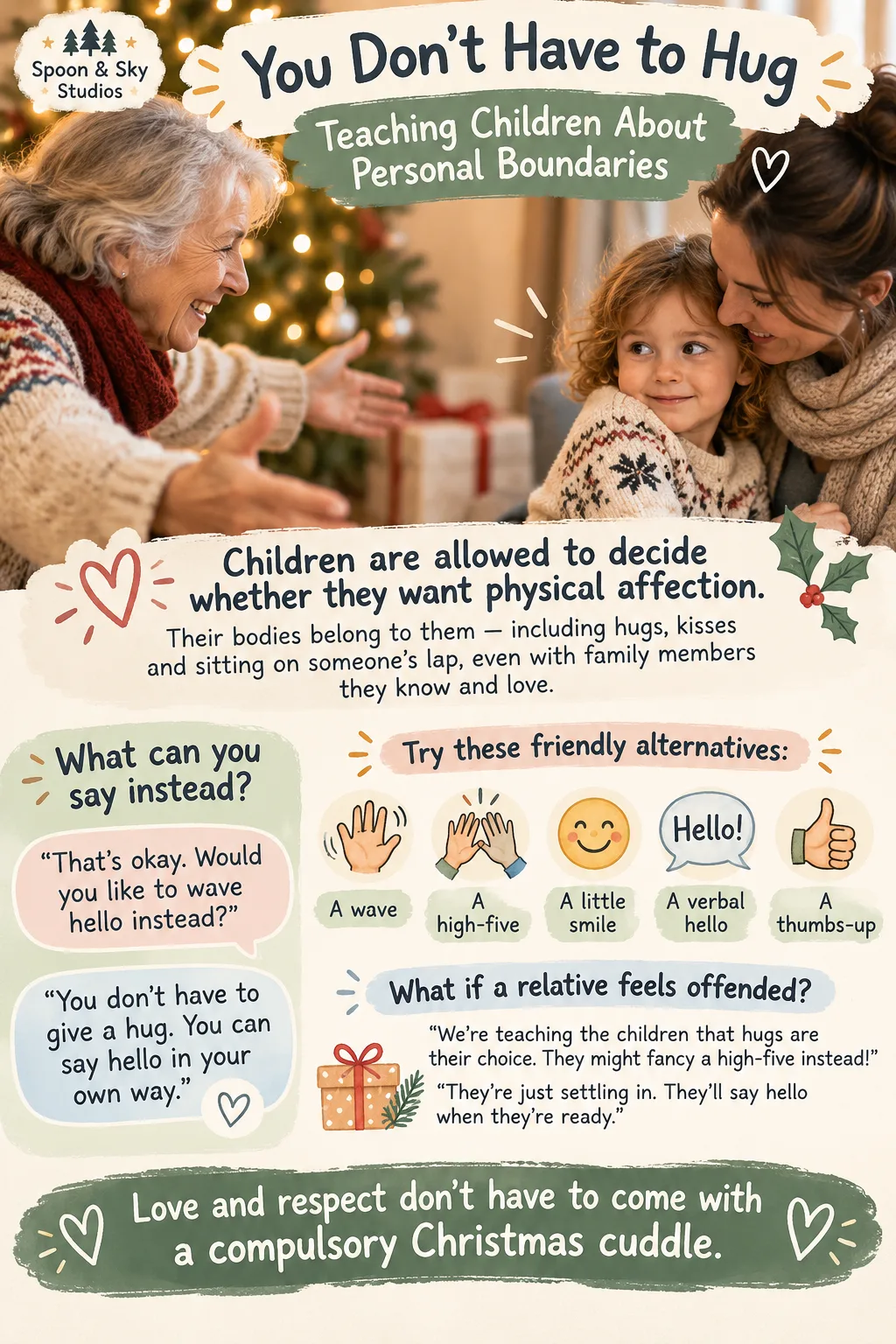
Children are allowed to decide whether they want physical affection.
Their bodies belong to them.
That includes hugs, kisses and sitting on someone's lap.
And it includes family members they know and love.
What Can You Say Instead?
If your child doesn't want a hug, try:
"That's okay. Would you like to wave hello instead?"
Or:
"You don't have to give a hug. You can say hello in your own way."
Offer a few alternatives:
-
A wave.
-
A high-five.
-
A little smile.
-
A verbal hello.
-
A thumbs-up.
And if your child doesn't feel ready for any of those things?
Give them a little time to settle.
You can model a friendly greeting without forcing them to participate.
What If a Relative Feels Offended?
You can respond warmly but clearly.
"We're teaching the children that hugs are their choice. They might fancy a high-five instead!"
Or:
"They're just settling in. They'll say hello when they're ready."
You don't need to apologise for respecting your child's boundaries.
And the same principle works both ways.
We can teach children to ask before hugging someone else and to respect the answer.
The goal isn't to discourage affection.
It's to help children understand that affection should be welcome and freely given.
Love and respect don't have to come with a compulsory Christmas cuddle.
4. Christmas Manners: What's Realistic for Ages 3–8?
Of course, we want our children to be thoughtful guests.
We'd love them to say please and thank you, share their toys, sit nicely at the table and remember to thank Grandma for their presents.
But expectations need to match children's age, abilities and individual needs.
A three-year-old and an eight-year-old are learning very different social skills.
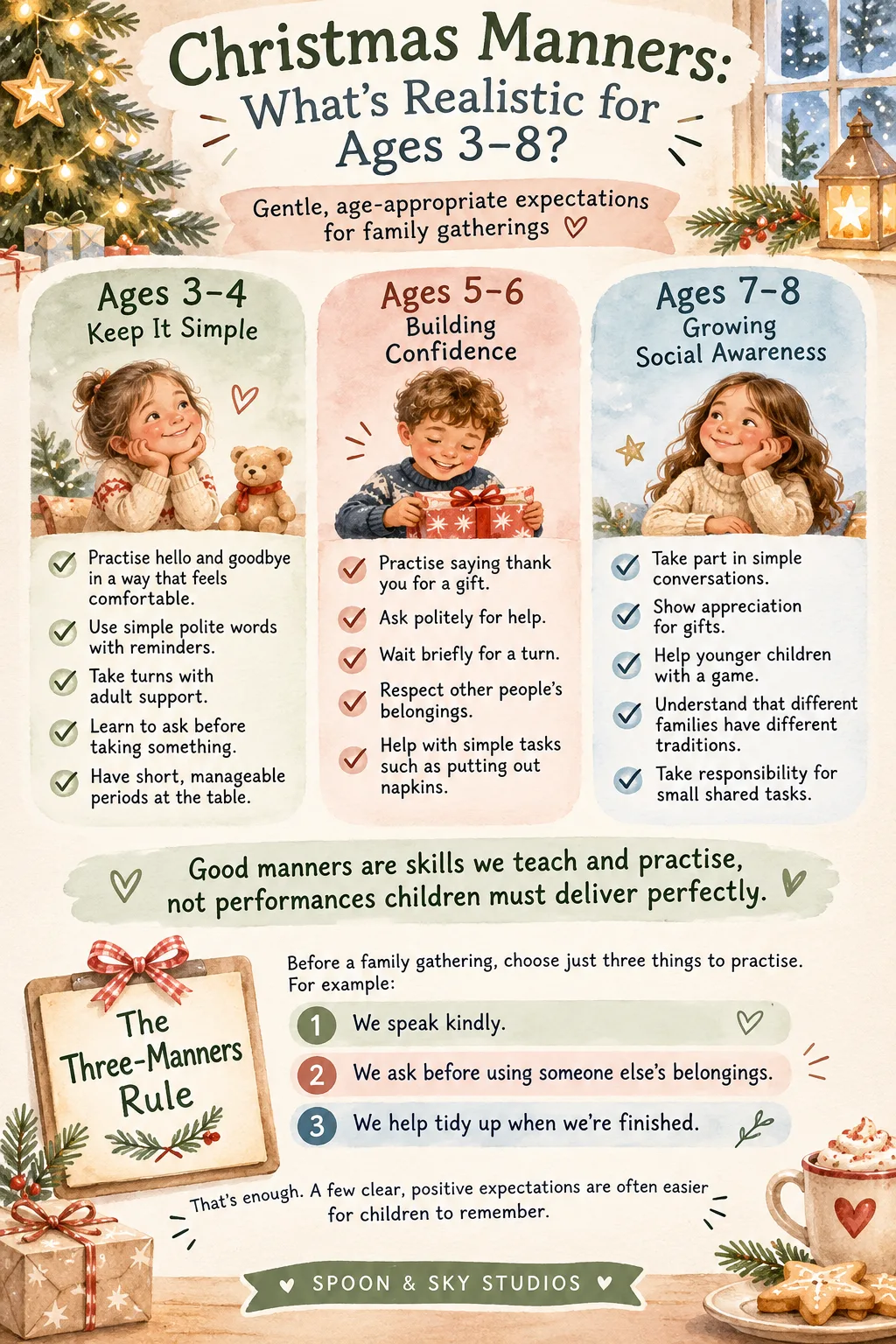
Ages 3–4: Keep It Simple
Focus on a few gentle expectations:
-
Practising hello and goodbye in a way that feels comfortable.
-
Using simple polite words with reminders.
-
Taking turns with adult support.
-
Learning to ask before taking something.
-
Having short, manageable periods at the table.
At this age, children often need help remembering what to do.
Model the behaviour rather than expecting them to manage everything independently.
Ages 5–6: Building Confidence
Children may be ready to:
-
Practise saying thank you for a gift.
-
Ask politely for help.
-
Wait briefly for a turn.
-
Respect other people's belongings.
-
Help with simple tasks such as putting out napkins.
They'll still need reminders, particularly when excited or tired.
Ages 7–8: Growing Social Awareness
Older children may be able to:
-
Take part in simple conversations.
-
Show appreciation for gifts.
-
Help younger children with a game.
-
Understand that different families have different traditions.
-
Take responsibility for small shared tasks.
But remember, age isn't the whole story.
Some children are shy.
Some find social situations overwhelming.
Others have communication differences or need extra support.
Good manners are skills we teach and practise, not performances children must deliver perfectly.
The Three-Manners Rule
Before a family gathering, choose just three things to practise.
For example:
1.
We speak kindly.
2.
We ask before using someone else's belongings.
3.
We help tidy up when we're finished.
That's enough.
We don't need a long lecture about how to behave.
A few clear, positive expectations are often easier for children to remember.
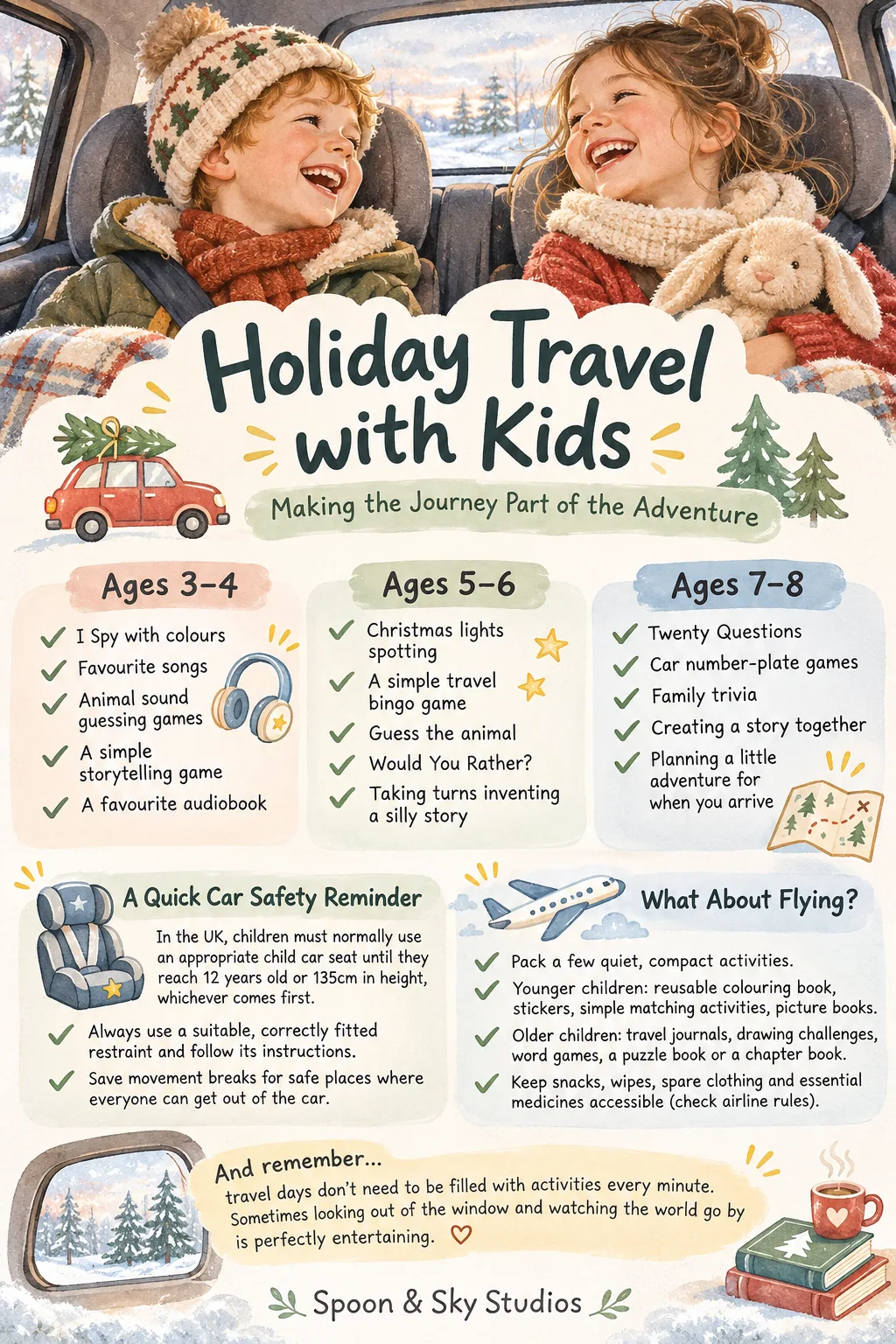
5. Holiday Travel with Kids: Making the Journey Part of the Adventure
For some families, the biggest challenge happens before they even reach the gathering.
Long car journeys.
Busy airports.
Delayed trains.
And the inevitable question:
"Are we nearly there yet?"
A little preparation can make travelling with children much more manageable.
Car Journey Ideas for Ages 3–4
Keep activities simple and easy to enjoy from their seats.
Try:
-
I Spy with colours.
-
Listening to favourite songs.
-
Animal sound guessing games.
-
A simple storytelling game.
-
A favourite audiobook.
You might say:
"Can you spot something red?"
Or:
"Let's see if we can find three Christmas trees!"
For children who experience travel sickness, looking out of the window and listening to stories may be more comfortable than looking down at books or activities.
Car Journey Ideas for Ages 5–6
Try:
-
Christmas lights spotting.
-
A simple travel bingo game.
-
Guess the animal.
-
Would You Rather?
-
Taking turns inventing a silly story.
You could begin:
"Once upon a time, a little robin found a magical mitten..."
Then let everyone add a sentence.
Car Journey Ideas for Ages 7–8
Older children might enjoy:
-
Twenty Questions.
-
Car number-plate games.
-
Family trivia.
-
Creating a story together.
-
Planning a little adventure for when you arrive.
If your child enjoys listening to stories, an audiobook can be a lovely option for the whole family.
A Quick Car Safety Reminder
In the UK, children must normally use an appropriate child car seat until they reach 12 years old or 135cm in height, whichever comes first.
Always use a suitable, correctly fitted restraint and follow its instructions.
Save movement breaks for safe places where everyone can get out of the car.
What About Flying?
If you're travelling by plane, pack a small collection of activities that don't require lots of equipment.
For younger children, consider:
-
A reusable colouring book.
-
Large, easy-to-handle stickers in an activity book.
-
Simple matching activities.
-
Favourite picture books.
For older children, try:
-
Travel journals.
-
Drawing challenges.
-
Word games.
-
A puzzle book.
-
A chapter book.
Keep snacks, wipes, spare clothing and essential medicines accessible, subject to airline and security requirements.
Choose activities that are quiet, compact and appropriate for your child's age. Check the airline's rules for child restraints and luggage before travelling.
And remember, travel days don't need to be filled with activities every minute.
Sometimes looking out of the window and watching the world go by is perfectly entertaining.
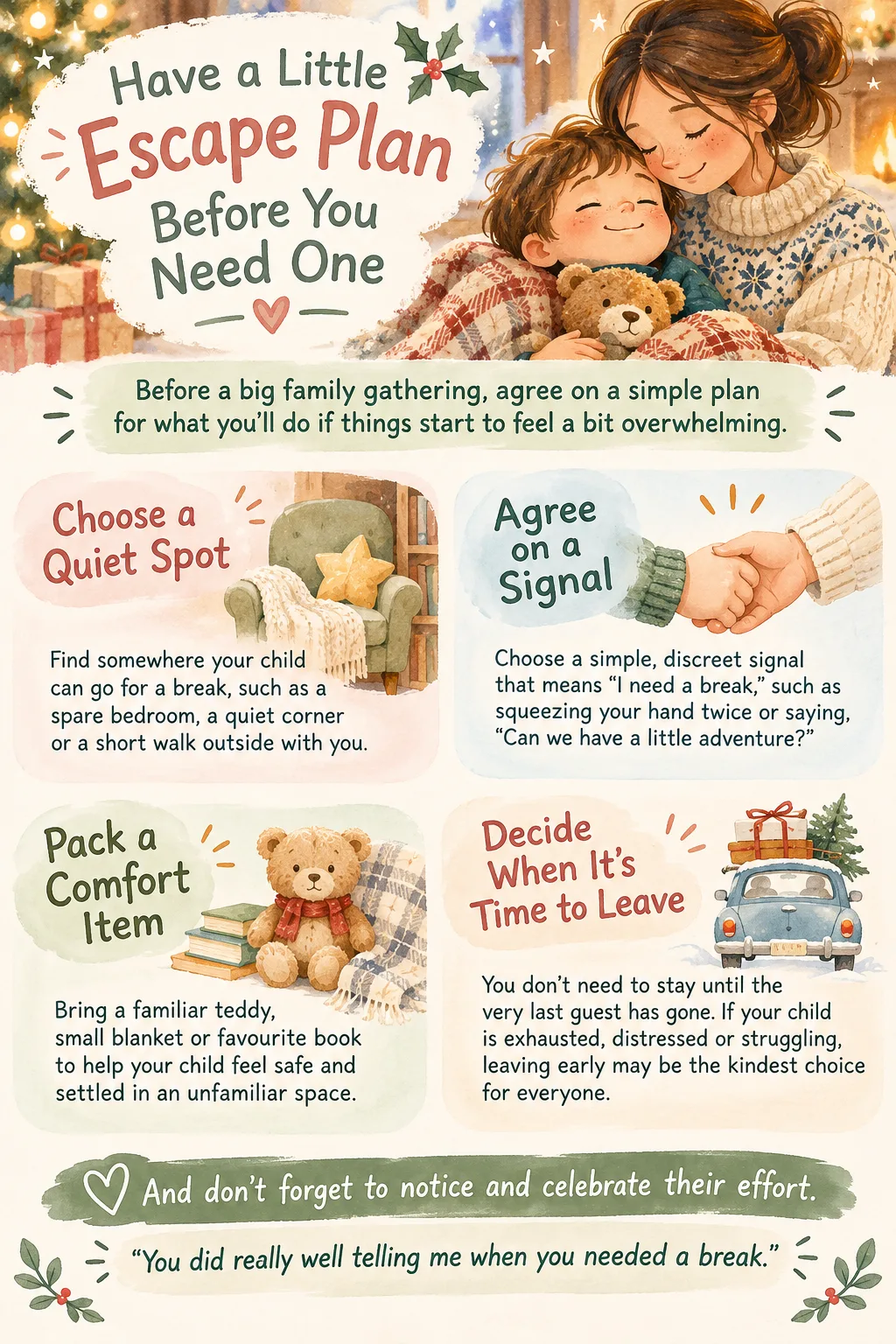
6. Have a Little Escape Plan Before You Need One
Here's something worth doing before any big gathering:
Agree on what you'll do if things become overwhelming.
Not a dramatic escape.
Just a simple plan.
Choose a Quiet Spot
If possible, find somewhere your child can go for a break.
This might be a spare bedroom, a quiet corner or a short walk outside with you.
Agree on a Signal
Older children might enjoy having a little secret signal that means:
"I need a break."
Perhaps they squeeze your hand twice.
Or say:
"Can we have a little adventure?"
Younger children may not remember a signal, so watch for signs that they're becoming tired or overwhelmed.
Pack a Comfort Item
A familiar teddy, small blanket or favourite book can help make an unfamiliar space feel more comfortable.
Decide When It's Time to Leave
You don't need to stay until the very last guest has gone home.
If your child is exhausted, distressed or struggling, leaving early may be the kindest decision for everyone.
You can simply say:
"We've had such a lovely time. We're going to get the little ones home for some rest."
No elaborate explanation needed.
And if your child has been trying especially hard to manage a busy situation, it's okay to recognise that effort.
"You did really well telling me when you needed a break."
That's a useful skill worth encouraging.
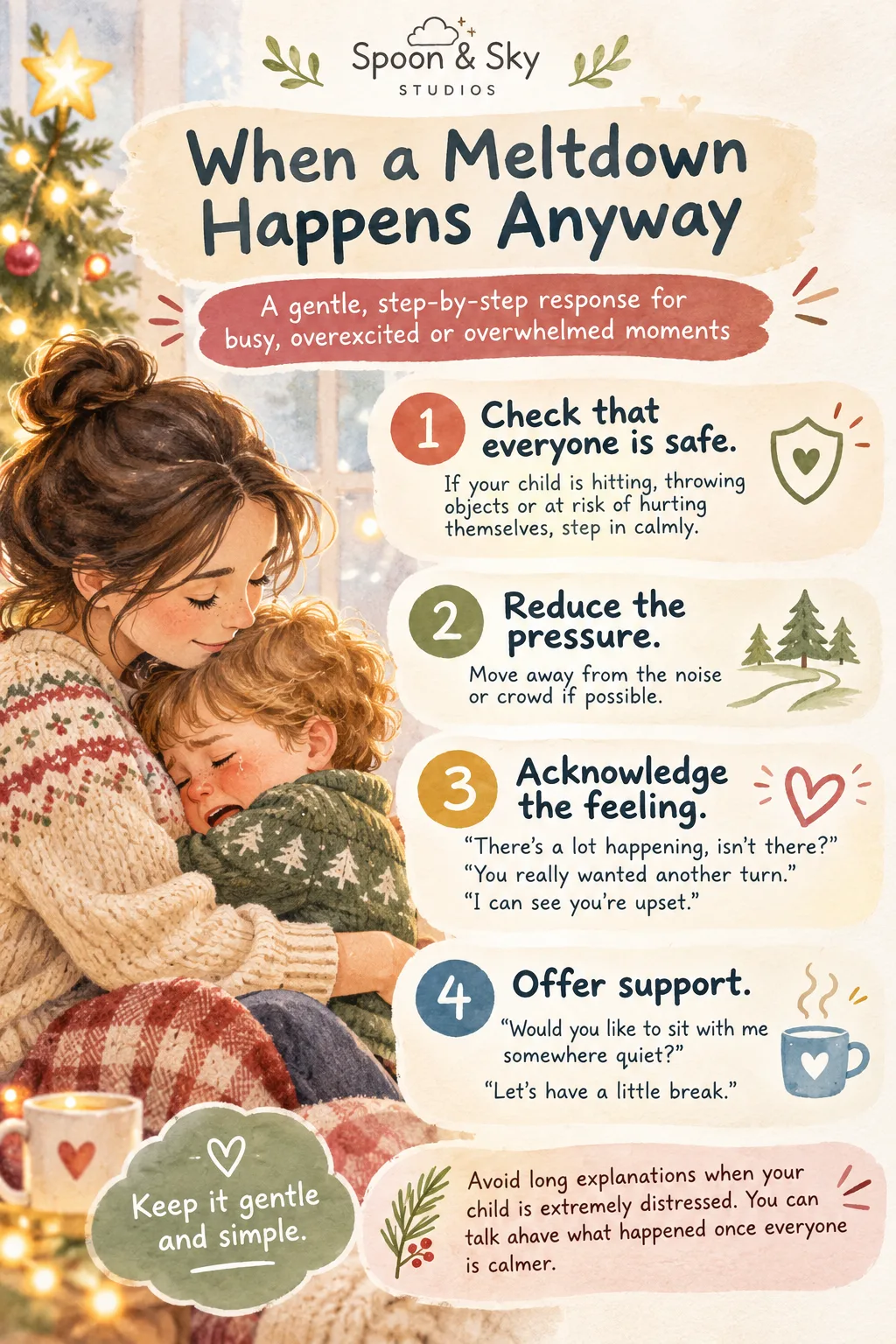
7. What to Do When a Meltdown Happens Anyway
Even with the best preparation, difficult moments will happen.
Perhaps your child becomes upset when it's time to share a toy.
Maybe the music is too loud.
Or perhaps they've simply had enough.
Try to keep your response gentle and simple.
First, check that everyone is safe.
If your child is hitting, throwing objects or at risk of hurting themselves, step in calmly.
Next, reduce the pressure.
Move away from the noise or crowd if possible.
Then, acknowledge the feeling.
"There's a lot happening, isn't there?"
"You really wanted another turn."
"I can see you're upset."
Finally, offer support.
"Would you like to sit with me somewhere quiet?"
"Let's have a little break."
Avoid long explanations when your child is extremely distressed.
You can talk about what happened once everyone is calmer.
And if someone comments on the meltdown?
You don't need to justify your parenting while you're helping your child.
A simple:
"They're having a difficult moment. We're going to take a little break."
Is more than enough.
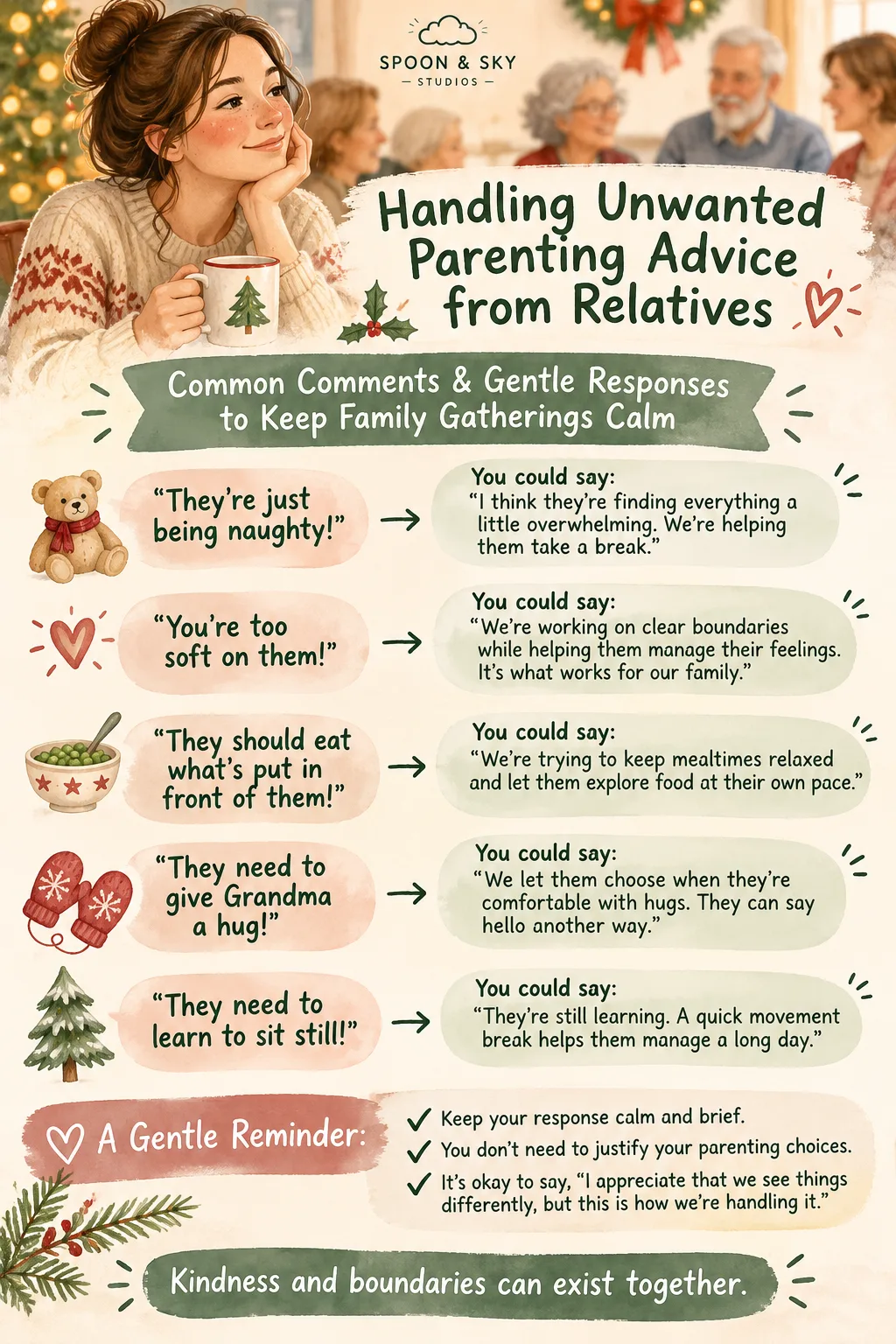
8. Handling Unwanted Parenting Advice from Relatives
Family gatherings have a wonderful way of bringing different generations, traditions and parenting opinions together.
Sometimes those differences are interesting.
Sometimes they're exhausting.
Perhaps someone comments on your child's eating.
Or suggests that they should be more affectionate.
Or questions why you're allowing them to take a quiet break.
It's helpful to have a few simple responses ready.
"They're Just Being Naughty!"
You could say:
"I think they're finding everything a little overwhelming. We're helping them take a break."
"You're Too Soft on Them!"
You could say:
"We're working on clear boundaries while helping them manage their feelings. It's what works for our family."
"They Should Eat What's Put in Front of Them!"
You could say:
"We're trying to keep mealtimes relaxed and let them explore food at their own pace."
"They Need to Give Grandma a Hug!"
You could say:
"We let them choose when they're comfortable with hugs. They can say hello another way."
"They Need to Learn to Sit Still!"
You could say:
"They're still learning. A quick movement break helps them manage a long day."
The key is to keep your response calm and brief.
You don't need to convince everyone that your approach is the right one.
And you don't need to enter a parenting debate in the middle of Christmas lunch.
If someone continues to push, it's okay to say:
"I appreciate that we see things differently, but this is how we're handling it."
Then move on.
If someone repeatedly ignores your child's physical boundaries or makes them feel unsafe, take their concerns seriously and prioritise their safety rather than trying to keep the peace.
Kindness and boundaries can exist together.
9. Don't Forget to Enjoy the Day Yourself
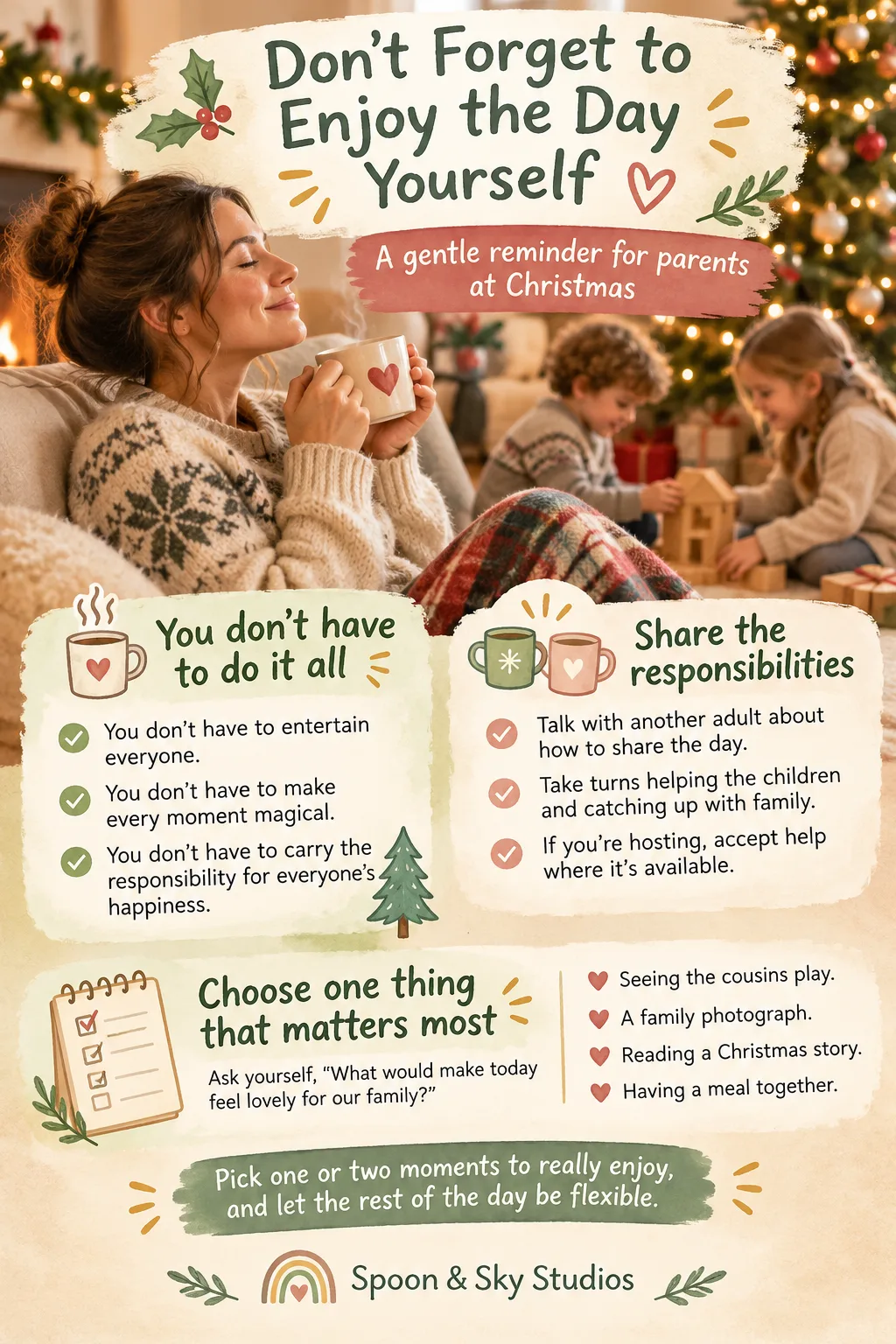
Here's something that often gets lost in the middle of preparing Christmas for children.
Parents deserve to enjoy the celebrations too.
You don't have to spend the entire day entertaining everyone.
You don't have to make every moment magical.
And you certainly don't need to carry the responsibility for everyone's happiness by yourself.
Sometimes it's enough to simply sit together.
Watch the children play.
Enjoy a cup of tea while it's still warm.
Have a conversation with someone you love.
Or step outside for a little fresh air.
Share the Responsibilities
If you're attending with another adult, talk about how you can share the day.
Perhaps one person helps the children settle while the other catches up with family.
Then swap.
If you're hosting, accept help where it's available.
Children don't need a perfectly organised celebration.
They benefit from adults who have enough time and energy to enjoy being with them.
Choose One Thing That Matters Most
Instead of trying to do everything, ask yourself:
"What would make today feel lovely for our family?"
Maybe it's seeing the cousins playing together.
Perhaps it's a family photograph.
Maybe it's reading a Christmas story before bed.
Or simply having everyone together for a meal.
Choose one or two moments you'd really like to enjoy.
Let the rest of the day be flexible.
10. Make Room for Little Moments of Connection
Sometimes the nicest parts of a family gathering are the simplest.
A grandparent reading a story with a child.
Cousins building something together on the living room floor.
Everyone laughing over a silly game.
A little walk after lunch.
Or children helping carry napkins to the table.
These moments don't need elaborate preparation.
They just need a little space to happen.
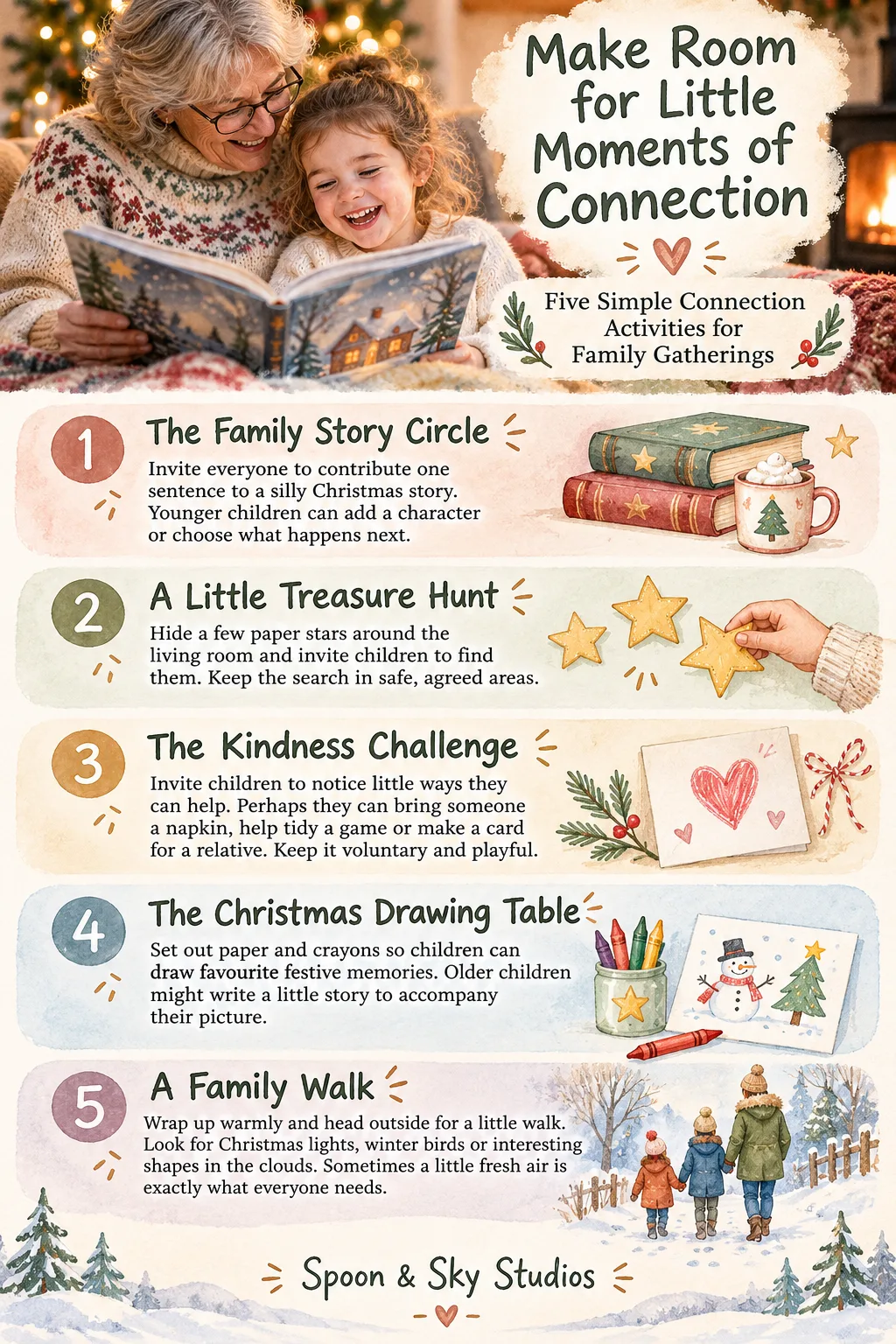
Five Simple Connection Activities for Family Gatherings
1. The Family Story Circle
Invite everyone to contribute one sentence to a silly Christmas story.
Younger children can add a character or choose what happens next.
2. A Little Treasure Hunt
Hide a few paper stars around the living room and invite children to find them.
Keep the search in safe, agreed areas.
3. The Kindness Challenge
Invite children to notice little ways they can help.
Perhaps they can bring someone a napkin, help tidy a game or make a card for a relative.
Keep it voluntary and playful.
4. The Christmas Drawing Table
Set out paper and crayons so children can draw favourite festive memories.
Older children might write a little story to accompany their picture.
5. A Family Walk
Wrap up warmly and head outside for a little walk.
Look for Christmas lights, winter birds or interesting shapes in the clouds.
Sometimes a little fresh air is exactly what everyone needs.
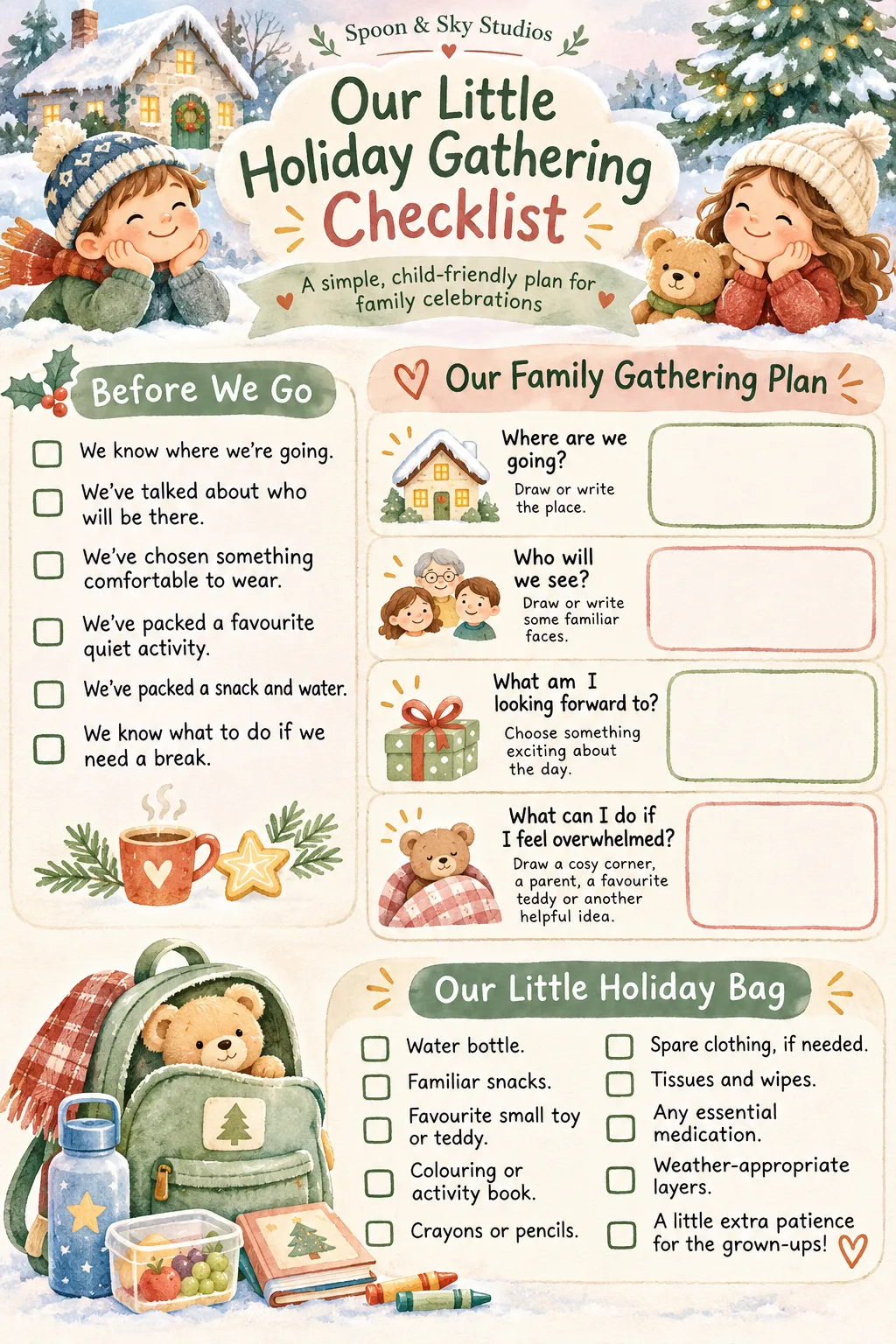
Free Printable: Our Little Holiday Gathering Checklist
A Little Reminder: Christmas Doesn't Have to Be Perfect
There may be tears.
Someone might refuse to wear their Christmas jumper.
A child might eat only the roast potatoes.
Someone may need a break from the noise.
And you might leave a gathering earlier than planned.
None of these things means your Christmas has been unsuccessful.
At Spoon & Sky Studios, we believe the moments that matter most aren't necessarily the perfectly planned ones.
They're the moments when children feel included.
When someone listens.
When a family laughs together.
When a little one feels safe enough to say, "I need a break."
And when parents give themselves permission to enjoy the day without trying to control every detail.
So this festive season, try making room for a little more flexibility.
A little more understanding.
And a little less pressure.
Because the magic of Christmas isn't found in perfect behaviour. It's found in feeling connected, safe and loved.
With love,
Spoon & Sky Studios
Simple ideas. Meaningful moments. Growing together.
This article provides general parenting information. Every child has different needs, and approaches should be adapted to their development, abilities and circumstances.