
Picky Eaters at Christmas: A Low-Stress Guide for Parents


Because Christmas dinner should be about making memories, not counting how many vegetables your child eats.
The table is beautifully set.
The roast potatoes are golden, the vegetables are ready, and everyone is gathering for a lovely festive meal.
And then...
"I don't like that."
"What's that green stuff?"
"I'm not eating it!"
Perhaps your child has taken one look at their Christmas dinner and decided that the only acceptable food on the entire table is a bread roll.
Or perhaps a well-meaning relative has already announced:
"Just try one bite!"
And suddenly, what was supposed to be a lovely family meal is becoming a negotiation.
Sound familiar?
If you have a picky eater, big family celebrations can bring a little extra pressure.
There are unfamiliar foods, different routines, excited children and plenty of adults who may have strong opinions about what little ones should eat.
But here's something worth remembering:
Your child doesn't need to eat a perfect festive dinner for your family to have a wonderful Christmas.
This season, let's take a gentler approach to picky eating — one that makes room for new experiences without turning mealtimes into a battle.
Why Is Picky Eating So Common in Young Children?

First, a little reassurance.
Being cautious about unfamiliar foods is common during early childhood.
In fact, reluctance to try new foods — sometimes called food neophobia — often becomes more noticeable between the ages of two and six.
Young children are discovering independence, developing preferences and learning about a world full of different tastes, smells, colours and textures.
Something that looks delicious to us might seem completely unfamiliar to them.
Think about it from a child's perspective.
A roast dinner can include several different foods, strong smells, unfamiliar sauces and textures that might touch or mix together.
Even a child who happily eats potatoes at home might reject them when they're prepared differently.
And children are wonderfully unpredictable.
The same child who loved carrots last Tuesday might suddenly declare carrots completely unacceptable this Thursday.
Sometimes it's about familiarity.
Sometimes it's about texture.
Sometimes it's about wanting a little control.
And for some children, sensory sensitivities, anxiety, previous uncomfortable experiences or feeding difficulties make eating genuinely challenging.
Picky eating isn't always about being difficult, and it isn't automatically a sign that something is wrong.
However, very restricted eating or significant distress deserves additional support, which we'll discuss later.
The Most Helpful Shift: Stop Trying to Control Every Bite
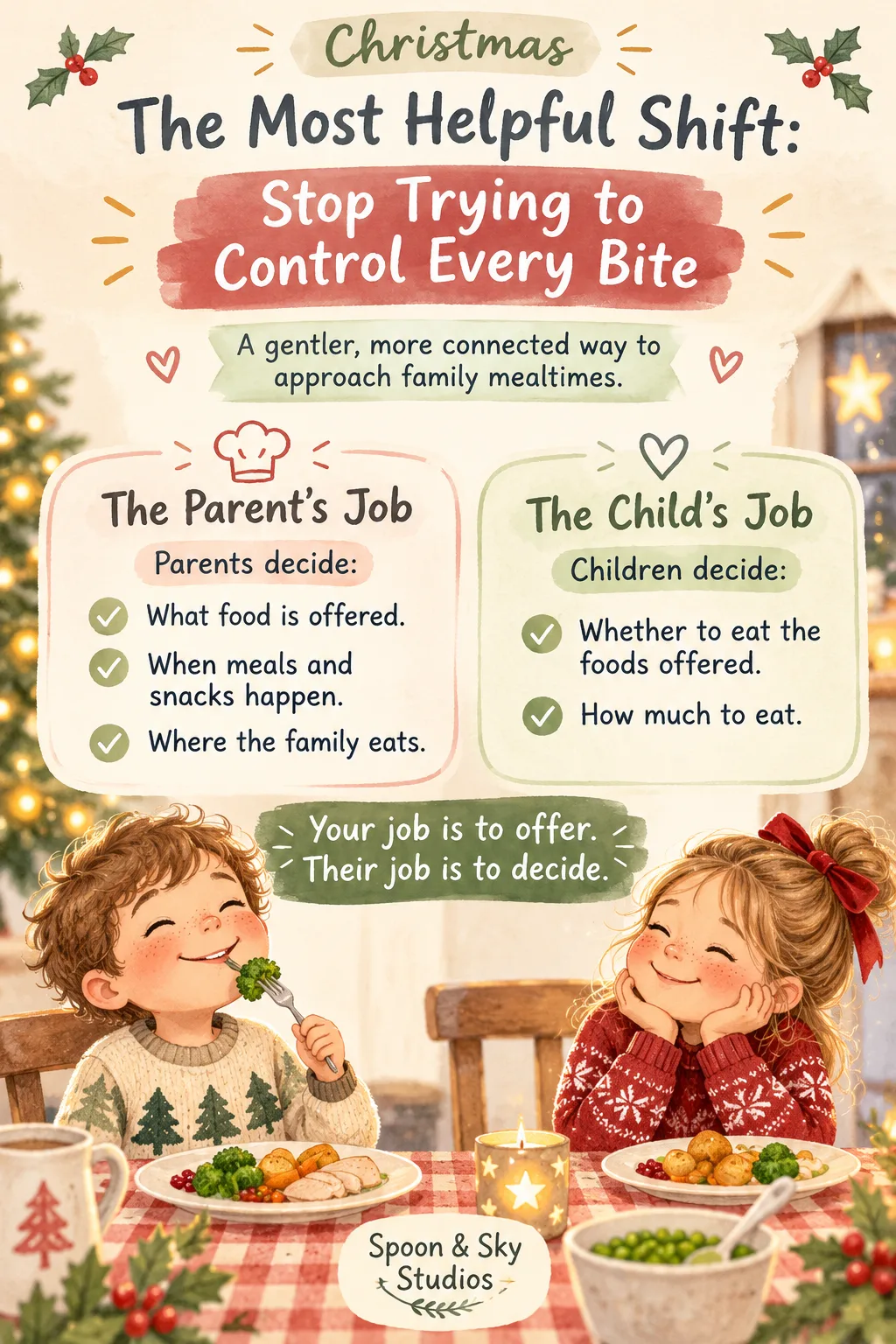
One of the most useful approaches to family mealtimes is something called the Division of Responsibility in Feeding.
Developed by dietitian and family therapist Ellyn Satter, this framework helps parents and children understand their different roles at the table.
And it's surprisingly simple.
The Parent's Job
Parents decide:
-
What food is offered.
-
When meals and snacks happen.
-
Where the family eats.
Your role is to provide regular opportunities to eat, offer variety and create a supportive environment.
The Child's Job
Children decide:
-
Whether to eat the foods offered.
-
How much to eat.
This means you can offer broccoli, but your child doesn't have to eat it.
You can prepare a lovely Christmas dinner, but your child doesn't need to finish their plate.
And if they're genuinely full, they can stop eating.
This doesn't mean allowing children to demand completely different meals every evening.
It means offering food thoughtfully, considering their preferences and allowing them some independence over their appetite.
For children with significant feeding difficulties, additional individual support may be needed.
But for many families, separating these responsibilities can reduce tension around food.
Instead of:
"Three more bites and then you can leave."
Try:
"Here's our dinner. You can choose what you'd like from what's on offer."
Your job is to offer. Their job is to decide.
It takes a little practice, particularly if you're used to encouraging every last mouthful.
But it can help shift the focus from how much your child eats to how everyone feels around the table.
Why "Just One More Bite" Can Backfire

Most parents have probably tried some version of these phrases:
"Just taste it!"
"You can't have pudding until you've eaten your vegetables."
"Your brother ate all of his."
"You're not leaving until you've finished."
Usually, these comments come from a good place.
We want our children to eat nourishing food.
We want them to try something new.
And sometimes we've spent a very long time preparing a meal we'd love them to enjoy.
But pressure, bargaining and forcing children to eat can make mealtimes more stressful and increase resistance to unfamiliar foods.
When every bite becomes a negotiation, children may become more focused on escaping the pressure than exploring the food.
And turning pudding into a reward can make the other foods seem like something unpleasant they must get through first.
So what can we do instead?
Offer food without making a big fuss about what gets eaten.
You might say:
"There's some broccoli here if you'd like it."
Or:
"These potatoes are crispy today. You can help yourself."
Then carry on with your meal.
Talk about the day.
Enjoy the company.
Let the food be part of the occasion rather than the main topic of conversation.
And remember, your child's appetite may naturally vary from one meal to another.
You don't need to judge their entire diet by one Christmas dinner.
Try the Familiar Food + Something New Approach
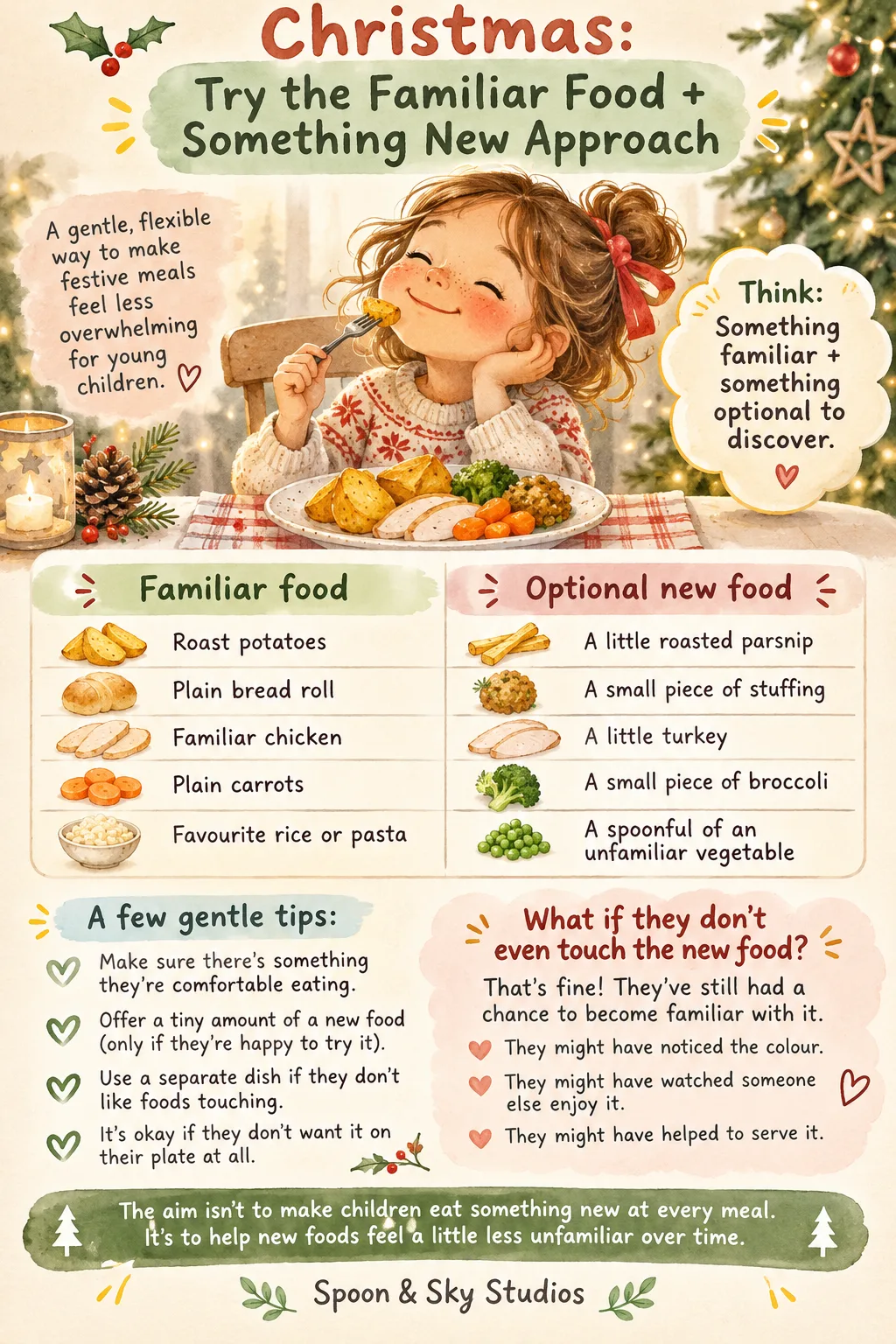
Here's one of my favourite ways to make festive meals feel less overwhelming.
Instead of expecting your child to eat everything the adults are having, offer a combination of familiar foods and opportunities to explore something different.
Think:
Something familiar + something optional to discover.
For example, a child's festive plate might include:
Familiar food
Optional new food
Roast potatoes
A little roasted parsnip
Plain bread roll
A small piece of stuffing
Familiar chicken
A little turkey
Plain carrots
A small piece of broccoli
Favourite rice or pasta
A spoonful of an unfamiliar vegetable
These are examples, not foods every child must accept.
The important part is that your child has access to something they're comfortable eating.
If they're happy to have a new food on their plate, offer a tiny amount.
If having it touch their familiar food causes distress, use a separate little dish.
If they don't want it on their plate at all, that's okay too. It can simply stay in the serving bowl where they can see it.
What If They Don't Even Touch the New Food?
That's fine.
They've still had an opportunity to become familiar with it.
Perhaps they noticed the colour.
Perhaps they watched someone else enjoy it.
Perhaps they helped serve it.
Those experiences can all be part of gradually becoming more comfortable around unfamiliar foods.
The aim isn't to make children eat something new at every meal.
It's to help new foods feel a little less unfamiliar over time.
Three Things to Say When Relatives Comment on Your Child's Eating
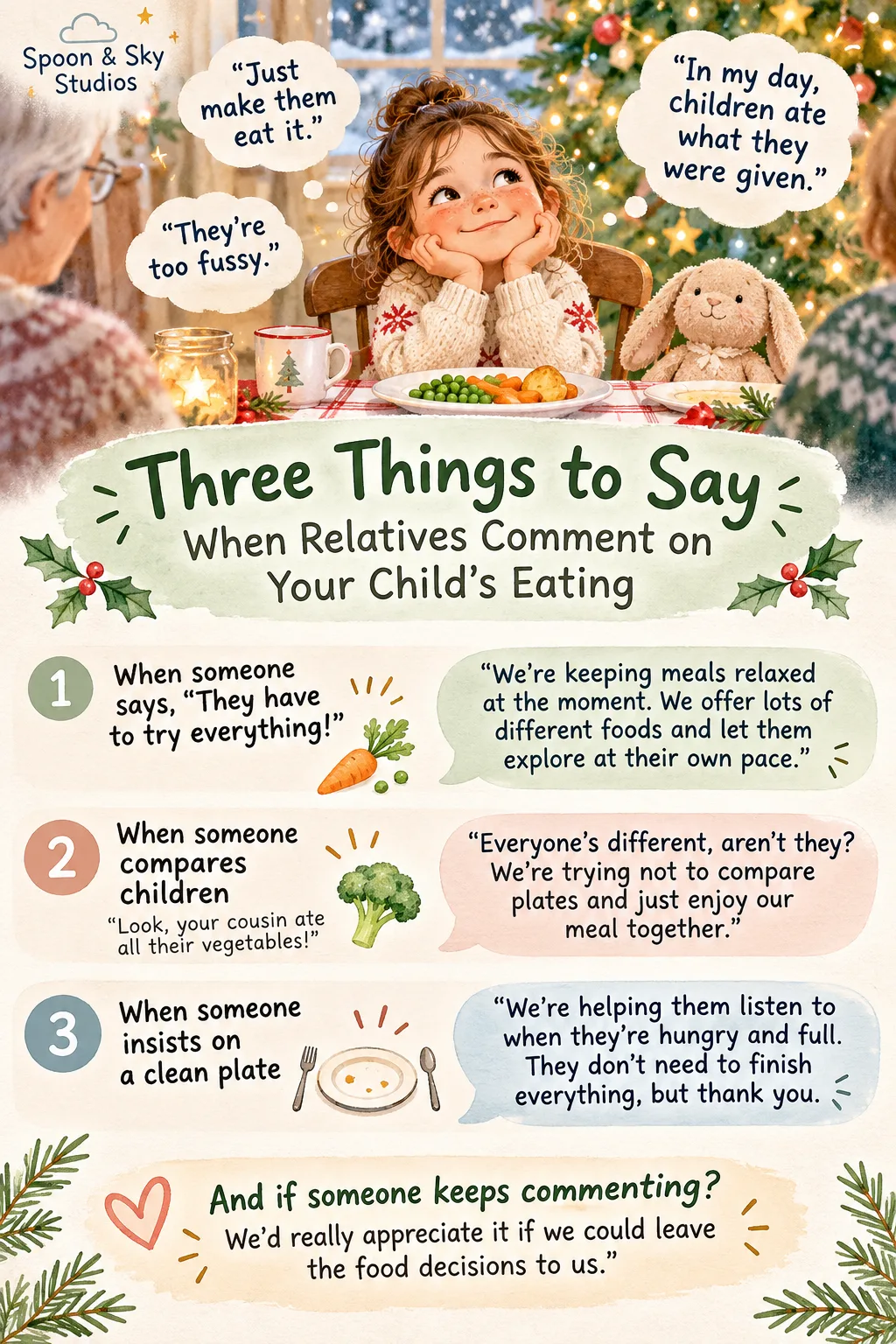
Ah, the festive family table.
A wonderful place for togetherness, laughter and the occasional unsolicited parenting opinion.
You may hear:
"Just make them eat it."
"They're too fussy."
"In my day, children ate what they were given."
Most relatives mean well.
They may simply be following the approaches they grew up with.
But that doesn't mean you have to abandon the way you've chosen to support your child.
Here are three gentle responses to keep handy.
1. When Someone Says, "They Have to Try Everything!"
Try saying:
"We're keeping meals relaxed at the moment. We offer lots of different foods and let them explore at their own pace."
Short, friendly and clear.
There's no need for a lengthy explanation.
2. When Someone Compares Children
Perhaps someone says:
"Look, your cousin ate all their vegetables!"
Try saying:
"Everyone's different, aren't they? We're trying not to compare plates and just enjoy our meal together."
This helps protect your child's confidence without making the situation confrontational.
3. When Someone Insists on a Clean Plate
Try saying:
"We're helping them listen to when they're hungry and full. They don't need to finish everything, but thank you."
Then change the subject.
A little preparation can help too.
If you're visiting family, you might mention beforehand that you're trying to keep mealtimes low-pressure.
It doesn't need to become a big discussion.
Just a simple shared understanding.
And if someone keeps commenting?
It's okay to be a little firmer.
"We'd really appreciate it if we could leave the food decisions to us."
You can set kind boundaries at the dinner table too.
Get Children Involved Before the Food Reaches the Table
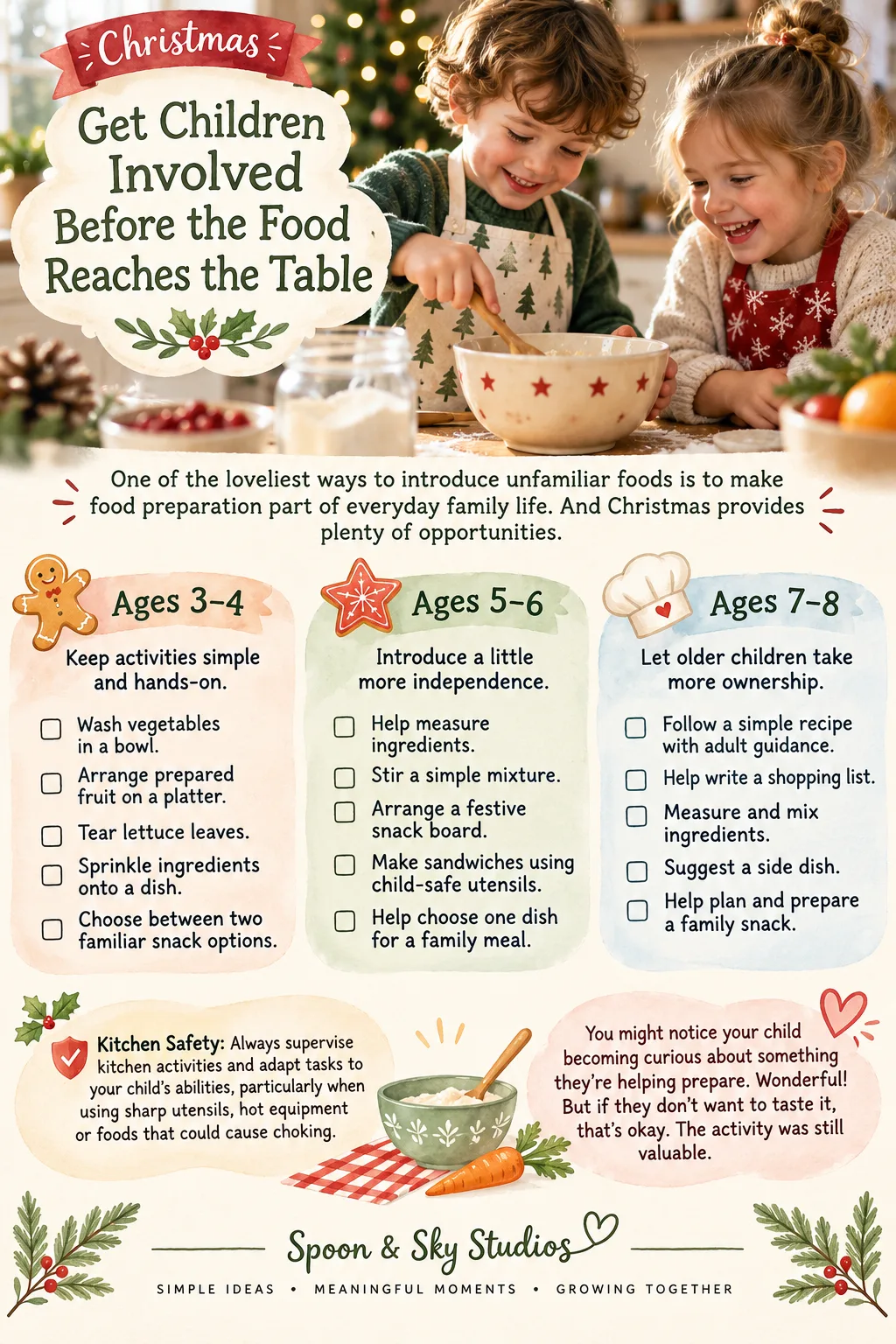
One of the loveliest ways to introduce unfamiliar foods is to make food preparation part of everyday family life.
And Christmas provides plenty of opportunities.
Children don't necessarily need to eat something to enjoy helping prepare it.
They might enjoy choosing ingredients, washing vegetables, stirring a mixture or arranging food on a plate.
The idea is to build curiosity and familiarity without creating an expectation that they must taste everything they touch.
For Ages 3–4
Keep activities simple and hands-on.
-
Wash vegetables in a bowl.
-
Arrange prepared fruit on a platter.
-
Tear lettuce leaves.
-
Sprinkle ingredients onto a dish.
-
Choose between two familiar snack options.
For Ages 5–6
Introduce a little more independence.
-
Help measure ingredients.
-
Stir a simple mixture.
-
Arrange a festive snack board.
-
Make sandwiches using child-safe utensils.
-
Help choose one dish for a family meal.
For Ages 7–8
Let older children take more ownership.
-
Follow a simple recipe with adult guidance.
-
Help write a shopping list.
-
Measure and mix ingredients.
-
Suggest a side dish.
-
Help plan and prepare a family snack.
Always supervise kitchen activities and adapt tasks to your child's abilities, particularly when using sharp utensils, hot equipment or foods that could cause choking.
You might notice your child becoming curious about something they're helping prepare.
Wonderful!
But if they don't want to taste it, that's okay.
The activity was still valuable.
Five Playful Ways to Explore New Foods Without Pressure
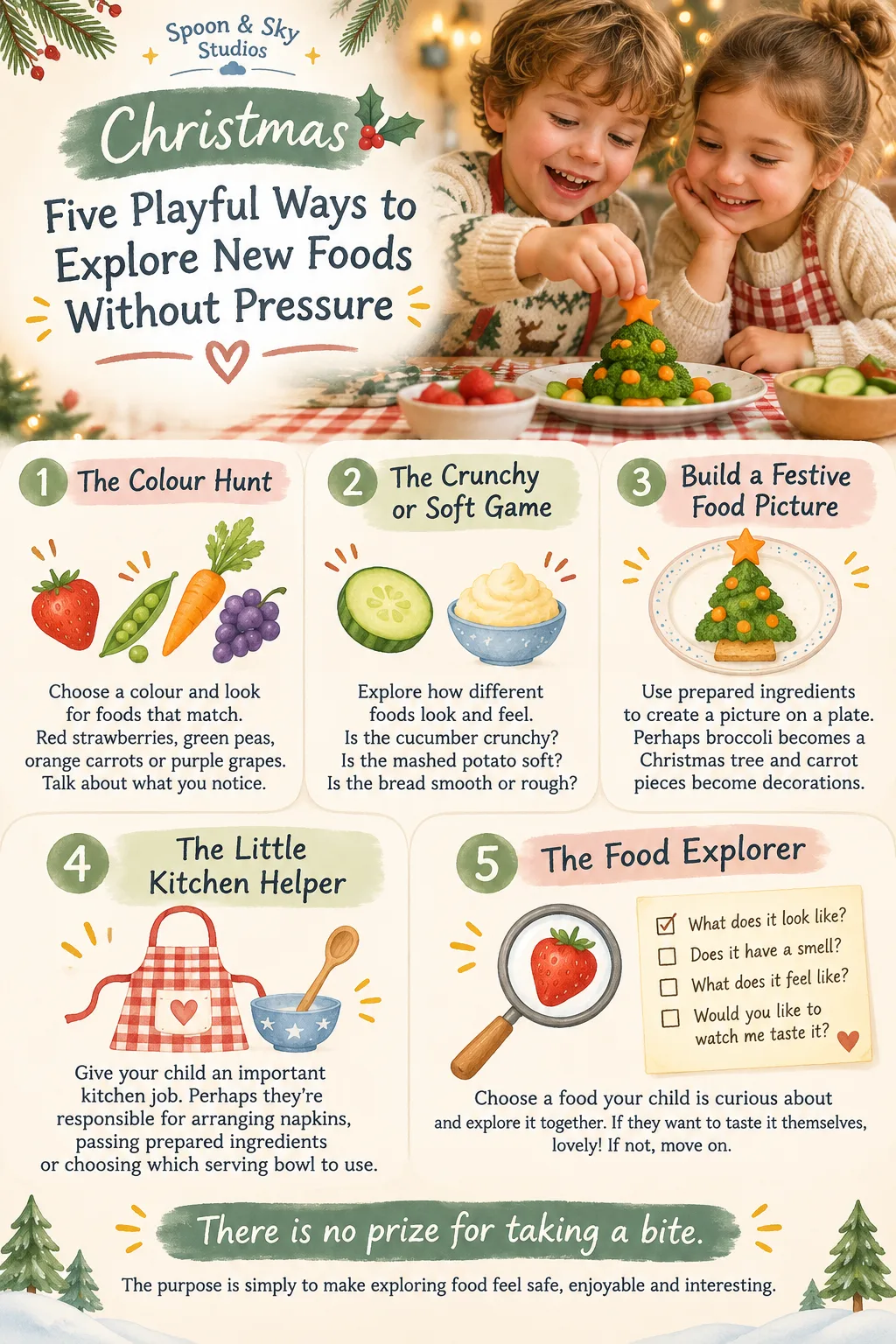
At Spoon & Sky Studios, we love finding little ways to turn everyday activities into moments of connection and discovery.
Food exploration can be one of them.
Here are five simple ideas to try together.
1. The Colour Hunt
Choose a colour and look for foods that match.
Red strawberries, green peas, orange carrots or purple grapes.
Talk about what you notice.
"Look how many different shades of green we found!"
For younger children, prepare foods safely, including cutting round fruits appropriately.
No tasting required.
2. The Crunchy or Soft Game
Explore how different foods look and feel.
Is the cucumber crunchy?
Is the mashed potato soft?
Is the bread smooth or rough?
Your child can investigate by looking or touching, without needing to put anything in their mouth.
For children with sensory sensitivities, let them decide what feels comfortable.
3. Build a Festive Food Picture
Use prepared ingredients to create a picture on a plate.
Perhaps broccoli becomes a Christmas tree.
Carrot pieces become decorations.
A piece of toast becomes a little house.
It doesn't matter whether the food gets eaten.
Enjoy the creative process together.
4. The Little Kitchen Helper
Give your child an important kitchen job.
Perhaps they're responsible for arranging napkins, passing prepared ingredients or choosing which serving bowl to use.
Feeling included can make mealtimes more enjoyable, even when the food itself feels unfamiliar.
5. The Food Explorer
Choose a food your child is curious about.
Explore it together.
What does it look like?
Does it have a smell?
What does it feel like?
Would they like to watch you taste it?
If they want to taste it themselves, lovely.
If not, move on.
There is no prize for taking a bite.
The purpose is simply to make exploring food feel safe, enjoyable and interesting.
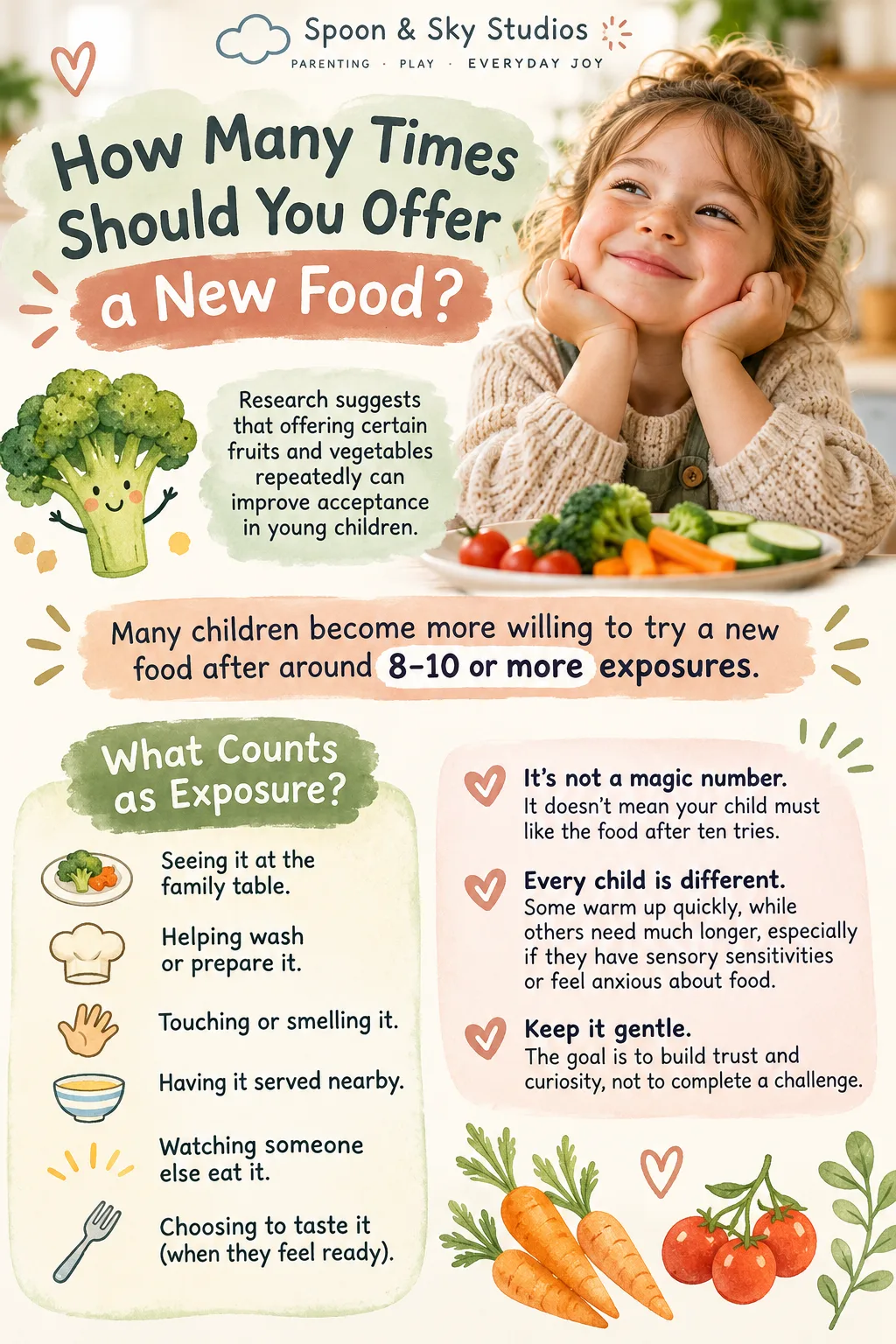
How Many Times Should You Offer a New Food?
Have you ever offered your child a new vegetable, watched them refuse it and decided they simply don't like it?
It's an understandable reaction.
But accepting unfamiliar foods can take time.
Research into repeated food exposure has found that offering certain fruits and vegetables repeatedly can improve acceptance in young children.
Some studies have observed improvements after eight to ten or more exposures.
But that's not a magic number.
It doesn't mean your child must like broccoli after their tenth encounter, and it doesn't mean you should insist on ten tastes.
Every child is different.
For some, familiarity grows relatively quickly.
Others need much longer, especially if they experience sensory sensitivities or anxiety around food.
What Counts as Exposure?
An opportunity to become familiar with food might mean:
-
Seeing it at the family table.
-
Helping wash or prepare it.
-
Touching or smelling it.
-
Having it served nearby.
-
Watching someone else eat it.
-
Choosing to taste it.
Not every experience needs to lead to a bite.
You can offer foods in slightly different ways over time.
For example, a child who dislikes steamed carrots might prefer them roasted, grated or served in a familiar dish.
Or you might build on a food they already accept by introducing something with a similar texture.
Remember to keep it gentle.
If your child becomes distressed, don't push through their discomfort.
The goal is to build trust and curiosity, not complete a challenge.
What If My Child Only Eats Five Foods?
There's a difference between being reluctant to try unfamiliar foods and having a very restricted diet.
Some children eat a fairly varied diet but dislike particular vegetables or textures.
Others may rely on only a handful of familiar foods and become extremely distressed when something changes.
For these children, simply continuing to offer unfamiliar foods may not be enough.
A very limited diet can sometimes be connected to sensory differences, anxiety, difficulties with chewing or swallowing, or a condition such as avoidant/restrictive food intake disorder (ARFID).
When to Ask for Professional Support
Speak to your GP or an appropriate healthcare professional if your child:
-
Has lost weight or isn't growing as expected.
-
Eats an extremely limited range of foods.
-
Regularly gags or vomits in response to foods.
-
Has persistent difficulty chewing or swallowing.
-
Becomes very distressed around food or mealtimes.
-
Avoids social situations because of food.
-
Seems unusually tired or may not be getting adequate nutrition.
Repeated coughing or choking during meals also needs prompt medical assessment.
Your GP may recommend support from a paediatric dietitian, speech and language therapist, occupational therapist or specialist feeding team, depending on the difficulty.
If your child is autistic or has sensory processing differences, feeding support may need to be adapted to their individual needs.
You don't have to wait for a child to lose weight before asking for help with a severely restricted diet.
And Christmas dinner is certainly not the time to try to force a major change.
For children who find eating genuinely difficult, having their reliable foods available can make festive celebrations much more manageable.
Your Low-Stress Christmas Meal Plan
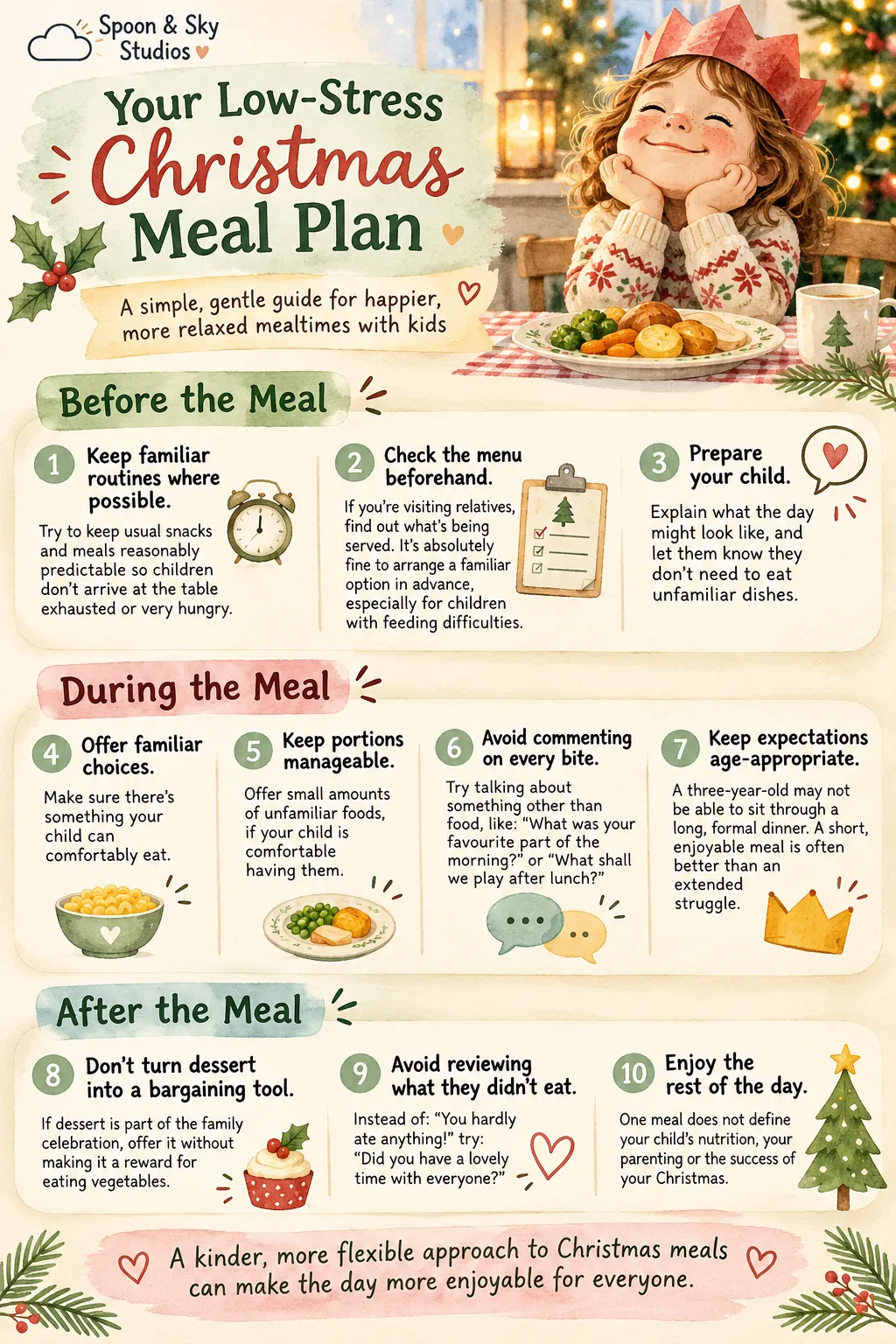
So what might a gentler Christmas dinner look like in practice?
Let's keep it simple.
Before the Meal
1. Keep familiar routines where possible.
A busy festive day often involves later meals, more excitement and lots of changes.
Try to keep usual snacks and meals reasonably predictable so children don't arrive at the table exhausted or extremely hungry.
2. Check the menu beforehand.
If you're visiting relatives, find out what's being served.
Think about which foods your child already feels comfortable eating.
It's absolutely fine to arrange a familiar option in advance, especially for children with more significant feeding difficulties.
3. Prepare your child.
Explain what the day might look like.
"We're going to Grandma's house. We'll play with our cousins, then we'll all have lunch together."
If food is a particular source of anxiety, explain that they don't need to eat unfamiliar dishes.
During the Meal
4. Offer familiar choices.
Make sure there's something your child can comfortably eat.
5. Keep portions manageable.
Offer small amounts of unfamiliar foods, if your child is comfortable having them nearby.
6. Avoid commenting on every bite.
Try talking about something other than food.
"What was your favourite part of the morning?"
"What shall we play after lunch?"
7. Keep expectations age-appropriate.
A three-year-old may not be able to sit through a long, formal dinner.
And an excited seven-year-old may still need a little break.
A short, enjoyable meal is often better than an extended struggle.
After the Meal
8. Don't turn dessert into a bargaining tool.
If dessert is part of the family celebration, offer it without making it a reward for eating vegetables.
You can still have normal family expectations around when food is served.
9. Avoid reviewing what they didn't eat.
Instead of:
"You hardly ate anything!"
Try:
"Did you have a lovely time with everyone?"
10. Enjoy the rest of the day.
One meal does not define your child's nutrition, your parenting or the success of your Christmas.
There are plenty of opportunities to offer a variety of foods throughout the rest of the week.
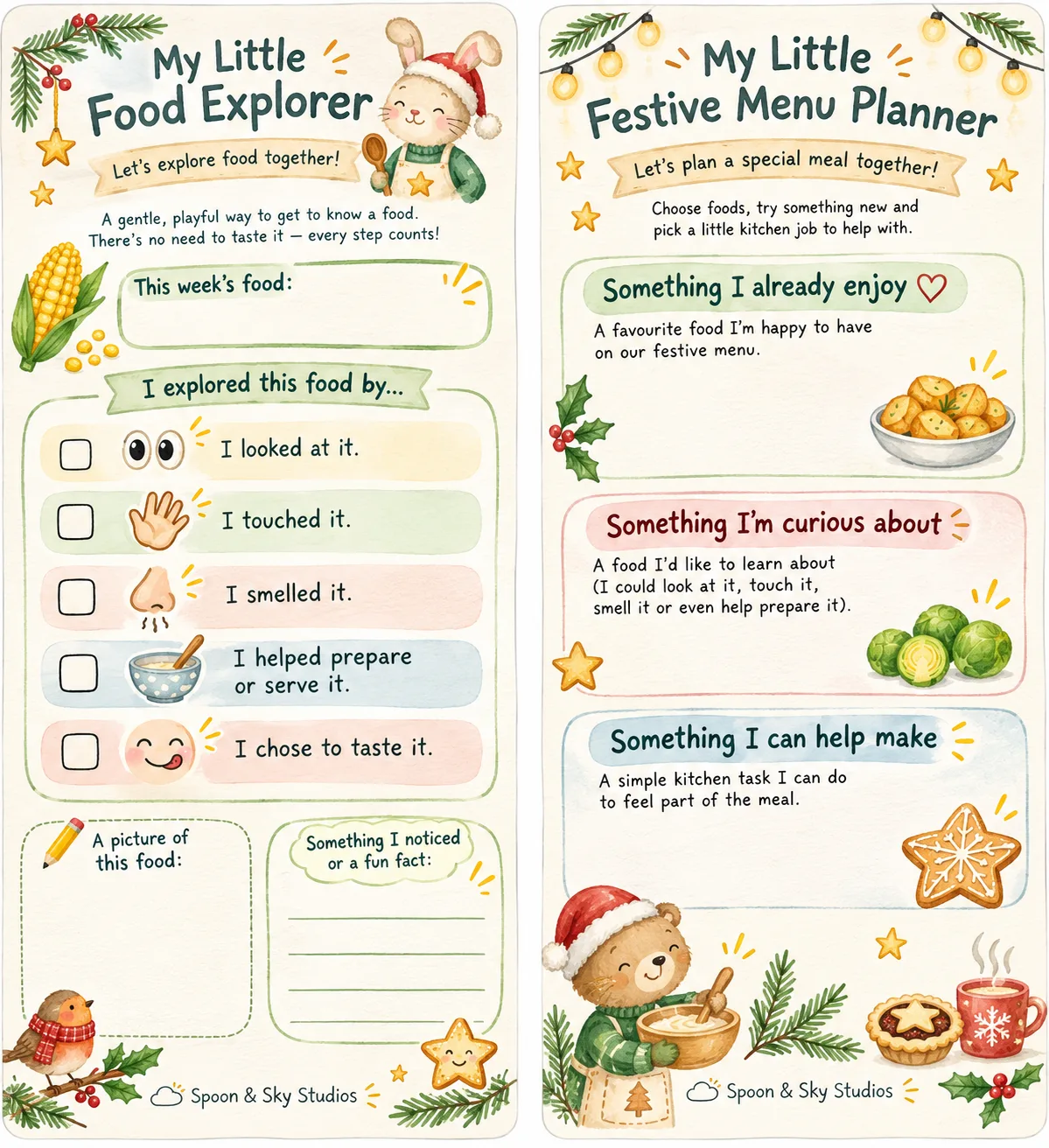
Free Printable: My Little Food Explorer
A Little Reminder for the Festive Season
There's something wonderful about gathering around a table with the people we love.
The conversations.
The laughter.
The familiar family traditions.
The little moments that become memories.
And when we look back on those celebrations, I doubt we'll remember exactly how many Brussels sprouts our children ate.
We'll remember the excitement.
The stories.
The funny moments.
The togetherness.
At Spoon & Sky Studios, we believe those everyday moments of connection matter.
And sometimes, making room for connection means letting go of a little pressure.
So if your child eats roast potatoes and a bread roll this Christmas, remember to look at the bigger picture, rather than judging everything by one meal.
Keep offering variety throughout the weeks ahead, seek support if eating difficulties are affecting their health or wellbeing, and let the festive table be a place where your family can enjoy being together.
Less pressure. More connection. One little food adventure at a time.
With love,
Spoon & Sky Studios
Simple ideas. Meaningful moments. Growing together.
This article provides general parenting and feeding information, not individual medical advice. Children with significant feeding difficulties, swallowing problems, allergies or medical dietary needs may require personalised guidance.